

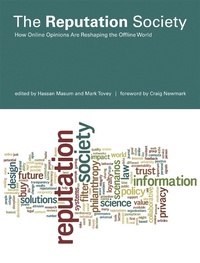
The Reputation Society
Description

In making decisions, we often seek advice. Online, we check Amazon recommendations, eBay vendors' histories, TripAdvisor ratings, and even our elected representatives' voting records. These online reputation systems serve as filters for information overload. In this book, experts discuss the benefits and risks of such online tools.
The contributors offer expert perspectives that range from philanthropy and open access to science and law, addressing reputation systems in theory and practice. Properly designed reputation systems, they argue, have the potential to create a "reputation society,” reshaping society for the better by promoting accountability through the mediated judgments of billions of people. Effective design can also steer systems away from the pitfalls of online opinion sharing by motivating truth-telling, protecting personal privacy, and discouraging digital vigilantism.
Contributors Madeline Ashby, Jamais Cascio, John Henry Clippinger, Chrysanthos Dellarocas, Cory Doctorow, Randy Farmer, Eric Goldman, Victor Henning, Anthony Hoffmann, Jason Hoyt, Luca Iandoli, Josh Introne, Mark Klein, Mari Kuraishi, Cliff Lampe, Paolo Massa, Hassan Masum, Marc Maxson, Craig Newmark, Michael Nielsen, Lucio Picci, Jan Reichelt, Alex Steffen, Lior Strahilevitz, Mark Tovey, John Whitfield, John Willinsky, Yi-Cheng Zhang, Michael Zimmer
More details
Other editions
Additional editions
Persons
Mark Tovey is an Affiliate Researcher at the Waterloo Institute for Complexity and Innovation at the University of Waterloo. He is the editor of Collective Intelligence: Creating a Prosperous World at Peace.
Hassan Masum is a policy and technology strategist and Affiliate Researcher at the Waterloo Institute for Complexity and Innovation at the University of Waterloo.
Mark Tovey is an Affiliate Researcher at the Waterloo Institute for Complexity and Innovation at the University of Waterloo. He is the editor of Collective Intelligence: Creating a Prosperous World at Peace.
John Willinsky is Pacific Press Professor of Literacy and Technology at the University of British Columbia. He is the author of Empire of Words: The Reign of the OED and a developer of Open Journals Systems software.
