

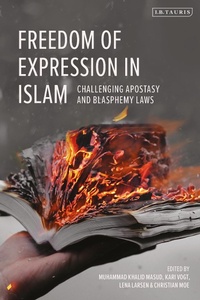
Freedom of Expression in Islam
Challenging Apostasy and Blasphemy Laws
1st Edition
Published on 28. January 2021
272 pages
978-0-7556-3767-6 (ISBN)
Description

In Muslim countries, apostasy and blasphemy laws are defended on the grounds that they are based on Islamic Shari'a and intended to protect religion. But blasphemy and apostasy laws can be used both to suppress thought and debate and to harass religious minorities, both inside and outside Islam. This book - comprising contributions from Muslim scholars, experts and activists - critically and constructively engages with the theological, historical and legal reasoning behind the most restrictive state laws around the world to open up new ways of thinking.
The book focuses on the struggle within Muslim societies in Iran, Egypt, Pakistan and Indonesia where blasphemy and apostasy laws serve powerful groups to silence dissent and stifle critical thought. The first part of the book covers the development of the law in shifting historical circumstances and surveys the interpretations of Qur'anic verses that seem to affirm freedom of religion. The second part examines the present politics and practices of prosecuting alleged blasphemers and/or apostates in Muslim countries. The third part looks to the future and where reforms of the law could be possible.
Debates on Islam and freedom of expression are often cast in polarizing terms of rights versus religion, East versus West. This volume avoids such approaches by bringing together a diverse group of Muslim scholars and activists with the knowledge, commitment and courage to contest repressive interpretations of religion and provide a resource for reclaiming the human rights to freedom of expression and belief.
The book focuses on the struggle within Muslim societies in Iran, Egypt, Pakistan and Indonesia where blasphemy and apostasy laws serve powerful groups to silence dissent and stifle critical thought. The first part of the book covers the development of the law in shifting historical circumstances and surveys the interpretations of Qur'anic verses that seem to affirm freedom of religion. The second part examines the present politics and practices of prosecuting alleged blasphemers and/or apostates in Muslim countries. The third part looks to the future and where reforms of the law could be possible.
Debates on Islam and freedom of expression are often cast in polarizing terms of rights versus religion, East versus West. This volume avoids such approaches by bringing together a diverse group of Muslim scholars and activists with the knowledge, commitment and courage to contest repressive interpretations of religion and provide a resource for reclaiming the human rights to freedom of expression and belief.
Reviews / Votes
This book provides an uncompromisingly honest and exhaustive treatment of the laws of blasphemy and apostasy in Islam. This well-written and highly accessible collection of essays will be an indispensable resource for anyone interested in freedom expression and belief in the classical Islamic tradition and the modern Muslim world.More details
Edition
1. Auflage
Language
English
Place of publication
United Kingdom
Publishing group
Bloomsbury Publishing PLC
ISBN-13
978-0-7556-3767-6 (9780755637676)
Copyright in bibliographic data and cover images is held by Nielsen Book Services Limited or by the publishers or by their respective licensors: all rights reserved.
Schweitzer Classification
Other editions
Additional editions
Muhammad Khalid Masud | Kari Vogt | Lena Larsen
Freedom of Expression in Islam
Challenging Apostasy and Blasphemy Laws
Book
02/2021
I.B. Tauris
€50.94
Shipment within 10-20 days
Persons
Muhammad Khalid Masud is an ad hoc member of the Shariat Appellate Bench of the Supreme Court of Pakistan. He is co-editor of Dispensing Justice in Islam: Qadis and Their Judgments (2006) and Islam and Modernity: An Introduction to Key Issues and Debates (2009).
Kari Vogt is Associate Professor (emeritus) at the Department of Cultural Studies and Oriental Languages at the University of Oslo, Norway. She has published widely on Islamic and Middle East issues.
Lena Larsen is Director of the Oslo Coalition on Freedom of Religion or Belief at the University of Oslo, Norway. She is the author of How Muftis Think: Islamic Legal Thought and Muslim Women in Western Europe (2018).
Christian Moe is an independent writer and researcher based in Slovenia. He has written on human rights and religion, religious education, and contemporary Islam in the former Yugoslavia.
Kari Vogt is Associate Professor (emeritus) at the Department of Cultural Studies and Oriental Languages at the University of Oslo, Norway. She has published widely on Islamic and Middle East issues.
Lena Larsen is Director of the Oslo Coalition on Freedom of Religion or Belief at the University of Oslo, Norway. She is the author of How Muftis Think: Islamic Legal Thought and Muslim Women in Western Europe (2018).
Christian Moe is an independent writer and researcher based in Slovenia. He has written on human rights and religion, religious education, and contemporary Islam in the former Yugoslavia.
Content
Introduction, Muhammad Khalid Masud, International Islamic University, Pakistan; Kari Vogt, University of Oslo, Norway; Lena Larsen, University of Oslo, Norway; & Christian Moe, Independent Scholar
PART ONE: THE HISTORICAL CONSTRUCTION
Blasphemy Laws in Islam: Towards a Rethinking?, Abdullah Saeed, The University of Melbourne, Australia
Freedom of Religion in Qur'anic Exegesis, Omaima Abou-Bakr, Cairo University, Egypt
al-Qadi 'Iyad's Defence of the Prophet and of Scholarly Tradition: al-Shifa', Nora S. Eggen, University of Oslo, Norway
Hermeneutic shifts in the definition of blasphemy: Reading Ibn Taymiyya's al-Sarim al-Maslul 'aala, Shatim al-Rasul, Muhammad Khalid Masud, International Islamic University, Pakistan
PART TWO: PRESENT PRACTICES
The Crimes of Blasphemy and Apostasy in Iran, Mohammad Mostafaei, Iranian human rights lawyer
Guarding the Mainstream: Blasphemy and Apostasy in Egypt, Moataz El Fegiery, School of Oriental and African Studies, University of London, UK
Plurality, Dissent and Hegemony: The Story Behind Pakistan's Blasphemy Law, Arafat Mazhar, Engage Pakistan, Pakistan; and Syed Zainuddin Moulvi, University of Virginia, USA
Politics of Fatwa, 'Deviant Groups' and Takfir in the Context of Indonesian pluralism: A Study of the Council of Indonesian Ulama, Syafiq Hasyim, State Islamic University Syarif Hidayatullah Jakarta, Indonesia
PART THREE: NEW DIRECTIONS
Transgressing All Bounds? Gendering Authority and Engendering Orthodoxy, Kecia Ali, Boston University, USA
Re-framing Reform: Lessons from the Apostasy Trials of Hassan Yousefi Eshkevari and Hashem Aghajari, Mahmoud Sadri, Texas Woman's University, USA
Toward Removing the Punishment of Apostasy in Islam, Mohsen Kadivar, Duke University, USA
PART ONE: THE HISTORICAL CONSTRUCTION
Blasphemy Laws in Islam: Towards a Rethinking?, Abdullah Saeed, The University of Melbourne, Australia
Freedom of Religion in Qur'anic Exegesis, Omaima Abou-Bakr, Cairo University, Egypt
al-Qadi 'Iyad's Defence of the Prophet and of Scholarly Tradition: al-Shifa', Nora S. Eggen, University of Oslo, Norway
Hermeneutic shifts in the definition of blasphemy: Reading Ibn Taymiyya's al-Sarim al-Maslul 'aala, Shatim al-Rasul, Muhammad Khalid Masud, International Islamic University, Pakistan
PART TWO: PRESENT PRACTICES
The Crimes of Blasphemy and Apostasy in Iran, Mohammad Mostafaei, Iranian human rights lawyer
Guarding the Mainstream: Blasphemy and Apostasy in Egypt, Moataz El Fegiery, School of Oriental and African Studies, University of London, UK
Plurality, Dissent and Hegemony: The Story Behind Pakistan's Blasphemy Law, Arafat Mazhar, Engage Pakistan, Pakistan; and Syed Zainuddin Moulvi, University of Virginia, USA
Politics of Fatwa, 'Deviant Groups' and Takfir in the Context of Indonesian pluralism: A Study of the Council of Indonesian Ulama, Syafiq Hasyim, State Islamic University Syarif Hidayatullah Jakarta, Indonesia
PART THREE: NEW DIRECTIONS
Transgressing All Bounds? Gendering Authority and Engendering Orthodoxy, Kecia Ali, Boston University, USA
Re-framing Reform: Lessons from the Apostasy Trials of Hassan Yousefi Eshkevari and Hashem Aghajari, Mahmoud Sadri, Texas Woman's University, USA
Toward Removing the Punishment of Apostasy in Islam, Mohsen Kadivar, Duke University, USA
