

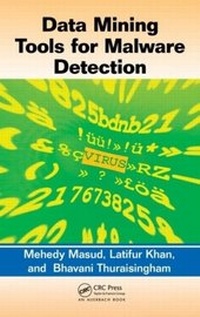
Data Mining Tools for Malware Detection
1st Edition
Published on 19. April 2016
450 pages
978-1-4665-1648-9 (ISBN)
Description

Although the use of data mining for security and malware detection is quickly on the rise, most books on the subject provide high-level theoretical discussions to the near exclusion of the practical aspects. Breaking the mold, Data Mining Tools for Malware Detection provides a step-by-step breakdown of how to develop data mining tools for malware detection. Integrating theory with practical techniques and experimental results, it focuses on malware detection applications for email worms, malicious code, remote exploits, and botnets.
The authors describe the systems they have designed and developed: email worm detection using data mining, a scalable multi-level feature extraction technique to detect malicious executables, detecting remote exploits using data mining, and flow-based identification of botnet traffic by mining multiple log files. For each of these tools, they detail the system architecture, algorithms, performance results, and limitations.
Discusses data mining for emerging applications, including adaptable malware detection, insider threat detection, firewall policy analysis, and real-time data mining
Includes four appendices that provide a firm foundation in data management, secure systems, and the semantic web
Describes the authors' tools for stream data mining
From algorithms to experimental results, this is one of the few books that will be equally valuable to those in industry, government, and academia. It will help technologists decide which tools to select for specific applications, managers will learn how to determine whether or not to proceed with a data mining project, and developers will find innovative alternative designs for a range of applications.
The authors describe the systems they have designed and developed: email worm detection using data mining, a scalable multi-level feature extraction technique to detect malicious executables, detecting remote exploits using data mining, and flow-based identification of botnet traffic by mining multiple log files. For each of these tools, they detail the system architecture, algorithms, performance results, and limitations.
Discusses data mining for emerging applications, including adaptable malware detection, insider threat detection, firewall policy analysis, and real-time data mining
Includes four appendices that provide a firm foundation in data management, secure systems, and the semantic web
Describes the authors' tools for stream data mining
From algorithms to experimental results, this is one of the few books that will be equally valuable to those in industry, government, and academia. It will help technologists decide which tools to select for specific applications, managers will learn how to determine whether or not to proceed with a data mining project, and developers will find innovative alternative designs for a range of applications.
More details
Edition
1. Auflage
Language
English
Place of publication
Philadelphia, PA
United States
Publishing group
Taylor & Francis Inc
Target group
Professional and scholarly
Technologists and managers working in cyber security; Homeland Security, DoD, and intelligence professionals and law enforcement agencies; computer professionals in statistical analysis and data mining; data mining product developers.
Product notice
Reflowable
Illustrations
131 s/w Abbildungen, 29 s/w Tabellen
131 b/w images, 29 tables and 1-50 equations
File size
2,59 MB
ISBN-13
978-1-4665-1648-9 (9781466516489)
Copyright in bibliographic data and cover images is held by Nielsen Book Services Limited or by the publishers or by their respective licensors: all rights reserved.
Schweitzer Classification
Other editions
Additional editions
Mehedy Masud | Latifur Khan | Bhavani Thuraisingham
Data Mining Tools for Malware Detection
Book
12/2011
1st Edition
Taylor & Francis
€187.60
Shipment within 15-20 days
Persons
Mehedy Masud is a postdoctoral fellow at the University of Texas at Dallas (UTD), where he earned his PhD in computer science in December 2009. He has published in premier journals and conferences, including IEEE Transactions on Knowledge and Data Engineering and the IEEE Data Mining Conference. He will be appointed as a research assistant professor at UTD in Fall 2012. Masud's research projects include reactively adaptive malware, data mining for detecting malicious executables, botnet, and remote exploits, and cloud data mining. He has a patent pending on stream mining for novel class detection.
Latifur Khan is an associate professor in the computer science department at the University of Texas at Dallas, where he has been teaching and conducting research since September 2000. He received his PhD and MS degrees in computer science from the University of Southern California in August 2000 and December 1996, respectively. Khan is (or has been) supported by grants from NASA, the National Science Foundation (NSF), Air Force Office of Scientific Research (AFOSR), Raytheon, NGA, IARPA, Tektronix, Nokia Research Center, Alcatel, and the SUN academic equipment grant program. In addition, Khan is the director of the state-of-the-art DML@UTD, UTD Data Mining/Database Laboratory, which is the primary center of research related to data mining, semantic web, and image/videoannotation at the University of Texas at Dallas. Khan has published more than 100 papers, including articles in several IEEE Transactions journals, the Journal of Web Semantics, and the VLDB Journal and conference proceedings such as IEEE ICDM and PKDD. He is a senior member of IEEE.
Bhavani Thuraisingham joined the University of Texas at Dallas (UTD) in October 2004 as a professor of computer science and director of the Cyber Security Research Center in the Erik Jonsson School of Engin
Latifur Khan is an associate professor in the computer science department at the University of Texas at Dallas, where he has been teaching and conducting research since September 2000. He received his PhD and MS degrees in computer science from the University of Southern California in August 2000 and December 1996, respectively. Khan is (or has been) supported by grants from NASA, the National Science Foundation (NSF), Air Force Office of Scientific Research (AFOSR), Raytheon, NGA, IARPA, Tektronix, Nokia Research Center, Alcatel, and the SUN academic equipment grant program. In addition, Khan is the director of the state-of-the-art DML@UTD, UTD Data Mining/Database Laboratory, which is the primary center of research related to data mining, semantic web, and image/videoannotation at the University of Texas at Dallas. Khan has published more than 100 papers, including articles in several IEEE Transactions journals, the Journal of Web Semantics, and the VLDB Journal and conference proceedings such as IEEE ICDM and PKDD. He is a senior member of IEEE.
Bhavani Thuraisingham joined the University of Texas at Dallas (UTD) in October 2004 as a professor of computer science and director of the Cyber Security Research Center in the Erik Jonsson School of Engin
Content
Data Mining and Security. Data Mining For Detecting Email Worms. Data Mining For Detecting Malicious Executables. Data Mining For Detecting Remote Exploits. Data Mining For Detecting Botnets. Data Mining For Emerging Cyber Security Applications.
