

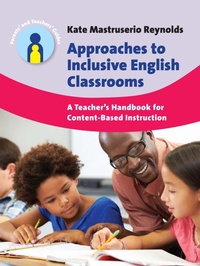
Approaches to Inclusive English Classrooms
A Teacher's Handbook for Content-Based Instruction
Published on 2. March 2015
328 pages
978-1-78309-335-9 (ISBN)
Description

This book provides educators with an accessible guide to best practices concerning content-based instruction (CBI) models and their use in English learner inclusive classrooms. The author effectively bridges the gap between theory and practice with a critical analysis of practical examples and diverse strategies for the inclusion of English learners into K-12 general education courses. The book also raises controversial questions regarding who is qualified to teach English learners and who is responsible for doing so, looking at the difficulties faced by both general educators and ESL teachers in Inclusive Classrooms. By providing a lens through which both ESL teachers and general educators are able to analyze, compare and contrast a range of widely-employed CBI methods, this book allows teachers to make informed decisions in their EL program development and work with English learners in K-12 schools.
Reviews / Votes
In this volume, Kate Mastruserio Reynolds has made a compelling argument for the need to prepare all educators, particularly mainstream teachers, to be knowledgeable about the needs of English language learners. Most notable is the evaluative framework she has developed based on a variety of content-based models from which educators may select an approach which is most appropriate for their educational context. -- Marguerite Ann Snow, California State University, Los Angeles, USA This volume, a welcome addition to the professional literature, is important for those of us who are concerned about meeting the pressing content- and language-learning needs of English learners. The author has done an excellent job demonstrating that there is more than one way to reach these students. The book conveys important information for pre- and in-service teachers, ESL coordinators, content teachers, program administrators, policy makers, and teacher educators. -- Fredricka L. Stoller, Northern Arizona University, USA The presence of many English language learners in English-medium, mainstream classrooms makes this new book by Kate Mastruserio Reynolds a must-read. The book brings together a range of curricular and pedagogical approaches to English language K-12 teaching and makes them accessible for mainstream teachers and will provide them with the tools to effectively work with a wide range of English language learners in their classrooms. -- Ester de Jong, University of Florida, USA Approaches to Inclusive English Classrooms is packed with information... While the target audience is primarily U.S. based educators who are grappling with the complex issues of effective programs for ELs, all readers will benefit from the detailed treatment of CBI models and in-depth evaluation of their strengths and weaknesses. -- Marguerite Ann Snow, California State University, Los Angeles, USA * Journal of Immersion and Content-Based Language Education, 4:2 *More details
Series
Language
English
Place of publication
Bristol
United Kingdom
Publishing group
Channel View Publications Ltd
Target group
Professional and scholarly
Product notice
Reflowable
ISBN-13
978-1-78309-335-9 (9781783093359)
Copyright in bibliographic data and cover images is held by Nielsen Book Services Limited or by the publishers or by their respective licensors: all rights reserved.
Schweitzer Classification
Other editions
Additional editions
Kate Mastruserio Reynolds
Approaches to Inclusive English Classrooms
A Teacher's Handbook for Content-Based Instruction
Book
03/2015
Multilingual Matters
€43.10
Shipment within 10-20 days
Person
Kate Mastruserio Reynolds is the Associate Director of the Foundation Program at Qatar University and a Professor of TESOL at the University of Wisconsin Eau-Claire. Her specific area of research is the scholarship of teaching and learning within an ESL context, including a particular focus on content-based instruction and ESL instructional and assessment practices.
Content
Introduction
Section I: Orientations to English Language Inclusion
Chapter 1: Why Must I Do This? The Drawbacks, Benefits and Challenges with EL Inclusion and the Impetus for General Educator Preparation in EL Inclusion
Chapter 2: I Just Want to Teach Math! Language is a Foundation for all Content Areas
Chapter 3: A Framework for General Educator Development in EL Instruction
Section II: Models of English Language Inclusion
Chapter 4: Models: Sheltered Instruction Observation Protocol (SIOP) Model
Chapter 5: Models: Cognitive Academic Language Learning Approach (CALLA)
Chapter 6: Models: Response to Intervention (RTI)
Chapter 7: Models: Specially Designed Academic Instruction in English (SDAIE)
Chapter 8: Models: Center for Research on Education, Diversity & Excellence (CREDE) Standards and the Expediting Comprehension for English Language Learners (ExC-ELL)
Chapter 9: Models: Content and Language Integrated Learning (CLiL) and Content-Based Language Learning through Technology (CoBaLTT) Models
Chapter 10: The "Winner": Which Model Should Be Chosen?
Appendices
Glossary
Section I: Orientations to English Language Inclusion
Chapter 1: Why Must I Do This? The Drawbacks, Benefits and Challenges with EL Inclusion and the Impetus for General Educator Preparation in EL Inclusion
Chapter 2: I Just Want to Teach Math! Language is a Foundation for all Content Areas
Chapter 3: A Framework for General Educator Development in EL Instruction
Section II: Models of English Language Inclusion
Chapter 4: Models: Sheltered Instruction Observation Protocol (SIOP) Model
Chapter 5: Models: Cognitive Academic Language Learning Approach (CALLA)
Chapter 6: Models: Response to Intervention (RTI)
Chapter 7: Models: Specially Designed Academic Instruction in English (SDAIE)
Chapter 8: Models: Center for Research on Education, Diversity & Excellence (CREDE) Standards and the Expediting Comprehension for English Language Learners (ExC-ELL)
Chapter 9: Models: Content and Language Integrated Learning (CLiL) and Content-Based Language Learning through Technology (CoBaLTT) Models
Chapter 10: The "Winner": Which Model Should Be Chosen?
Appendices
Glossary
