

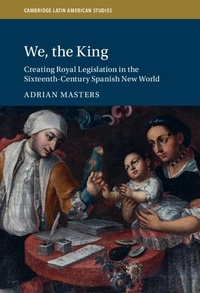
We, the King
Creating Royal Legislation in the Sixteenth-Century Spanish New World
Published on 1. March 2023
338 pages
978-1-009-31543-2 (ISBN)
Description

We, the King challenges the dominant top-down interpretation of the Spanish Empire and its monarchs' decrees in the New World, revealing how ordinary subjects had much more say in government and law-making than previously acknowledged. During the viceregal period spanning the post-1492 conquest until 1598, the King signed more than 110,000 pages of decrees concerning state policies, minutiae, and everything in between. Through careful analysis of these decrees, Adrian Masters illustrates how law-making was aided and abetted by subjects from various backgrounds, including powerful court women, indigenous commoners, Afro-descendant raftsmen, secret saboteurs, pirates, sovereign Chiriguano Indians, and secretaries' wives. Subjects' innumerable petitions and labor prompted - and even phrased - a complex body of legislation and legal categories demonstrating the degree to which this empire was created from the "bottom up". Innovative and unique, We, the King reimagines our understandings of kingship, imperial rule, colonialism, and the origins of racial categories.
Reviews / Votes
'Meticulously researched and beautifully written, We, the King unveils the labyrinthine petitioning process involved in enacting thousands of legislative decrees and reveals how diligent vassals shaped colonial policies and categories of difference. It dismantles the standard view of the Spanish colonial state as the architect of legal rule that was all-seeing and all-pervasive. This outstanding work should be required reading for all colonial Latin Americanists.' Nancy E. van Deusen, author of Global Indos: The Indigenous Struggle for Justice in Sixteenth-Century Spain 'Adrian Masters has produced an ambitious study of early modern bureaucracy, law-making, and subaltern agency. Deeply researched and carefully written, We, the King is an indispensable resource for scholars of the Iberian empire.' Michelle McKinley, author of Fractional Freedoms: Slavery, Intimacy and Legal Mobilization in Colonial Lima, 1600-1700 'In this tour de force analysis of lawmaking in the early modern Spanish empire, Adrian Masters reveals that not only were the king's New World vassals co-creators of royal law, but most provocatively, that it was their petitions to the crown that helped codify the human differences that would inform the caste system.' S. Elizabeth Penry, author of The People Are King: The Making of an Indigenous Andean Politics 'Adrian Masters masterfully unpacks the powerful legal fiction of the King of Spain and Emperor of the Indies, demonstrating that the world's first global empire was a contingent and collective enterprise made by paper-peddling brokers and subalterns. A must read for anyone interested in the early modern history of empires and governance.' Mark Thurner, author of History's Peru: The Poetics of Colonial and Postcolonial Historiography '... this is a strong book with superb writing. While scholars generally know that princes of many European empires often merely accepted and pasted petitions of social groups and individuals into royal communications to change policy, Masters unearths and discusses many illustrative examples of this mechanism. By doing so, he successfully traces the intricate working of the imperial administration and details how social communities drummed up support to reverse discriminatory rulings against them.' Christoph Rosenmueller, American Historical ReviewMore details
Series
Language
English
Place of publication
Cambridge
United Kingdom
Illustrations
Worked examples or Exercises
File size
5,90 MB
ISBN-13
978-1-009-31543-2 (9781009315432)
Copyright in bibliographic data and cover images is held by Nielsen Book Services Limited or by the publishers or by their respective licensors: all rights reserved.
Schweitzer Classification
Other editions
Additional editions
Book
11/2025
Cambridge University Press
€37.50
Shipment within 15-20 days
Book
03/2023
Cambridge University Press
€113.50
Shipment within 15-20 days
Person
Content
List of figures; List of tables; Acknowledgments; Prelude: A Peruvian pestizo at the Spanish Court; Introduction: the collective making of an empire; 1. Paper ceremonies for a global empire: Gobierno petitions and the collective work of Voluntad; 2. The co-creation of the Imperial Logistics Network; 3. Distant kings, powerful women, prudent ministers: the gendered creation of the Council of the Indies; 4. Lawmaking in a portable council: Gobierno decision-making technologies before 1561; 5. 'Bring the Papers:' Royal decision-making and the power of archives in Madrid, 1561-1598; 6. Creating the royal decree: format, phraseology, and petitioners' transformation of Indies law; 7. Pedro Rengifo's epilogue: subjects of chance; Conclusions; Index.
