

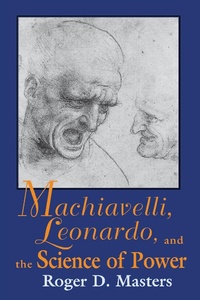
Machiavelli, Leonardo, and the Science of Power
Published on 14. October 2016
406 pages
978-0-268-16011-1 (ISBN)
Description

In recent years, Niccolo Machiavelli's works have been viewed primarily with historical interest as analysis of the tactics used by immoral political officials. Roger D. Masters, a leading expert in the relationship between modern natural sciences and politics, argues boldly in this book that Machiavelli should be reconsidered as a major philosopher whose thought makes the wisdom of antiquity accessible to the modern (and post-modern) condition, and whose understanding of human nature is superior to that of Hobbes, Locke, Rousseau, Marx, or Mill. Central to Masters's claim is his discovery, based on previously untranslated documents, that Machiavelli knew and worked with Leonardo da Vinci between 1502-1507. An interdisciplinary tour de force, Machiavelli, Leonardo, and the Science of Power will challenge, perplex, and ultimately delight readers with its evocative story of the relationship between Machiavelli and da Vinci, their crucial roles in the emergence of modernity, and the vast implications this holds for contemporary life and society.
Reviews / Votes
"Masters' book illuminates our understanding of Leonardo and Machiavelli as individuals and as connected figures who established modern ways of thinking about science and society. For the first time it clearly defines their distinct legacies and their combined impact on the history of western culture. It points to how their combined impact was the basis for Hobbes and other moderns to grow their theories, which unfortunately oversimplified the originators. In proposing a provocative, enlightening, and challenging theory of modernity based on science and power, the book establishes a comprehensive critical approach to two of the most creative and influential thinkers and artists in human history." -Sixteenth Century Journal"Here is a book with which to plunge into a corner of the Renaissance while keeping that period's relevance to modern life and thought squarely at the center of attention. . . A fascinating element of the author's argument is the possibility that Machiavelli might have been an intellectual intimate of Leonardo, but that they kept their friendship entirely secret from both the world and posterity for reasons of their own. . .This book is very much worth reading." -The Jerusalem Post
"In this provocative interdisciplinary study, Masters offers a new interpretation of Machiavelli which helps us understand his ambiguous relation to modern political science." -The Review of Politics
"Roger Masters has aroused debate by arguing that Leonardo influenced Machiavelli's thinking in a way that ultimately sparked the development of modern industrial society." -The New York Times
"Roger Masters finds that the two men of genius collaborated on a Florentine project to divert the course of the river Arno and leave rival Pisa without water. Masters postulates, with good reason, that two such aggressively innovative thinkers must have exchanged more than their views on water channels, and suggests provocatively that Machiavelli's notoriously objective analysis of power shows traces of Leonardo's science." -The New York Review of Books
More details
Series
Language
English
Place of publication
Notre Dame IN
United States
Target group
Professional and scholarly
Product notice
Reflowable
Illustrations
- 22 Halftones, black and white
ISBN-13
978-0-268-16011-1 (9780268160111)
Copyright in bibliographic data and cover images is held by Nielsen Book Services Limited or by the publishers or by their respective licensors: all rights reserved.
Schweitzer Classification
Other editions
Additional editions
Roger D. Masters
Machiavelli, Leonardo, and the Science of Power
Book
03/1998
University of Notre Dame Press
€50.70
Shipment within 10-20 days
Roger D. Masters
Machiavelli, Leonardo, and the Science of Power
Book
07/1995
University of Notre Dame Press
€147.40
Shipment within 10-20 days
Person
Roger D. Masters is Nelson A. Rockefeller Professorof Government, Emeritus, at Dartmouth College. He published 16 books and is the author of over 125 scholarly articles. His most recent books include The Neurotransmitter Revolution: Serotonin, Social Behavior and Law and Beyond Relativism: Science and Human Values.
Content
- Intro
- Title
- Series Page
- Machiavelli, Leonardo, and the Science of Power
- Copyright
- Dedication
- Contents
- List of Illustrations
- Introduction
- 1. Leonardo and Machiavelli
- 2. On Reading Machiavelli's "Prince
- 3. Machiavelli's Science of Human Nature
- 4. Using the Beast: Animal Dominance and Human Leadership
- 5. Using the Man: The Biological Nature of the State
- 6. Political Ladership, Emotion, and Communication
- 7. Machiavelli, Leonardo,and the Emergence of Modernity
- Conclusion
- Appendix I: Documents from Machiavelli's Association with Leonardo da Vinci
- Appendix II: Machiavelli's Letters
- Appendix III: Why Doesn't Machiavelli Speak of Loenardo?
- Notes
- Index
