

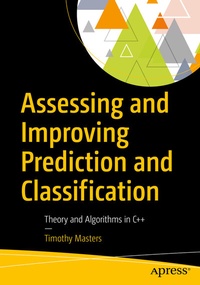
Assessing and Improving Prediction and Classification
Theory and Algorithms in C++
Published on 19. December 2017
XX, 517 pages
978-1-4842-3336-8 (ISBN)
Description

Assess the quality of your prediction and classification models in ways that accurately reflect their real-world performance, and then improve this performance using state-of-the-art algorithms such as committee-based decision making, resampling the dataset, and boosting. This book presents many important techniques for building powerful, robust models and quantifying their expected behavior when put to work in your application.
Considerable attention is given to information theory, especially as it relates to discovering and exploiting relationships between variables employed by your models. This presentation of an often confusing subject avoids advanced mathematics, focusing instead on concepts easily understood by those with modest background in mathematics.
All algorithms include an intuitive explanation of operation, essential equations, references to more rigorous theory, and commented C++ source code. Manyof these techniques are recent developments, still not in widespread use. Others are standard algorithms given a fresh look. In every case, the emphasis is on practical applicability, with all code written in such a way that it can easily be included in any program.
What You'll Learn
Who This Book is For
Anyone who creates prediction or classification models will find a wealth of useful algorithms in this book. Although all code examples are written in C++, the algorithms are described in sufficient detail that they can easily be programmed in any language.
Considerable attention is given to information theory, especially as it relates to discovering and exploiting relationships between variables employed by your models. This presentation of an often confusing subject avoids advanced mathematics, focusing instead on concepts easily understood by those with modest background in mathematics.
All algorithms include an intuitive explanation of operation, essential equations, references to more rigorous theory, and commented C++ source code. Manyof these techniques are recent developments, still not in widespread use. Others are standard algorithms given a fresh look. In every case, the emphasis is on practical applicability, with all code written in such a way that it can easily be included in any program.
What You'll Learn
-
Compute entropy to detect problematic predictors
-
Improve numeric predictions using constrained and unconstrained combinations, variance-weighted interpolation, and kernel-regression smoothing
-
Carry out classification decisions using Borda counts, MinMax and MaxMin rules, union and intersection rules, logistic regression, selection by local accuracy, maximization of the fuzzy integral, and pairwise coupling
-
Harness information-theoretic techniques to rapidly screen large numbers of candidate predictors, identifying those that are especially promising
-
Use Monte-Carlo permutation methods to assessthe role of good luck in performance results
-
Compute confidence and tolerance intervals for predictions, as well as confidence levels for classification decisions
Who This Book is For
Anyone who creates prediction or classification models will find a wealth of useful algorithms in this book. Although all code examples are written in C++, the algorithms are described in sufficient detail that they can easily be programmed in any language.
More details
Series
Edition
1st ed.
Language
English
Place of publication
Berkeley
United States
Publishing group
APRESS
Target group
Professional and scholarly
Product notice
Reflowable
Illustrations
XX, 517 p. 26 illus., 8 illus. in color.
File size
7,11 MB
ISBN-13
978-1-4842-3336-8 (9781484233368)
DOI
10.1007/978-1-4842-3336-8
Schweitzer Classification
Other editions
Additional editions
Book
12/2017
APress
€85.59
Shipment within 15-20 days
Person
Timothy Masters
received a PhD in mathematical statistics with a specialization in numerical computing. Since then he has continuously worked as an independent consultant for government and industry. His early research involved automated feature detection in high-altitude photographs while he developed applications for flood and drought prediction, detection of hidden missile silos, and identification of threatening military vehicles. Later he worked with medical researchers in the development of computer algorithms for distinguishing between benign and malignant cells in needle biopsies. For the last twenty years he has focused primarily on methods for evaluating automated financial market trading systems. He has authored four books on practical applications of neural networks: Practical Neural Network Recipes in C++ (Academic Press, 1993) Signal and Image Processing with Neural Networks (Wiley, 1994) Advanced Algorithms for Neural Networks (Wiley, 1995) Neural, Novel, and Hybrid Algorithms for Time Series Prediction (Wiley, 1995).
Content
1. Assessment of Numeric Predictions.- 2. Assessment of Class Predictions.- 3. Resampling for Assessing Parameter Estimates.- 4. Resampling for Assessing Prediction and Classification.- 5. Miscellaneous Resampling Techniques.- 6. Combining Numeric Predictions.- 7. Combining Classification Models.- 8. Gaiting Methods.- 9. Information and Entropy.- References.
