

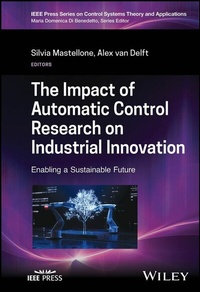
The Impact of Automatic Control Research on Industrial Innovation
Description

Bring together the theory and practice of control research with this innovative overview
Automatic control research focuses on subjects pertaining to the theory and practice of automation science and technology subjects such as industrial automation, robotics, and human-machine interaction. With each passing year, these subjects become more relevant to researchers, policymakers, industrialists, and workers alike. The work of academic control researchers, however, is often distant from the perspectives of industry practitioners, creating the potential for insights to be lost on both sides.
The Impact of Automatic Control Research on Industrial Innovation seeks to close this distance, providing an industrial perspective on the future of control research. It seeks to outline the possible and ongoing impacts of automatic control technologies across a range of industries, enabling readers to understand the connection between theory and practice. The result is a book that combines scholarly and practical understandings of industrial innovations and their possible role in building a sustainable world.
The Impact of Automatic Control Research on Industrial Innovation readers will also find:
* Insights on industrial and commercial applications of automatic control theory.
* Detailed discussion of industrial sectors including power, automotive, production processes, and more.
* An applied research roadmap for each sector.
This book is a must-own for both control researchers and control engineers, in both theoretical and applied contexts, as well as for graduate or continuing education courses on control theory and practice.
Editorial board: Silvia Mastellone, University of Applied Science Northwestern Switzerland; Alex van Delft, vanDelft.it, DSM; Tariq Samad, University of Minnesota; Iven Mareels, Federation University Australia, IBM; Scott Bortoff, Mitsubishi Electric Research Labs; Stefano Di Cairano, Mitsubishi Electric Research Labs; Alisa Rupenyan, ETHZ.
More details
Other editions
Additional editions
Persons
Editors
Silvia Mastellone, PhD, is Professor for Signals and Systems at the Institute for Electric Power Systems in the School of Engineering, University of Applied Sciences Northwestern Switzerland (FHNW), Switzerland. She is one of the principal investigators and Equal Opportunity Officer in the NCCR-Automation, and a member of the advisory board for the multiutility company IBB. She currently serves as the VP of Finances for the International Federation of Automatic Control, and as member of the CSS Board of Governors.
Alex van Delft, PhD, is co-founder of VanDelft.IT, the Netherlands, a technology company whose portfolio includes the areas of process control and automation, machine learning, and data engineering. Until 2020 he worked as Corporate Manager Process Control for Royal DSM in the Netherlands. He is also an active member of the Industry Committee of the International Federation of Automatic Control.
Content
About the Editors xi
List of Contributors xiii
Foreword xv
Preface xvii
Acknowledgments xix
1 Introduction 1
Silvia Mastellone and Alex van Delft
1.1 Background and Motivation 4
1.2 The Cradle of Innovation 5
1.3 Final Remarks 10
References 11
Part I Infrastructure and Mobility 13
2 Data Industry 15
Amritam Das, Ramachandra R. Kolluri, and Iven Mareels
2.1 Introduction 15
2.2 Anatomy of a Data Center 20
2.3 Reducing Power in a Data Center 23
2.4 Codesigning Energy Assets 31
2.5 Beyond the Data Center 36
2.6 Conclusion 36
References 37
3 Building Automation 43
Scott A. Bortoff, Bryan Eisenhower, Veronica Adetola, and Zheng O'Neill
3.1 Introduction 43
3.2 HVAC Background 45
3.3 Industry Trends and Drivers of Innovation 60
3.4 Consequences and Implications 65
3.5 Industry Needs-Driven Innovation 67
3.6 Vision-Driven Innovation 70
3.7 Conclusions 79
References 80
4 Future Impact and Challenges of Automotive Control 85
Stefano Di Cairano, Carlos Guardiola, Andreas A. Malikopoulos, and Jason B. Siegel
4.1 Introduction 85
4.2 Internal Combustion Powertrain 86
4.3 Electrification 96
4.4 Driver Assistance Systems and Automated Driving 104
4.5 Connected and Integrated Transportation Systems 111
References 117
Part II Energy and Production 135
5 Control of Electric Power Conversion Systems 137
Peter Hokayem, Pieder Joerg, Silvia Mastellone, and Mario Schweizer
5.1 Introduction 137
5.2 Power Electronic Conversion Systems 138
5.3 Grid-Connected Power Converters 145
5.4 Industrial Drives 157
5.5 Research Roadmap 162
5.6 Conclusions 164
References 164
6 Robotics and Manufacturing Automation 169
Alisa Rupenyan and Efe C. Balta
6.1 Introduction 169
6.2 Vision 178
6.3 Future Challenges and Trends 188
References 189
7 Process Industry 199
Alex van Delft
7.1 Introduction 199
7.2 Existing Control Challenges in Process Industry 208
7.3 Vision of the Future Generation of Products and Processes 211
7.4 Formulation of Control Research - Directions for Process Industry 216
7.5 Conclusion: What Drives and Blocks Innovation in Process Industry? 221
References 222
Index 225
1
Introduction
Silvia Mastellone1 and Alex van Delft2
1Institute for Electric Power Systems, University of Applied Science Northwestern Switzerland, Windisch, Switzerland
2VanDelft.IT, Sittard, The Netherlands
Technological innovation has shaped human lives across generations, but what are the basic forces driving the innovation process? Arguably we can state that the drive for innovation is rooted in the genuine human curiosity for knowledge, the desire to realize ambitious visions, and, at the same time, in the need for progress and comfort in our daily lives.
Automatic control, as an elegant multidisciplinary science that sets systems in motion, has enabled key steps in the history of technological innovation, from the Kalman filter that empowered humans to reach the moon, to optimal and robust controllers today pervasively present in every system and every process across industry sectors. In an environment where the complexity of engineering systems is ever-growing and technology is developing toward more digital and data-based solutions, automatic control is undergoing a transformation by integrating classical methods with data-driven approaches to address the new complexity, thus opening the door to a new chapter in its history. In this context, it is valuable to identify the way automatic control can enable the next innovation steps in different industrial sectors and thus realize its full potential. To address this question from an application perspective, in [1] we proposed a framework at the interplay between incremental improvement and disruptive innovation. The framework, named the cradle of innovation, will be presented in Section 1.2 and consists of a sustainable innovation process driven by a long-term vision and market requirements, where system know-how, economical and technical requirements are considered to ultimately bring a brilliant idea into practice.
The work presented in this volume is part of a broader ongoing effort within the IFAC Industry Committee formed by academic and industrial members and established by IFAC in 2017 with the objective of bridging the gap between industry and academia in the field of automatic control.
Besides providing a framework for the innovation process, the scope of the paper [1] was to link automatic control research to technology innovation. Within this scope, different industrial sectors and government institutions were surveyed, the data were analyzed and translated into technical requirement specifications. Finally, the paper provided pointers to research directions that would address the sustainability challenges across industries.
Starting from this point, with the present volume, we aim to apply the framework of the cradle of innovation, expand and detail this concept across six industry sectors.
Building on this vision, in the present volume we invite the reader to join a journey toward the birth of innovation across six specific industry sectors. The journey is inspired by a story that took place in the eighteenth century; the story of the Turk [2], an eighteenth-century automaton that could beat human chess opponents (see Figure 1.1).
The Turk first appeared in Vienna in 1770 as a chess-playing robot dressed in Turkish clothing, seated above a cabinet with a chessboard on top. The operator would assemble a paying audience and invite a challenger to play chess. The automaton would gaze at the opponent's move, ponder, then raise its mechanical arm, and make a move. Of course, the thing was a hack - a clever magician's illusion. The only real ingenuity was a hidden chess player inside the machine.
Figure 1.1 Mechanical Turk or Automaton Chess Player was a fake chess-playing machine constructed in the late eighteenth century.
Source: Joseph Racknitz/Humboldt University Library.
It is true that the late eighteenth century was a great age of automatons, but the deeper truth that chess-playing was an entirely different kind of creative activity seemed as obscure to people at that time as it seems obvious to us now.
The great-grandfather of computer science, Charles Babbage, saw the Turk and though he realized that it was probably a magic trick, he also asked himself what exactly would be required to produce an elegant solution. What kind of technology would one need to develop in order to build a machine that plays chess? And his "difference engine" - the first computer - rose in part from his desire to believe that there was a beautiful solution to the problem, even if the one before him was not.
Taking inspiration from the story of the Turk, with this volume, we ask the same question for the next generation of products, processes, and services across several industrial sectors: What does the future look like? What is beyond hacking? What would an elegant solution look like?
The volume includes six chapters and is organized into two main parts: Part I focuses on Infrastructure and Mobility and includes the following:
- Data Industry
- Building Automation
- Automotive Control
Part II addresses Energy and Production and includes:
- Power Conversion Systems
- Robotics and Manufacturing Automation
- Process Industry
Each chapter will discuss drivers and limits to innovation for a specific sector. Starting from customer needs and challenges, and system requirements, an applied research agenda will be formulated.
In addition to the research directions driven by industrial requirements, there are visionary ideas that promise to spark a new drive for innovation and where automatic control plays a pivotal role. Examples of such disruptive visions include the city of the future characterized by pervasive automation in the transportation (e.g. hyperloop and autonomous cars), energy (e.g. autonomous microgrids and economy), manufacturing (e.g. Industry 4.0), and financial sectors. Additionally, the adoption of control concepts in support of management decision-making could open completely new dimensions with great benefits for both fields.
1.1 Background and Motivation
The gap between fundamental control research and practice has been addressed by several authors from different perspectives. In 1964, Axelby [3] observed that "Certainly some gap between theory and application should be maintained, for without it there would be no progress.. It appears that the problem of the gap is a control problem in itself; it must be properly identified and optimized through proper action."
In a paper by Bennett [4], a historic overview is given of the landmark developments in automatic control. It began in the nineteenth century, when developments were mainly driven by industrial problems, e.g. the steam engine governor. Later on, the PID controller was developed by Elmer Sperry. The first theoretical analysis of a PID controller was published by Nicolas Minorsky in 1922. Another development highlighted in the paper is the feedback amplifier that enabled long-distance telephony, combining experimental data and mathematical models. In the era of classical control theory, the focus was on the development of rigorous mathematical foundations. Later on, the development was driven and sponsored by aerospace and defense, and the advancements in computing power allowed to solve more complex problems.
Rosenbrock, in his work [5], addresses the dilemma of whether automatic control should further develop toward fundamental theory backed up by rigorous mathematics or engineering more centered around experience and intuition. He points toward future developments where computers enhance the human skills rather than replace them.
Aström and Kumar [6] describe the dynamic gap between theory and practice as rooted in the open-loop process of theoretical research without feedback from practice. With current technology, deployment and implementation of complex control solutions have become simpler, thus reducing the gap between theory and application.
Lamnabhi-Lagarrigue et al. [7] build on this analysis and bring it a step further by describing the cross-fertilization and bi-directional interplay between five critical societal challenges (transportation, energy, water, healthcare, and manufacturing) and seven research and innovation challenges (cyber-physical systems of systems, distributed networked control systems, autonomy, cognition and control, data-driven dynamic modeling and control, cyber-physical and human systems, complexity and control in networks, and critical infrastructure systems). The main recommendation from their analysis is the fostering of both fundamental and application-oriented research in sector-specific programs and in ICT as a program that provides enabling technologies for all sectors.
In the paper by Deng [8], the author provides an overview on developments and application areas in automatic control that are driven by societal challenges such as food production, land use, water, logistics, and e-health.
In his 2020 editorial, Grimble [9] establishes a concise link between historical developments in automatic control and the need for a broader, systems-engineering-driven...
