

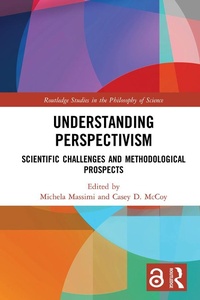
Understanding Perspectivism
Scientific Challenges and Methodological Prospects
Published on 3. June 2019
210 pages
978-1-351-38340-0 (ISBN)
Description

This edited collection is the first of its kind to explore the view called perspectivism in philosophy of science. The book brings together an array of essays that reflect on the methodological promises and scientific challenges of perspectivism in a variety of fields such as physics, biology, cognitive neuroscience, and cancer research, just as a few examples. What are the advantages of using a plurality of perspectives in a given scientific field and for interdisciplinary research? Can different perspectives be integrated? What is the relation between perspectivism, pluralism, and pragmatism? These ten new essays by top scholars in the field offer a polyphonic journey towards understanding the view called 'perspectivism' and its relevance to science.
Reviews / Votes
"It's an impressive collection of essays providing careful answers to questions about how to make sense of multiple, sometimes conflicting, perspectives in science. Ten chapters from outstanding scholars address a slew of implications of scientific perspectivism for classic positions in philosophy of science, primarily scientific realism, pluralism, and pragmatism . . . Professionals and graduate students would benefit from reading the book, as it should inspire ideas for philosophical questions to be addressed about their own areas of expertise." - Notre Dame Philosophical Reviews"This impressive collection is essential reading for appreciating the inevitable contextualities of scientific knowledge. It explores of how notions of "perspective" can illuminate the epistemic upshot of the sciences and how they are situated in their history, practices, representations, and sometimes competing aims, provocatively advancing debates about realism, pragmatism, explanation, and modeling in the process, all through a wealth of cases from physics, biology, neuroscience, and medical science." - Anjan Chakravartty, University of Miami
"An excellent collection of essays on a topic rapidly establishing itself as an important interpretive programme in philosophy of science. One of the volume's many merits consists in showing the diversity and versatility of perspectivism while illustrating common features among its different varieties. The reader is thus provided an enormously rich foundation for evaluating the role of perspectivism in understanding science and its practices." - Margaret Morrison, University of Toronto
"Perspectivism is a fruitful metaphor for imagining alternatives to traditional realism in philosophy of science. Massimi and McCoy have gathered ten essays which show how perspectivism is illuminating in areas such as molecular biology and measurement theory, and also explore the relationships between perspectivism and other recent accounts including pragmatism, structural realism, pluralism, and scientific modelling. There is an excellent balance of established and emerging scholars in the field. This volume is a superb, cutting-edge text to use in an advanced graduate seminar." - Miriam Solomon, Temple University
"Massimi and McCoy's collection provides the opposite of a one-sided diet of examples, and thus, it will clearly be nourishing to our thinking about PR." - Alexander Rueger, Metascience, 2020
More details
Series
Language
English
Place of publication
London
United Kingdom
Publishing group
Taylor & Francis Ltd
Target group
College/higher education
Illustrations
2 Tables, black and white; 1 Line drawings, black and white; 1 Halftones, black and white; 4 Illustrations, black and white
File size
4,81 MB
ISBN-13
978-1-351-38340-0 (9781351383400)
Copyright in bibliographic data and cover images is held by Nielsen Book Services Limited or by the publishers or by their respective licensors: all rights reserved.
Schweitzer Classification
Other editions
Additional editions
Michela Massimi | Casey D. McCoy
Understanding Perspectivism
Scientific Challenges and Methodological Prospects
Book
06/2021
1st Edition
Routledge
€67.10
Shipment within 10-20 days
Michela Massimi | Casey D. McCoy
Understanding Perspectivism
Scientific Challenges and Methodological Prospects
Book
06/2019
1st Edition
Routledge
€206.20
Shipment within 10-20 days
Persons
Michela Massimi is Professor of Philosophy of Science at the University of Edinburgh, UK. She was Co-Editor-in-Chief of the British Journal for the Philosophy of Science (2011-2016) and Vice President of the European Philosophy of Science Association (2015-2019).
Casey D. McCoy is a Postdoc at Stockholm University, Sweden. His research falls primarily within the philosophy of science and the philosophy of science and the philosophy of physics, and he has written on topics including inflationary cosmology, fine-tuning problems in physics, and the interpretation of statistical mechanics.
Casey D. McCoy is a Postdoc at Stockholm University, Sweden. His research falls primarily within the philosophy of science and the philosophy of science and the philosophy of physics, and he has written on topics including inflationary cosmology, fine-tuning problems in physics, and the interpretation of statistical mechanics.
Content
Introduction
Michela Massimi and Casey D. McCoy
Chapter 1. Pragmatism, Perspectivism, and the Historicity of Science
Hasok Chang
Chapter 2. Explanation, interdisciplinarity, and perspectives
Melinda Bonnie Fagan
Chapter 3. What is Perspectivism, and Does it Count as Realism?
Paul Teller
Chapter 4. Realism and Explanatory Perspectives
Juha Saatsi
Chapter 5. Universality and the Problem of Inconsistent Models
Collin Rice
Chapter 6. Representationalism in Measurement Theory. Structuralism or Perspectivalism?
Johanna E. Wolff
Chapter 7. Safe-and-substantive perspectivism
David Danks
Chapter 8. Charting the Heraclitean Brain: Perspectivism and Simplification in Models of the Motor Cortex
Mazviita Chirimuuta
Chapter 9. Cancer Modeling: the Advantages and Limitations of Multiple Perspectives
Anya Plutynski
Chapter 10. Perspectives, Representation, and Integration
Sandra D. Mitchell
Michela Massimi and Casey D. McCoy
Chapter 1. Pragmatism, Perspectivism, and the Historicity of Science
Hasok Chang
Chapter 2. Explanation, interdisciplinarity, and perspectives
Melinda Bonnie Fagan
Chapter 3. What is Perspectivism, and Does it Count as Realism?
Paul Teller
Chapter 4. Realism and Explanatory Perspectives
Juha Saatsi
Chapter 5. Universality and the Problem of Inconsistent Models
Collin Rice
Chapter 6. Representationalism in Measurement Theory. Structuralism or Perspectivalism?
Johanna E. Wolff
Chapter 7. Safe-and-substantive perspectivism
David Danks
Chapter 8. Charting the Heraclitean Brain: Perspectivism and Simplification in Models of the Motor Cortex
Mazviita Chirimuuta
Chapter 9. Cancer Modeling: the Advantages and Limitations of Multiple Perspectives
Anya Plutynski
Chapter 10. Perspectives, Representation, and Integration
Sandra D. Mitchell
