

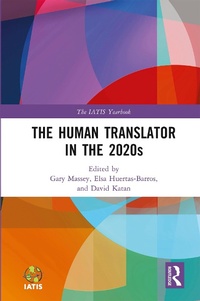
The Human Translator in the 2020s
1st Edition
Published on 19. December 2022
160 pages
978-1-000-80030-2 (ISBN)
Description

Has the language industry of the 21st century been racing ahead of the translation profession and leaving translators behind? Or are translators adapting to new sociotechnical realities and societal demands, and if so, how? The chapters in this volume seek to shed light on the profiles and position of human translators in the current decade.
This collection draws together the work of leading authors to reflect on the constantly evolving language industry. The eight chapters present new perspectives on, and concepts of, translation in a digital world. They highlight the shifts taking place in the sociotechnical environment of translation and the need to address changing buyer needs and market demands with new services, profiles and training. In doing so, they share a common focus on the added value that human translators can and do bring to bear as adaptive, creative, digitally literate experts.
Addressing an international readership, this volume is of interest to advanced students and researchers in translation and interpreting studies, and professionals in the global language industry.
This collection draws together the work of leading authors to reflect on the constantly evolving language industry. The eight chapters present new perspectives on, and concepts of, translation in a digital world. They highlight the shifts taking place in the sociotechnical environment of translation and the need to address changing buyer needs and market demands with new services, profiles and training. In doing so, they share a common focus on the added value that human translators can and do bring to bear as adaptive, creative, digitally literate experts.
Addressing an international readership, this volume is of interest to advanced students and researchers in translation and interpreting studies, and professionals in the global language industry.
More details
Series
Edition
1. Auflage
Language
English
Place of publication
London
United Kingdom
Publishing group
Taylor & Francis Ltd
Target group
College/higher education
Professional and scholarly
Illustrations
9 Tables, black and white; 4 Line drawings, black and white; 4 Illustrations, black and white
ISBN-13
978-1-000-80030-2 (9781000800302)
Copyright in bibliographic data and cover images is held by Nielsen Book Services Limited or by the publishers or by their respective licensors: all rights reserved.
Schweitzer Classification
Other editions
Additional editions
Gary Massey | Elsa Huertas-Barros | David Katan
The Human Translator in the 2020s
Book
08/2024
1st Edition
Routledge
€62.70
Shipment within 10-20 days
Gary Massey | Elsa Huertas-Barros | David Katan
The Human Translator in the 2020s
Book
12/2022
1st Edition
Routledge
€185.50
Shipment within 10-20 days
Persons
Gary Massey is a Professor of Translation Studies, Director of the Institute of Translation and Interpreting, and Deputy Dean of the School of Applied Linguistics at the Zurich University of Applied Sciences. He has published widely, and his research interests cover translator education, trainer training, translator profiles and translation process research.
Elsa Huertas-Barros is a Senior Lecturer in Translation in the School of Humanities at the University of Westminster. Her main research interests include translator education, translator competence and assessment practices. She has published her work in and with international journals and publishers and is co-editor of The Interpreter and Translator Trainer (ITT).
David Katan is a Professor of English and Translation at the University of Salento (Lecce), specialising in intercultural communication. He is editor of Cultus. Publications include Translating Cultures (3rd edition), contributions for the Routledge Encyclopaedias of Translation and Conflict and Translation and Globalisation and for the Benjamins Handbook of Translation Studies.
Elsa Huertas-Barros is a Senior Lecturer in Translation in the School of Humanities at the University of Westminster. Her main research interests include translator education, translator competence and assessment practices. She has published her work in and with international journals and publishers and is co-editor of The Interpreter and Translator Trainer (ITT).
David Katan is a Professor of English and Translation at the University of Salento (Lecce), specialising in intercultural communication. He is editor of Cultus. Publications include Translating Cultures (3rd edition), contributions for the Routledge Encyclopaedias of Translation and Conflict and Translation and Globalisation and for the Benjamins Handbook of Translation Studies.
Content
List of contributors
Acknowledgements
The human translator in the 2020s: An Introduction
Gary Massey, Elsa Huertas-Barros and David Katan
1. Translation's new high-tech clothes
Felix do Carmo and Joss Moorkens
2. Teaching translation technologies: an analysis of a corpus of syllabi for translation and interpreting undergraduate degrees in Spain
Roser Sanchez-Castany
3. Translation, translation revision and post-editing competence models: where are we now?
Isabelle Robert, Jim J. J. Ureel and Iris Schrijver
4. Weaving adaptive expertise into translator training
Erik Angelone
5. Tools for transforming translators into homo narrans or 'what machines can't do'
David Katan
6. 'Expanding' or 'rebranding' the translation concept? A pedagogical approach to future-proofing the translation profession in the 2020s
Juliet Vine and Elsa Huertas Barros
7. Creativity as an added value in translators' training: learning through transcreation
Marian Moron
8. The translator as a plain text designer for the Public Administration: a necessary role?
Elena Ruiz-Cortes
Index
Acknowledgements
The human translator in the 2020s: An Introduction
Gary Massey, Elsa Huertas-Barros and David Katan
1. Translation's new high-tech clothes
Felix do Carmo and Joss Moorkens
2. Teaching translation technologies: an analysis of a corpus of syllabi for translation and interpreting undergraduate degrees in Spain
Roser Sanchez-Castany
3. Translation, translation revision and post-editing competence models: where are we now?
Isabelle Robert, Jim J. J. Ureel and Iris Schrijver
4. Weaving adaptive expertise into translator training
Erik Angelone
5. Tools for transforming translators into homo narrans or 'what machines can't do'
David Katan
6. 'Expanding' or 'rebranding' the translation concept? A pedagogical approach to future-proofing the translation profession in the 2020s
Juliet Vine and Elsa Huertas Barros
7. Creativity as an added value in translators' training: learning through transcreation
Marian Moron
8. The translator as a plain text designer for the Public Administration: a necessary role?
Elena Ruiz-Cortes
Index
