

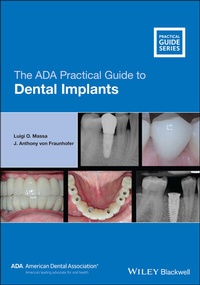
The ADA Practical Guide to Dental Implants
Description

The ADA Practical Guide to Dental Implants starts with a brief history of the subject then examines the clinical and economic considerations for implants. Patient factors, including systemic, oral, and periodontal health, diet, age, gender, and more are discussed. The book also looks at the experience of the clinician, followed by clinical considerations such as case planning, implant design, surgical techniques, antibiotics, and more. The last chapters cover post-surgical follow-up and the many factors that lead to a successful outcome.
* Discusses all aspects of dental implantology in the practice setting
* Supports dental practitioners in incorporating dental implants into their practices
* Considers pros and cons, patient factors, clinical considerations, success and failure, and implant restoration
* Offers foundational information on dental implants in an easy-to-read format
* Includes photographs and drawings to depict the concepts discussed
The ADA Practical Guide to Dental Implants is a useful introduction and guide to dental implants for any practitioner interested in incorporating implants into clinical practice.
More details
Other editions
Additional editions
Persons
Luigi O. Massa, DDS, is the owner and practitioner of Premier Dental Centers, Art & Technology Dental Studio in Boerne, Texas, USA.
J. Anthony von Fraunhofer, MSc, PhD, FADM, FRSC, is Professor Emeritus at the University of Maryland in Baltimore, Maryland, USA.
Content
Preface
1. Why dental implants
2. A brief history of dental implants
3. Design of Implants
4. Patient factors
5. Patient consults
6. Treatment planning and Evaluating implant sites
7. Implant scenarios
8. Implant surgery: simple healed sites
9. Bone grafting
10. Guided surgery
11. Immediate implant placement: complicated immediate sites
12. Full arch cases
13. Screw-retention vs. Cement-retention of restorations
14. Restoring dental implants
15. Dental implant failures
16. Economics of dental implants
17. Maintaining dental implants
Appendix A: Restoring dental implants
Appendix B: Abutments
Appendix C: Bone graft materials
1
Why Dental Implants?
Why dental implants? There is one simple answer: there is an overwhelming need. Within the last one to two generations, there have been vast societal changes, including the fact that people are now living longer with greater motivation to maintain the function and esthetics of their natural teeth. It was common for people just 60 or so years ago to lose most, if not all, of their teeth well before retirement age. As a result, dentistry prior to the 1960s was largely focused on providing restorations for carious teeth and fabricating removable appliances such as removable partial dentures (RPDs) and complete dentures (CDs) as the final dental solutions for missing teeth.
Partial and Complete Edentulism in the Twenty-First Century
The population is aging and, by 2030, more that 20% of the U. S. population will be aged 65 years or older, Fig. 1.1 [1].
These projected data indicate that within 10-12 years, about 20% of the population will be "senior citizens," namely 65 years or older [1]. Although advances in medicine and pharmacology, together with improved nutrition, dietary awareness and exercise, have significantly improved the average life expectancy, the outlook for maintained and even improved dental hygiene as well as overall oral health still looks bleak. In fact, partial or complete edentulism is increasing. Whereas fluoridation has markedly reduced dental caries [2, 3], the prevalence of tooth loss through periodontal disease, enamel erosion, wear, trauma and disease (e.g., cancer) is growing [4-7].
Figure 1.1 Projected aging of the United States.
(Source: Based on United States Census Bureau. Release Number CB20-99: 65 and Older Population Grows Rapidly as Baby Boomers Age. Washington, DC, June 25, 2020).
Figure 1.2 Prevalence of edentulism by race and ethnicity in adults =65 years [9].
(Source: Based on Centers for Disease Control and Prevention. Edentulism and tooth retention. Atlanta, Ga., September 10, 2019).
According to the American College of Prosthodontics, more than 35 million Americans are edentulous, and 178 million people are missing at least one tooth and these numbers are expected to grow over the next two decades [8].
What is distressing about these statistics is that edentulism affects our most vulnerable populations - the aging and the economically disadvantaged, Fig. 1.2. In the geriatric population, for example, the ratio of edentulous to dentate individuals is 2 : 1, with about 23 million being completely edentulous and some 12 million are edentulous in one arch. About 90% of edentulous patients have dentures and some 15% of edentulous patients will have dentures made each year [8].
The consequences of partial or complete edentulism are well-known and include many facets of the quality of life (QoL) as well as facial appearance, self-image and self-confidence. Overall, health consequences of edentulism encompass significant nutritional changes, digestive issues, obesity, diabetes, and coronary artery disease to name but a few.
The Reality of Dental Implants
Although there have been minor variations over the past few years, the current life expectancy for the U.S. population in 2020 is 78.93 years [10], and we can anticipate increases in tooth failures. Vertical root fractures, endodontic failures, restorative failures, and periodontal disease may result in tooth loss. In contrast to the practice of dentistry in the nineteenth and twentieth centuries, modern dentistry focuses on the replacement of lost teeth utilizing implants, combined with comprehensive analysis of function and esthetics.
In modern dentistry, the dental implant is the best tooth replacement option for nearly all situations where a tooth is missing or is failing. The primary reason for this is the extremely high success rate achieved with dental implants. Saving teeth at all costs is no longer the norm because of the unpredictability of the longevity of heroic dentistry. In other words, preserving bone and tissue regeneration are now considered to be more important than trying to prolong tooth retention. This approach not only promotes bone healing and preservation but ensures that implants are placed in a predictable and solid bony environment with a high rate of success.
The consensus regarding dental implants within the international dental community can be summarized in Table 1.1. Whereas the order of the comments may vary with the individual clinician, most would agree that these comments are valid and pertinent.
Implants and the Edentulous Patient
Over 32 million people in the U.S. wear partial or CDs [11] and approximately 33% of these patients complain that their dentures fit poorly, tend to loosen or dislodge during activities such as chewing and laughing, and/or there is pain on mastication. Flat ridges and/or shallow palatal vaults add to denture retention and instability problems and most dentists are aware that the mandibular CD presents retention issues.
Table 1.1 Advantages of dental implants.
- Implant dentistry is the future of dentistry.
- There is copious scientific literature on dental implantology.
- The 95-97% success rate of dental implants makes them an extremely predictable treatment.
- There is an overwhelming need for tooth replacement and predictable treatment of failing teeth.
- Implant-retained prosthetics are a very satisfactory solution to the growing prevalence of edentulism in our aging population.
Limitations and/or restrictions on diet, especially which foods can or cannot be eaten, also play a major role in the decision to seek dental implants. It is likely that a significant percentage of those patients experiencing pain or discomfort on chewing will not use their dentures during eating. Due to the decreased mastication forces associated with dentures, edentulous patients have been found to consume less food and have lower intakes of protein, intrinsic and milk sugars, non-starch polysaccharides (fibrous matter), calcium, non-heme iron, niacin and vitamin C than dentate people [12]. These dietary deficiencies often have significant adverse effects on overall health and wellbeing, as well as their QoL.
Many patients will resort to utilizing denture adhesives to aid in retention. These adhesives may lead to further problems as they are extremely difficult to remove from the tissues. Impaired speech patterns as well as halitosis (oral malodor or "denture breath") are frequent complaints among denture wearers, even when the fit of the denture is not a significant issue.
It follows from the above, that patients seek dental implant therapy for a number of reasons, including the following:
- Function
- Esthetics
- Comfort
- Confidence
- Facial appearance
General dental practitioners can address these issues and assist the patient in achieving oral health and functionality lost through missing teeth.
There are two major implant treatment modalities for the edentulous patient:
- Implant over-dentures. Implant overdentures are removable appliances which are both implant and tissue-borne prostheses. They utilize an abutment and a denture attachment for the retention (Fig. 1.3). These appliances solve several major problems with traditional dentures by allowing:
- Increased masticatory forces
- Increased retention to potentially eliminate the need for denture adhesives
- Removal of palatal coverage for patients who cannot tolerate the denture due to their gag reflex
An implant-supported denture is a satisfactory and viable economic alternative to the traditional CD.
- Screw-retained fixed implant bridges. Fixed implant bridges are implant-borne prostheses which are not removable by the patient. They are manufactured in zirconia or in acrylic overlaying a chrome-cobalt or titanium bar. These appliances give patients the greatest masticatory forces and are more appealing to most patients because they are fixed in place.
Implants for Single Crowns and Bridgework
As stated above, 178 million people in the U.S. are missing at least one tooth [11]. Before the use of dental implants, fixed partial dentures (bridges) or RPDs were utilized. One major problem with these treatment modalities is that fewer teeth are taking the load. For example, in the case of a four-unit fixed bridge, only two teeth are carrying the load of the four teeth it restores because the pontics provide no functional support.
Figure 1.3 Implant-supported overdenture.
Source: Courtesy of Zest Anchor.
The advantages for placing an implant and restoring it to replace a missing, free-standing tooth are summarized in Table 1.2.
Table 1.2 Advantages of implants replacing individual teeth.
No unnecessary preparation of adjacent teeth for a...