

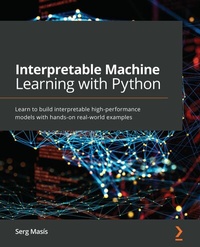
Interpretable Machine Learning with Python
Learn to build interpretable high-performance models with hands-on real-world examples
1st Edition
Published on 3. June 2024
736 pages
978-1-80020-657-1 (ISBN)
Description

A deep and detailed dive into the key aspects and challenges of machine learning interpretability, complete with the know-how on how to overcome and leverage them to build fairer, safer, and more reliable modelsKey Features - Learn how to extract easy-to-understand insights from any machine learning model
- Become well-versed with interpretability techniques to build fairer, safer, and more reliable models
- Mitigate risks in AI systems before they have broader implications by learning how to debug black-box models
Book DescriptionDo you want to gain a deeper understanding of your models and better mitigate poor prediction risks associated with machine learning interpretation? If so, then Interpretable Machine Learning with Python deserves a place on your bookshelf. We'll be starting off with the fundamentals of interpretability, its relevance in business, and exploring its key aspects and challenges. As you progress through the chapters, you'll then focus on how white-box models work, compare them to black-box and glass-box models, and examine their trade-off. You'll also get you up to speed with a vast array of interpretation methods, also known as Explainable AI (XAI) methods, and how to apply them to different use cases, be it for classification or regression, for tabular, time-series, image or text. In addition to the step-by-step code, this book will also help you interpret model outcomes using examples. You'll get hands-on with tuning models and training data for interpretability by reducing complexity, mitigating bias, placing guardrails, and enhancing reliability. The methods you'll explore here range from state-of-the-art feature selection and dataset debiasing methods to monotonic constraints and adversarial retraining. By the end of this book, you'll be able to understand ML models better and enhance them through interpretability tuning. What you will learn - Recognize the importance of interpretability in business
- Study models that are intrinsically interpretable such as linear models, decision trees, and Naïve Bayes
- Become well-versed in interpreting models with model-agnostic methods
- Visualize how an image classifier works and what it learns
- Understand how to mitigate the influence of bias in datasets
- Discover how to make models more reliable with adversarial robustness
- Use monotonic constraints to make fairer and safer models
Who this book is forThis book is primarily written for data scientists, machine learning developers, and data stewards who find themselves under increasing pressures to explain the workings of AI systems, their impacts on decision making, and how they identify and manage bias. It's also a useful resource for self-taught ML enthusiasts and beginners who want to go deeper into the subject matter, though a solid grasp on the Python programming language and ML fundamentals is needed to follow along.
- Become well-versed with interpretability techniques to build fairer, safer, and more reliable models
- Mitigate risks in AI systems before they have broader implications by learning how to debug black-box models
Book DescriptionDo you want to gain a deeper understanding of your models and better mitigate poor prediction risks associated with machine learning interpretation? If so, then Interpretable Machine Learning with Python deserves a place on your bookshelf. We'll be starting off with the fundamentals of interpretability, its relevance in business, and exploring its key aspects and challenges. As you progress through the chapters, you'll then focus on how white-box models work, compare them to black-box and glass-box models, and examine their trade-off. You'll also get you up to speed with a vast array of interpretation methods, also known as Explainable AI (XAI) methods, and how to apply them to different use cases, be it for classification or regression, for tabular, time-series, image or text. In addition to the step-by-step code, this book will also help you interpret model outcomes using examples. You'll get hands-on with tuning models and training data for interpretability by reducing complexity, mitigating bias, placing guardrails, and enhancing reliability. The methods you'll explore here range from state-of-the-art feature selection and dataset debiasing methods to monotonic constraints and adversarial retraining. By the end of this book, you'll be able to understand ML models better and enhance them through interpretability tuning. What you will learn - Recognize the importance of interpretability in business
- Study models that are intrinsically interpretable such as linear models, decision trees, and Naïve Bayes
- Become well-versed in interpreting models with model-agnostic methods
- Visualize how an image classifier works and what it learns
- Understand how to mitigate the influence of bias in datasets
- Discover how to make models more reliable with adversarial robustness
- Use monotonic constraints to make fairer and safer models
Who this book is forThis book is primarily written for data scientists, machine learning developers, and data stewards who find themselves under increasing pressures to explain the workings of AI systems, their impacts on decision making, and how they identify and manage bias. It's also a useful resource for self-taught ML enthusiasts and beginners who want to go deeper into the subject matter, though a solid grasp on the Python programming language and ML fundamentals is needed to follow along.
All prices
More details
Other editions
New editions
Serg Masís | Aleksander Molak | Denis Rothman
Interpretable Machine Learning with Python
Build explainable, fair, and robust high-performance models with hands-on, real-world examples
E-Book
05/2024
2nd Edition
Packt Publishing Limited
from
€35.99
Available for download
Additional editions
Serg Masis
Interpretable Machine Learning with Python
Learn to build interpretable high-performance models with hands-on real-world examples
Book
03/2021
Packt Publishing
€66.40
Shipment within 3-4 weeks
Person
Masís Serg :
Serg Masís has been at the confluence of the internet, application development, and analytics for the last two decades. Currently, he's a climate and agronomic data scientist at Syngenta, a leading agribusiness company with a mission to improve global food security. Before that role, he co-founded a start-up, incubated by Harvard Innovation Labs, that combined the power of cloud computing and machine learning with principles in decision-making science to expose users to new places and events. Whether it pertains to leisure activities, plant diseases, or customer lifetime value, Serg is passionate about providing the often-missing link between data and decision-making-and machine learning interpretation helps bridge this gap robustly.
Serg Masís has been at the confluence of the internet, application development, and analytics for the last two decades. Currently, he's a climate and agronomic data scientist at Syngenta, a leading agribusiness company with a mission to improve global food security. Before that role, he co-founded a start-up, incubated by Harvard Innovation Labs, that combined the power of cloud computing and machine learning with principles in decision-making science to expose users to new places and events. Whether it pertains to leisure activities, plant diseases, or customer lifetime value, Serg is passionate about providing the often-missing link between data and decision-making-and machine learning interpretation helps bridge this gap robustly.
Content
Table of Contents - Interpretation, Interpretability and Explainability; and why does it all matter?
- Key Concepts of Interpretability
- Interpretation Challenges
- Fundamentals of Feature Importance and Impact
- Global Model-Agnostic Interpretation Methods
- Local Model-Agnostic Interpretation Methods
- Anchor and Counterfactual Explanations
- Visualizing Convolutional Neural Networks
- Interpretation Methods for Multivariate Forecasting and Sensitivity Analysis
- Feature Selection and Engineering for Interpretability
- Bias Mitigation and Causal Inference Methods
- Monotonic Constraints and Model Tuning for Interpretability
- Adversarial Robustness
- What's Next for Machine Learning Interpretability?
- Key Concepts of Interpretability
- Interpretation Challenges
- Fundamentals of Feature Importance and Impact
- Global Model-Agnostic Interpretation Methods
- Local Model-Agnostic Interpretation Methods
- Anchor and Counterfactual Explanations
- Visualizing Convolutional Neural Networks
- Interpretation Methods for Multivariate Forecasting and Sensitivity Analysis
- Feature Selection and Engineering for Interpretability
- Bias Mitigation and Causal Inference Methods
- Monotonic Constraints and Model Tuning for Interpretability
- Adversarial Robustness
- What's Next for Machine Learning Interpretability?
