

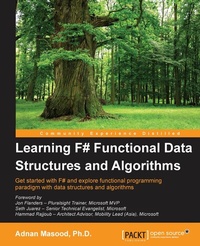
Learning F# Functional Data Structures and Algorithms
Get started with F# and explore functional programming paradigm with data structures and algorithms
Published on 7. October 2025
206 pages
978-1-78355-385-3 (ISBN)
Description

Key Features
Book DescriptionIf you have just started your adventure with F#, then this book will help you take the right steps to become a successful F# coder. An intermediate knowledge of imperative programming concepts, and a basic understanding of the algorithms and data structures in .NET environments using the C# language and BCL (Base Class Library), would be helpful.What you will learn
Familiarize yourself with the functional programming nature of F# and explore its fundamentals
Utilize data structures available in F# and apply recursion and lazy evaluation
Gain insights into functional programming paradigms; dissect F# code and analyze code available in community projects
Build abstract data structures and utilize powerful optimization techniques such as memoization
Explore and test builtin F# bespoke data structures and algorithms
Become resourceful and learn how to easily reuse libraries contributed by the C# and F# community
Understand the tradeoffs in selecting purely functional (persistent) over mutable data structures
Implement custom ADT (Abstract Data Type), and discover parallel programming and asynchrony within F#
Who this book is forIf you have just started your adventure with F#, then this book will help you take the right steps to become a successful F# coder. An intermediate knowledge of imperative programming concepts, and a basic understanding of the algorithms and data structures in .NET environments using the C# language and BCL (Base Class Library), would be helpful.
Book DescriptionIf you have just started your adventure with F#, then this book will help you take the right steps to become a successful F# coder. An intermediate knowledge of imperative programming concepts, and a basic understanding of the algorithms and data structures in .NET environments using the C# language and BCL (Base Class Library), would be helpful.What you will learn
Familiarize yourself with the functional programming nature of F# and explore its fundamentals
Utilize data structures available in F# and apply recursion and lazy evaluation
Gain insights into functional programming paradigms; dissect F# code and analyze code available in community projects
Build abstract data structures and utilize powerful optimization techniques such as memoization
Explore and test builtin F# bespoke data structures and algorithms
Become resourceful and learn how to easily reuse libraries contributed by the C# and F# community
Understand the tradeoffs in selecting purely functional (persistent) over mutable data structures
Implement custom ADT (Abstract Data Type), and discover parallel programming and asynchrony within F#
Who this book is forIf you have just started your adventure with F#, then this book will help you take the right steps to become a successful F# coder. An intermediate knowledge of imperative programming concepts, and a basic understanding of the algorithms and data structures in .NET environments using the C# language and BCL (Base Class Library), would be helpful.
All prices
More details
Edition
Digital original
Language
English
Place of publication
Birmingham
United Kingdom
Target group
Professional and scholarly
US School Grade: College Graduate Student
Edition type
Digital original
File size
3,38 MB
ISBN-13
978-1-78355-385-3 (9781783553853)
Copyright in bibliographic data and cover images is held by Nielsen Book Services Limited or by the publishers or by their respective licensors: all rights reserved.
Schweitzer Classification
Other editions
Additional editions
Book
05/2015
Packt Publishing
€50.30
Shipment within 3-4 weeks
Person
Masood Adnan :
Adnan Masood, PhD is an artificial intelligence and machine learning researcher, visiting scholar at Stanford AI Lab, software engineer, Microsoft MVP (Most Valuable Professional), and Microsoft's regional director for artificial intelligence. As chief architect of AI and machine learning at UST Global, he collaborates with Stanford AI Lab and MIT CSAIL, and leads a team of data scientists and engineers building artificial intelligence solutions to produce business value and insights that affect a range of businesses, products, and initiatives.
Adnan Masood, PhD is an artificial intelligence and machine learning researcher, visiting scholar at Stanford AI Lab, software engineer, Microsoft MVP (Most Valuable Professional), and Microsoft's regional director for artificial intelligence. As chief architect of AI and machine learning at UST Global, he collaborates with Stanford AI Lab and MIT CSAIL, and leads a team of data scientists and engineers building artificial intelligence solutions to produce business value and insights that affect a range of businesses, products, and initiatives.
Content
Table of Contents
Embrace the truth
Now lazily get over it again
What?s in the bag anyway?
Are we there yet?
Let?s stack up
See the forest for the trees
Jumping the queue
Quick boost with graph
Vectors of indirection
Where to go next?
Embrace the truth
Now lazily get over it again
What?s in the bag anyway?
Are we there yet?
Let?s stack up
See the forest for the trees
Jumping the queue
Quick boost with graph
Vectors of indirection
Where to go next?

