

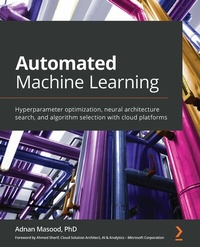
Automated Machine Learning
Hyperparameter optimization, neural architecture search, and algorithm selection with cloud platforms
Published on 23. September 2024
312 pages
978-1-80056-552-4 (ISBN)
Description

Get to grips with automated machine learning and adopt a hands-on approach to AutoML implementation and associated methodologies
Key Features
Get up to speed with AutoML using OSS, Azure, AWS, GCP, or any platform of your choice
Eliminate mundane tasks in data engineering and reduce human errors in machine learning models
Find out how you can make machine learning accessible for all users to promote decentralized processes
Book DescriptionEvery machine learning engineer deals with systems that have hyperparameters, and the most basic task in automated machine learning (AutoML) is to automatically set these hyperparameters to optimize performance. The latest deep neural networks have a wide range of hyperparameters for their architecture, regularization, and optimization, which can be customized effectively to save time and effort. This book reviews the underlying techniques of automated feature engineering, model and hyperparameter tuning, gradient-based approaches, and much more. You'll discover different ways of implementing these techniques in open source tools and then learn to use enterprise tools for implementing AutoML in three major cloud service providers: Microsoft Azure, Amazon Web Services (AWS), and Google Cloud Platform. As you progress, you'll explore the features of cloud AutoML platforms by building machine learning models using AutoML. The book will also show you how to develop accurate models by automating time-consuming and repetitive tasks in the machine learning development lifecycle. By the end of this machine learning book, you'll be able to build and deploy AutoML models that are not only accurate, but also increase productivity, allow interoperability, and minimize feature engineering tasks.What you will learn
Explore AutoML fundamentals, underlying methods, and techniques
Assess AutoML aspects such as algorithm selection, auto featurization, and hyperparameter tuning in an applied scenario
Find out the difference between cloud and operations support systems (OSS)
Implement AutoML in enterprise cloud to deploy ML models and pipelines
Build explainable AutoML pipelines with transparency
Understand automated feature engineering and time series forecasting
Automate data science modeling tasks to implement ML solutions easily and focus on more complex problems
Who this book is forCitizen data scientists, machine learning developers, artificial intelligence enthusiasts, or anyone looking to automatically build machine learning models using the features offered by open source tools, Microsoft Azure Machine Learning, AWS, and Google Cloud Platform will find this book useful. Beginner-level knowledge of building ML models is required to get the best out of this book. Prior experience in using Enterprise cloud is beneficial.
Key Features
Get up to speed with AutoML using OSS, Azure, AWS, GCP, or any platform of your choice
Eliminate mundane tasks in data engineering and reduce human errors in machine learning models
Find out how you can make machine learning accessible for all users to promote decentralized processes
Book DescriptionEvery machine learning engineer deals with systems that have hyperparameters, and the most basic task in automated machine learning (AutoML) is to automatically set these hyperparameters to optimize performance. The latest deep neural networks have a wide range of hyperparameters for their architecture, regularization, and optimization, which can be customized effectively to save time and effort. This book reviews the underlying techniques of automated feature engineering, model and hyperparameter tuning, gradient-based approaches, and much more. You'll discover different ways of implementing these techniques in open source tools and then learn to use enterprise tools for implementing AutoML in three major cloud service providers: Microsoft Azure, Amazon Web Services (AWS), and Google Cloud Platform. As you progress, you'll explore the features of cloud AutoML platforms by building machine learning models using AutoML. The book will also show you how to develop accurate models by automating time-consuming and repetitive tasks in the machine learning development lifecycle. By the end of this machine learning book, you'll be able to build and deploy AutoML models that are not only accurate, but also increase productivity, allow interoperability, and minimize feature engineering tasks.What you will learn
Explore AutoML fundamentals, underlying methods, and techniques
Assess AutoML aspects such as algorithm selection, auto featurization, and hyperparameter tuning in an applied scenario
Find out the difference between cloud and operations support systems (OSS)
Implement AutoML in enterprise cloud to deploy ML models and pipelines
Build explainable AutoML pipelines with transparency
Understand automated feature engineering and time series forecasting
Automate data science modeling tasks to implement ML solutions easily and focus on more complex problems
Who this book is forCitizen data scientists, machine learning developers, artificial intelligence enthusiasts, or anyone looking to automatically build machine learning models using the features offered by open source tools, Microsoft Azure Machine Learning, AWS, and Google Cloud Platform will find this book useful. Beginner-level knowledge of building ML models is required to get the best out of this book. Prior experience in using Enterprise cloud is beneficial.
All prices
More details
Edition
Digital original
Language
English
Place of publication
Birmingham
United Kingdom
Target group
Professional and scholarly
US School Grade: College Graduate Student
Edition type
Digital original
Product notice
Reflowable
File size
37,86 MB
ISBN-13
978-1-80056-552-4 (9781800565524)
Copyright in bibliographic data and cover images is held by Nielsen Book Services Limited or by the publishers or by their respective licensors: all rights reserved.
Schweitzer Classification
Other editions
Additional editions
Adnan Masood
Automated Machine Learning
Hyperparameter optimization, neural architecture search, and algorithm selection with cloud platforms
Book
02/2021
Packt Publishing
€56.00
Shipment within 3-4 weeks
Person
Masood Adnan :
Adnan Masood, PhD is an artificial intelligence and machine learning researcher, visiting scholar at Stanford AI Lab, software engineer, Microsoft MVP (Most Valuable Professional), and Microsoft's regional director for artificial intelligence. As chief architect of AI and machine learning at UST Global, he collaborates with Stanford AI Lab and MIT CSAIL, and leads a team of data scientists and engineers building artificial intelligence solutions to produce business value and insights that affect a range of businesses, products, and initiatives.
Adnan Masood, PhD is an artificial intelligence and machine learning researcher, visiting scholar at Stanford AI Lab, software engineer, Microsoft MVP (Most Valuable Professional), and Microsoft's regional director for artificial intelligence. As chief architect of AI and machine learning at UST Global, he collaborates with Stanford AI Lab and MIT CSAIL, and leads a team of data scientists and engineers building artificial intelligence solutions to produce business value and insights that affect a range of businesses, products, and initiatives.
Content
Table of Contents
A Lap around Automated Machine Learning
Automated Machine Learning, Algorithms, and Techniques
Automated Machine Learning with Open Source Tools and Libraries
Getting Started with Azure Machine Learning
Automated Machine Learning with Microsoft Azure
Machine Learning with Amazon Web Services
Doing Automated Machine Learning with Amazon SageMaker Autopilot
Machine Learning with Google Cloud Platform
Automated Machine Learning with GCP Cloud AutoML
AutoML in the Enterprise
A Lap around Automated Machine Learning
Automated Machine Learning, Algorithms, and Techniques
Automated Machine Learning with Open Source Tools and Libraries
Getting Started with Azure Machine Learning
Automated Machine Learning with Microsoft Azure
Machine Learning with Amazon Web Services
Doing Automated Machine Learning with Amazon SageMaker Autopilot
Machine Learning with Google Cloud Platform
Automated Machine Learning with GCP Cloud AutoML
AutoML in the Enterprise
