

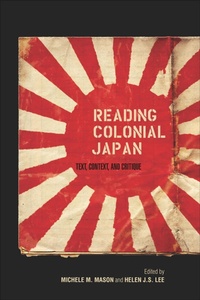
Reading Colonial Japan
Text, Context, and Critique
Published on 28. March 2012
320 pages
978-0-8047-8159-6 (ISBN)
Description

By any measure, Japan's modern empire was formidable. The only major non-western colonial power in the 20th century, Japan controlled a vast area of Asia and numerous archipelagos in the Pacific Ocean. The massive extraction of resources and extensive cultural assimilation policies radically impacted the lives of millions of Asians and Micronesians, and the political, economic, and cultural ramifications of this era are still felt today.
The Japanese empire lasted from 1869-1945. During this time, how was the Japanese imperial project understood, imagined, and lived? Reading Colonial Japan is a unique anthology that aims to deepen knowledge of Japanese colonialism(s) by providing an eclectic selection of translated Japanese primary sources and analytical essays that illuminate Japan's many and varied colonial projects. The primary documents highlight how central cultural production and dissemination were to the colonial effort, while accentuating the myriad ways colonialism permeated every facet of life. The variety of genres the explored includes legal documents, children's literature, cookbooks, serialized comics, and literary texts by well-known authors of the time. These cultural works, produced by a broad spectrum of "ordinary" Japanese citizens (a housewife in Manchuria, settlers in Korea, manga artists and fiction writers in mainland Japan, and so on), functioned effectively to reinforce the official policies that controlled and violated the lives of the colonized throughout Japan's empire.
By making available and analyzing a wide-range of sources that represent "media" during the Japanese colonial period, Reading Colonial Japan draws attention to the powerful role that language and imagination played in producing the material realities of Japanese colonialism.
The Japanese empire lasted from 1869-1945. During this time, how was the Japanese imperial project understood, imagined, and lived? Reading Colonial Japan is a unique anthology that aims to deepen knowledge of Japanese colonialism(s) by providing an eclectic selection of translated Japanese primary sources and analytical essays that illuminate Japan's many and varied colonial projects. The primary documents highlight how central cultural production and dissemination were to the colonial effort, while accentuating the myriad ways colonialism permeated every facet of life. The variety of genres the explored includes legal documents, children's literature, cookbooks, serialized comics, and literary texts by well-known authors of the time. These cultural works, produced by a broad spectrum of "ordinary" Japanese citizens (a housewife in Manchuria, settlers in Korea, manga artists and fiction writers in mainland Japan, and so on), functioned effectively to reinforce the official policies that controlled and violated the lives of the colonized throughout Japan's empire.
By making available and analyzing a wide-range of sources that represent "media" during the Japanese colonial period, Reading Colonial Japan draws attention to the powerful role that language and imagination played in producing the material realities of Japanese colonialism.
Reviews / Votes
"Reading Colonial Japan is an anthology of finely written essays that squarely speaks to the burgeoning scholarship of 'multiple Japans' . . . [T]he anthology exhibits perceptive as well as theoretically- and historically-informed scholarship. The collection would appeal to scholars whose work straddles several disciplines as it places various forms of text in their historical contexts."-Ryota Nishino, New Zealand Journal of Asian Studies "Reading Colonial Japan illuminates Japan's seven decades of colonial rule (1869-1945) through well-written translations of Japanese primary sources from the colonial era and related analytical essays . . . This monograph is an excellent contribution to the fields of Asian studies and post-colonial studies."-Elise Foxworth, Monumenta Nipponica "Reading Colonial Japan is a splendid collection of colonial writings in translation, paired with critical essays that address historical and theoretical concerns in original and engaging ways. It is an exceptional achievement and a truly important addition to cultural studies, Asian studies, history, and the study of colonialism/postcolonialism, migration, and translation."-Sabine Fruehstueck, Professor of Modern Japanese Cultural Studies, University of California, Santa BarbaraMore details
Edition
New edition
Language
English
Place of publication
Palo Alto
United States
Edition type
New edition
Illustrations
2 s/w Abbildungen
2 figures
File size
10,48 MB
ISBN-13
978-0-8047-8159-6 (9780804781596)
Copyright in bibliographic data and cover images is held by Nielsen Book Services Limited or by the publishers or by their respective licensors: all rights reserved.
Schweitzer Classification
Other editions
Additional editions
Book
03/2012
Stanford University Press
€111.50
Shipment within 15-20 days
Book
03/2012
Stanford University Press
€26.50
Shipment within 15-20 days
Persons
Michele M. Mason is assistant professor of Japanese literature at the University of Maryland, College Park. She is also the co-producer and interpreter for the short documentary film Witness to Hiroshima (2010).
Helen J.S. Lee is an assistant professor of Japanese studies at the Underwood International College, Yonsei University, Seoul, Korea.
Helen J.S. Lee is an assistant professor of Japanese studies at the Underwood International College, Yonsei University, Seoul, Korea.
Content
- Intro
- Contents
- Contributors
- Acknowledgments
- Note on Japanese Names
- Introduction - Michele M. Mason and Helen J. S. Lee
- Chapter One
- Text: The Shores of the Sorachi River - Kunikida Doppo, Translation by Michele M. Mason
- Context/Critique: Writing Ainu Out/Writing Japanese In: The "Nature" of Japanese Colonialism in Hokkaido - Michele M. Mason
- Chapter Two
- Text: Hokkaido Former Natives Protection Law, Translation by Richard Siddle
- Context/Critique Rule in the Name of "Protection": The Vocabulary of Colonialism - Komori Yoichi, Translation by Michele M. Mason
- Chapter Three
- Text: Officer Ukuma - Ikemiyagi Sekiho, Translation by Davinder L. Bhowmik
- Context/Critique: Subaltern Identity in Okinawa - Davinder L. Bhowmik
- Chapter Four
- Text: Demon Bird - Sato Haruo, Translation by Robert Tierney
- Context/Critique: Violence, Borders, Identity: An Ethnographic Narrative Set in Colonial Taiwan - Robert Tierney
- Chapter Five
- Text: The Manual of Home Cuisine - The Women's Division of the Green Flag Association, Translation by Helen J. S. Lee
- Context/Critique: Eating for the Emperor: The Nationalization of Settler Homes and Bodies in the Kominka Era - Helen J. S. Lee
- Chapter Six
- Text: Wolf Forest, Basket Forest, and Thief Forest - Miyazawa Kenji, Translation by Kota Inoue
- Context/Critique: A Little Story of Settler Colonialism: Imperialist Consciousness and Children's Literature in the 1920s - Kota Inoue
- Chapter Seven
- Text: Manchu Girl - Koizumi Kikue, Translation by Kimberly T. Kono
- Context/Critique: Imperializing Motherhood: The Education of a "Manchu Girl" in Colonial Manchuria - Kimberly T. Kono
- Chapter Eight
- Text: The Adventures of Dankichi - Shimada Keizo, Translation by Helen J. S. Lee
- Context/Critique: Popular Orientalism and Japanese Views of Asia - Kawamura Minato, Translation by Kota Inoue and Helen J. S. Lee
- Index
