

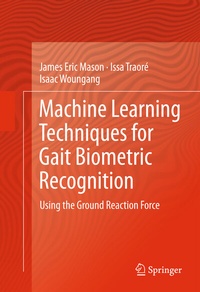
Machine Learning Techniques for Gait Biometric Recognition
Description

More details
Other editions
Additional editions
Persons
James Eric Mason obtained his BSEng and MASc from the University of Victoria, Canada, in 2009 and 2014, respectively. During his Master's program, under the supervision of Dr. Issa Traore, his research focused primarily on biometric security solutions with a particular emphasis on the gait biometric. In 2014 he completed his thesis titled Examining the impact of Normalization and Footwear on Gait Biometrics Recognition using the Ground Reaction Force , which served as an inspiration for the work presented in this book. His research interests include biometric security, machine learning, software engineering, web development, and weather/climate sciences. Since 2011, he has been working with the software startup Referral SaaSquatch as a full stack software developer.
Issa Traore obtained a PhD in Software Engineering in 1998 from Institute Nationale Polytechnique (INPT)-LAAS/CNRS, Toulouse, France. He has been with the faculty of the Department of Electrical and Computer Engineering of the University of Victoria since 1999. He is currently a Full Professor and the Coordinator of the Information Security and object Technology (ISOT) Lab at the University of Victoria. His research interests include biometrics technologies, computer intrusion detection, network forensics, software security, and software quality engineering. He is currently serving as Associate Editor for the International Journal of Communication Systems (IJCS) and the International Journal of Communication Networks and Distributed Systems (IJCNDS). Dr. Traore is also a co-founder and Chief Scientist of Plurilock Security Solutions Inc., a network security company which provides innovative authentication technologies, and is one of the pioneers in bringing behavioral biometric authentication products to the market.
Isaac Woungang
received
his M.Sc. & Ph.D degrees, all in Mathematics, from the University of Aix
Marseille II, France, and University of South, Toulon and Var, France, in 1990
and 1994 respectively. In 1999, he received a MSc degree from the
INRS-Materials and Telecommunications, University of Quebec, Montreal, QC,
Canada. From 1999 to 2002, he worked as a software engineer at Nortel Networks,
Ottawa, Canada, in the Photonic Line Systems Group. Since 2002, he has been
with Ryerson University, where he is now a full professor of Computer Science
and Director of the Distributed Applications and Broadband (DABNEL) Lab. His current research interests include
radio resource management in next generation wireless networks, biometrics
technologies, network security. Dr. Woungang has published 8 books and over 89
refereed technical articles in scholarly international journals and proceedings
of international conferences. He has served as Associate Editor of the
Computers and Electrical Engineering (Elsevier), and the International Journal
of Communication Systems (Wiley). He has Guest Edited several Special Issues
withvarious reputed journals such as IET Information Security, Mathematical
and Computer Modeling (Elsevier), Computer Communications (Elsevier), Computers
and Electrical Engineering (Elsevier), and Telecommunication Systems
(Springer). Since January 2012, He serves as Chair of Computer Chapter, IEEE
Toronto Section.
