

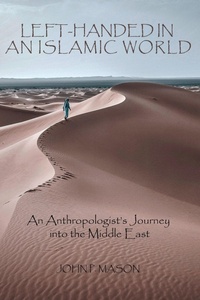
Left-Handed in an Islamic World
An Anthropologist's Journey into the Middle East
Published on 11. August 2021
288 pages
978-1-955835-11-4 (ISBN)
Description

A social anthropologist recounts his time living and working in the Middle East.
In Left-Handed in the Islamic World, the author, a social anthropologist, shares stories of Arabs he met and lived with, covering a period from 1968 to 2012. Lawrence of Arabia serves as an inspiration for the journey. Throughout the book the author calls upon a significant amount of history to give a background and to contextualize the stories.
The stories describe the social lives of Arabs in a variety of places, those living in an oasis village, others in a mid-sized city, and yet others in a major metropolis. Some of the places are conflict or post-conflict zones. One is in a state of war. The countries include Libya and Egypt for longer periods and many other Arab countries for shorter visits. In most of the stories, the Arabs are Muslims, though in some they are Christians.
The book presents Islam in its many shapes and different contexts. At its "best," Islam will be seen as lived by Libyan Desert oasis villagers in creating a harmonious, well-lived life. In other cases, Islam will be glimpsed in ways not so favorable, especially in the treatment of non-Muslim Arabs living in Islamic societies. The author touches on a few theories as to why conflict is endemic to the Middle East. But none of these theories accounts fully for the recent emergence of the egregious behavior of such self-acclaimed groups as the Islamic State or ISIS, who pervert the religion to achieve their renewed Caliphate prophesies.
Being left-handed in a right-handed Islamic World was for the author a metaphor for some of the complexities of living in that World as a development anthropologist, and also when developing programs as an international development consultant for firms tied to USAID and the World Bank. Stories of success and folly of such programs in the Middle East are instructive for development practitioners.
The larger context raises questions about the Middle East and its perennial involvement in conflict, including the Arab-Israeli situation and the place of ISIS and al-Quaeda.
"Dr. Mason's book is just plain fun to read. It is interesting, amusing, and informative, without being annoyingly dense, complicated or tedious. It is written in a voice that is human and recognizable, candid and friendly, rather than technical and scientific. It is refreshingly accessible to a broad audience, while being equally interesting for the academic, anthropologist or students of social science, international development, or Middle Eastern studies. The book has just the right mix of personal story, situational context, cultural and historical description to paint a realistic and holistic picture of life in seemingly exotic lands, made more familiar through this narrative. It does a good job of humanizing people who may well be very different from the reader." -Adam Koons, PhD, Applied Anthropologist, Overseas Humanitarian Assistance
In Left-Handed in the Islamic World, the author, a social anthropologist, shares stories of Arabs he met and lived with, covering a period from 1968 to 2012. Lawrence of Arabia serves as an inspiration for the journey. Throughout the book the author calls upon a significant amount of history to give a background and to contextualize the stories.
The stories describe the social lives of Arabs in a variety of places, those living in an oasis village, others in a mid-sized city, and yet others in a major metropolis. Some of the places are conflict or post-conflict zones. One is in a state of war. The countries include Libya and Egypt for longer periods and many other Arab countries for shorter visits. In most of the stories, the Arabs are Muslims, though in some they are Christians.
The book presents Islam in its many shapes and different contexts. At its "best," Islam will be seen as lived by Libyan Desert oasis villagers in creating a harmonious, well-lived life. In other cases, Islam will be glimpsed in ways not so favorable, especially in the treatment of non-Muslim Arabs living in Islamic societies. The author touches on a few theories as to why conflict is endemic to the Middle East. But none of these theories accounts fully for the recent emergence of the egregious behavior of such self-acclaimed groups as the Islamic State or ISIS, who pervert the religion to achieve their renewed Caliphate prophesies.
Being left-handed in a right-handed Islamic World was for the author a metaphor for some of the complexities of living in that World as a development anthropologist, and also when developing programs as an international development consultant for firms tied to USAID and the World Bank. Stories of success and folly of such programs in the Middle East are instructive for development practitioners.
The larger context raises questions about the Middle East and its perennial involvement in conflict, including the Arab-Israeli situation and the place of ISIS and al-Quaeda.
"Dr. Mason's book is just plain fun to read. It is interesting, amusing, and informative, without being annoyingly dense, complicated or tedious. It is written in a voice that is human and recognizable, candid and friendly, rather than technical and scientific. It is refreshingly accessible to a broad audience, while being equally interesting for the academic, anthropologist or students of social science, international development, or Middle Eastern studies. The book has just the right mix of personal story, situational context, cultural and historical description to paint a realistic and holistic picture of life in seemingly exotic lands, made more familiar through this narrative. It does a good job of humanizing people who may well be very different from the reader." -Adam Koons, PhD, Applied Anthropologist, Overseas Humanitarian Assistance
More details
Other editions
Additional editions
Book
01/2017
Nap/Vellum
€27.90
Shipment within 3-4 weeks
Content
- Intro
- Title
- Copyright
- Contents
- Acknowledgments
- Introduction
- PART I: Our Introduction to 'Arabdom'
- TRANSITION 1: Visualizing and Planning the Journey
- PART II: Onward to Libya
- TRANSITION 2: A Libyan Way of Life at Risk
- PART III: Out with the King-In with a Colonel
- TRANSITION 3: From Student of Desert Peoples to Teacher
- PART IV: A Time of Trial in the Land of the Pharaohs
- TRANSITION 4: Leaving Cairo and Taking Some Diversions into Iran, Libyan Prehistory, and Arab Cultural Meanings
- PART V: Return to Libya and Life on the Edge
- TRANSITION 5: Onto Life as a Consultant
- PART VI: A Narrower Window on the Middle East
- TRANSITION 6: Moving Back to a 'Safe Haven'
- PART VII: Reconsidering Life as an Anthropologist in a Conflictive Middle East
- Final Thoughts
- Postscript
- Selected Middle East and Related Publications by the Author
