

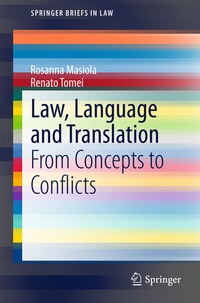
Law, Language and Translation
Description

This book is a survey of how law, language and translation overlap with concepts, crimes and conflicts. It is a transdisciplinary survey exploring the dynamics of colonialism and the globalization of crime. Concepts and conflicts are used here to mean 'conflicting interpretations' engendering real conflicts. Beginning with theoretical issues and hermeneutics in chapter 2, the study moves on to definitions and applications in chapter 3, introducing cattle stealing as a comparative theme and global case study in chapter 4. Cattle stealing is also known in English as 'rustling, duffing, raiding, stock theft, lifting and predatorial larceny.' Crime and punishment are differently perceived depending on cultures and legal systems: 'Captain Starlight' was a legendary 'duffer'; in India 'lifting' a sacred cow is a sacrilegious act. Following the globalization of crime, chapter 5 deals with human rights, ethnic cleansing and genocide. International treaties in translation set the scene for two world wars. Introducing 'unequal treaties' (e.g. Hong Kong), chapter 6 highlights disasters caused by treaties in translation. Cases feature American Indians (the 'trail of broken treaties'), Maoris (Treaty of Waitangi) and East Africa (Treaty of Wuchale).
More details
Other editions
Additional editions
Persons
Rosanna Masiola
is professor of English Language and Translation at the University for Foreigners of Perugia, Italy. She holds degrees from the Universities of Venice and Trieste, where she also taught.
Masiola worked as in-house translator with Generali, Trieste. She has published twenty books:
Questioni Traduttive
(1988),
Pianeti Proibiti.
Descrizione Traduzione Intertesti
(1997),
La traduzione è servita! Food for
Thought
(2004),
Il Fascino nel Tradurre
(2009). Masiola co-authored with Renato Tomei,
West of Eden: Botanical Discourse Contact Languages and
T
ranslation
(2009).
Introduction is co-authored; Masiola has written chapter 2 of this book
Renato Tomei is assistant professor of English Language and Translation at the University for Foreigners of Perugia, Italy. He holds a joint PhD in linguistics from the University of Addis Ababa and the University of the West Indies where he is engaged in post-doctoral research. He teaches legal English at postgraduate and doctoral level. His recent publications include Jamaican English in Ethiopia: From Africa to Africa (2014). He is the founder of Youths of the World (NGO) and is committed to cultural exchanges with Africa and the Caribbean.
Introduction is co-authored; Tomei has written chapters 3,4,5, and 6 of this book.
Content
1. Introduction.- 2. Theoretical Concepts.- 3. Definitions and Applications.- 4. A Global Crime.- 5. Conflicts and Clashes.- 6. Treaties in Translation.
