

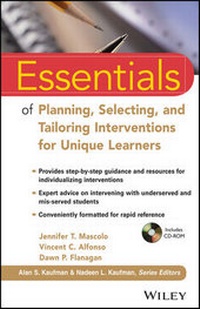
Essentials of Planning, Selecting, and Tailoring Interventions for Unique Learners
Description

More details
Other editions
Additional editions
Persons
Content
One
A Systematic Method of Analyzing Assessment Results for Tailoring Interventions (SMAARTI)
Jennifer T. Mascolo
Dawn P. Flanagan
Vincent C. Alfonso
The term intervention is one that is familiar to anyone working in a school system. Adjectives such as research-based and evidence-based when placed in front of this term elevate it to an indubitable status. This is primarily because these descriptors suggest that the intervention was subjected to a rigorous evaluation and was found to be effective, meaning that when implemented with fidelity, it leads to positive outcomes (e.g., Cooney, Huser, Small, & O'Connor, 2007; Flanagan & Alfonso, 2011).
Not surprisingly, then, evidence-based interventions are often the ones that are used first in either general or specialized instructional settings as compared to those interventions and techniques without such support. In general, it is incumbent upon practitioners to use evidence-based interventions with students who struggle academically. It is also prudent to use comprehensive interventions that can meet students' multiple manifest academic difficulties (e.g., remedial reading programs that contain the five essential components of reading; Feifer, 2011). However, it is clear from the literature that despite their overt relevancy, not all comprehensive, evidence-based interventions address the academic needs of every student effectively (e.g., Della Tofallo, 2010; Hale, Wycoff, & Fiorello, 2011).
In a tiered service delivery model, interventions are planned for and selected based on universal screening data. For example, students who are at risk for reading difficulties may receive Wilson if their reading difficulties are related primarily to decoding difficulties or Read 180 if their reading difficulties are related primarily to comprehension difficulties (e.g., Feifer, 2011, and Chapter 5, this volume). When a student does not respond as expected to evidence-based interventions, a comprehensive evaluation is often recommended to gain a better understanding of the nature of and basis for the student's learning difficulties. It is through a comprehensive and focused evaluation that the intervention process moves from planning and selecting interventions to tailoring interventions. Planning and selecting interventions is typical of a standard treatment protocol Response to Intervention (RTI) service delivery model, whereas tailoring interventions is more consistent with a problem-solving RTI model.
Planning and Selecting Interventions versus Tailoring Interventions
Planning and selecting interventions is conceptualized here as the process of identifying evidence-based interventions that are most often used in standard service delivery models to address manifest academic difficulties that are revealed via progress monitoring (e.g., a particular reading program is selected by a district as a Tier II intervention for students with reading fluency difficulties). On the other hand, a primary focus of tailoring interventions involves understanding the student's pattern of cognitive and academic strengths and weaknesses and how this pattern interacts with the instructional materials used by the student as well as classroom instructional factors, environmental factors, and other individual/situational factors that may facilitate or inhibit learning. The goals, therefore, are (a) to use information about a variety of intrinsic and extrinsic factors to tailor specific interventions; and (b) to ensure that a student has appropriate access to the curriculum by minimizing or bypassing the adverse affects that cognitive and other weaknesses have on the student's learning. Tailoring interventions may include Modification (e.g., instructional, curricular), Accommodation, Remediation, and Compensation. The acronym, MARC, can be used to assist in remembering these methods of tailoring interventions, which are defined in Rapid Reference 1.1.
Rapid Reference 1.1 Methods of Tailoring Interventions
Tailoring Method Brief Description Examples Modification Changes content of material to be taught or measured; typically involves changing or reducing learning or measurement expectations; may change the depth, breadth, and complexity of learning and measurement goals.
Reducing the amount of material that a student is required to learn
Simplifying material to be learned
Requiring only literal (as opposed to critical/inferential) questions from an end-of-chapter comprehension check
Simplifying test instructions and content
Accommodation Changes conditions under which learning occurs or is measured, but does not change or reduce learning or assessment expectations. Accommodations may include timing, flexible scheduling, presentation, setting, and response accommodations.Extending time on exams
Assigning a project in advance or allowing more time to complete a project
Aligning math problems vertically, as opposed to horizontally
Providing a separate room to work
Having a student dictate responses to a scribe
Remediation Techniques or programs used to ameliorate cognitive and academic deficits. Academic interventions typically focus on developing a skill, increasing automaticity of skills, or improving the application of skills. Cognitive interventions typically focus on improving cognitive processes such as working memory capacity and phonological processing. There are many techniques, published programs, and software designed for the purpose of remediation.Evidence-based programs listed at What Works Clearing House: http://ies.ed.gov/ncee/wwc
Reading programs appearing on the Florida Center for Reading Research website: www.fcrr.org/
Techniques and materials from the Reading Rockets website: www.readingrockets.org
CogMed (Pearson)
Spotlight on Listening Comprehension (LinguiSystems, 2006)
Compensation Procedures, techniques, and strategies that are intended to bypass or minimize the impact of a cognitive or academic deficit.Teaching the use of mnemonic devices
Organizational aids or techniques
Teaching a student to outline or use graphic organizers
A Method for Tailoring Interventions
This chapter provides a Systematic Method of Analyzing Assessment Results for Tailoring Interventions (SMAARTI). This method, as initially conceptualized by Mascolo (2008), involves the organization, analysis, and synthesis of assessment data to aid in understanding the cognitive basis of students' learning difficulties. Based on multiple data sources, the steps of SMAARTI assist in identifying various methods of tailoring intervention (i.e., MARC) that make instruction more accessible to the student, thereby improving learning. SMAARTI is used when a student fails to respond as expected to evidence-based interventions (typically those used at Tier II) and, therefore, undergoes a comprehensive evaluation that includes an assessment of cognitive functioning.
Steps of SMAARTI
SMAARTI consists of five steps (see Rapid Reference 1.2). While this method assumes that several forms of data have already been collected for a particular student and, therefore, will be viewed post-hoc, the steps of SMAARTI can also serve as a roadmap to the types of data that ought to be gathered in an initial evaluation to aid in tailoring interventions for students with unique learning needs.
Don't Forget
A comprehensive evaluation should include data from the following areas of functioning: (a) educational history and current academic performance; (b) familial factors and medical history; (c) cognitive performance (including Cattell-Horn-Carroll [CHC] ability domains and neuropsychological processes); (d) behavioral and social-emotional functioning; and (e) classroom/instructional/environmental observations. Other information that must be garnered during the course of an evaluation to ensure that interventions are practical include parent/home resources (e.g., time available to spend with student, parent interest/motivation, parents' level of language proficiency, computer in the home), student's schedule and routine, current and past interventions used, and current strategies used by the student. When necessary, a comprehensive evaluation may include assessment of cultural and linguistic factors as well as any other factors that will assist in differential diagnosis.
Rapid Reference 1.2 The Five Steps of SMAARTI
- Organize primary data using the CHC-based Data Organization and Targets for Intervention form (or DOTI form; see Table 1.1 and CD). Primary data include information from norm-referenced, standardized tests of cognitive and academic ability and neuropsychological processes and provide information about characteristics that reside mainly within the child (i.e., that are intrinsic). Examine all primary data to gain an understanding of the student's unique pattern of ability and processing strengths and weaknesses.
- Determine whether academic weaknesses are...
