

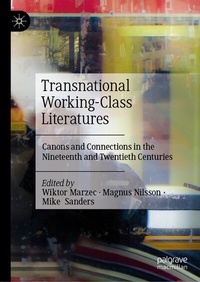
Transnational Working-Class Literatures
Description

This book offers a pioneering study of the national, transnational, and international dimensions of working-class literature. It explores both the historically and geographically varied nature of the relationship between working-class literatures and national 'canons', and the importance of international and transnational exchanges in the development of working-class literature. Through a series of detailed case studies (its sixteen essays analyse working-class literatures from the early nineteenth century to the present day and cover thirteen countries across three continents) this collection not only analyses the factors which lead to the incorporation or exclusion of working-class literature from a given national 'canon', but also traces the various ways in which working-class literatures participate in international networks of exchange. With its wide historical range, extensive geographical coverage and broad definition of working-class literature, which includes samba poetry as well as socialist realism, this collection charts new territory for the study of working-class literature.
Reviews / Votes
"This is a monumental collection with groundbreaking implications for the study of working-class literature, which has too often been viewed solely from within a limited national perspective. In its geographical scope and pluralistic definition of its subject, Transnational Working-Class Literatures: Canons and Connections in the Nineteenth and Twentieth Centuries will surely become required reading for future scholars and students and inspire further projects both in and outside the UK." (Florence Boos, Professor of English, University of Iowa, USA)
More details
Other editions
Additional editions
Persons
Wiktor Marzec is Assistant Professor at the Robert Zajonc Institute for Social Studies, University of Warsaw, Poland. His publications include, Rising Subjects: The 1905 Revolution and the Origins of Modern Polish Politics (2020) and the co-authored From Cotton and Smoke. Lódz - Industrial City and Discourses of Asynchronous Modernity, 1897-1994 (2019).
Magnus Nilsson is Professor of Comparative Literature at Malmö University, Sweden. Working-class literature is his main area of expertise. His publications include Literature and Class: Aesthetical-Political Strategies in Modern Swedish Working-Class Literature (2014) and Working-Class Literature(s): Historical and International Perspectives (two volumes, edited with John Lennon, 2017 and 2020).
Mike Sanders is Professor of Nineteenth-Century Literature and Culture at the University of Manchester, UK. Chartist literature and culture is his main area of expertise. His publications include, The Poetry of Chartism: Aesthetics, Politics, History (2009) and the co-edited collection, Subaltern Medievalisms: Medievalism 'from below' in Nineteenth-Century Britain (2021).
Content
Chapter 1: Towards the Transnational Study of Working-Class Literature.- Chapter 2: The Early German Socialist Novel: Johann-Baptist von Schweitzer's Lucinde and August Otto Walster's Am Webstuhl der Zeit.- Chapter 3: A Century of Criticism: Canon Formation and the English Working-Class Movement from the 1830s - 1930s.- Chapter 4: The Erasure of Class from Working-Class Fiction in the Modern Greek Literary Canon (1922-1989).- Chapter 5: The Construction of The Worker in Brazilian Poetry: Between Canonical Lyric and Popular Song.- Chapter 6: Romanian Working-Class Literature between critical realism and socialist realism.- Chapter 7: Proletarian Literature and the Problem of the Communalisation of Culture in Interwar Poland.- Chapter 8: People's Literature and the National Canon in Post-War Polish Literary Criticism.- Minds among the Spindles and Chevilles: Identity, Genre, and Literary Representation among New England "Mill Girls" and Lyonnaise Canuses.- Chapter 10: Global Texts as Local Weapons: Towards the Transnational Network of Proletarian Imagination in Early Twentieth-Century Finland.- Chapter 11: Links Richten (1932-1933): Dutch contribution to transnational proletarian literature.- Chapter 12: Patrícia Galvão: Militant for a Cause.- Chapter 13: The international dimension of Henry Poulaille's "Proletarian literature".- Chapter 14: Italian Working-Class Literature's Publishing Landscape, from "Il menabò" to Alegre.- Chapter 15: Ordinary People and Literary Pirouettes: Working-Class Literature in the Swedish Municipal Workers' Trade-Union Magazine Until 1970.- Chapter 16: In the Shadow of the 20th Century: Working-Class Literature in China and the Worker Poetry Journal.
