

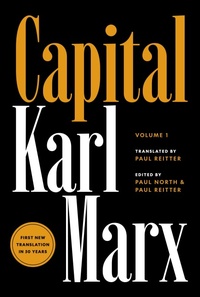
Capital
Critique of Political Economy, Volume 1
1st Edition
Published on 5. September 2024
944 pages
978-0-691-24046-6 (ISBN)
Description

Marx for the twenty-first century
The first new English translation in fifty years-and the only one based on the last German edition revised by Marx himself
Featuring extensive original commentary, including a foreword by acclaimed political theorist Wendy Brown
"An astounding achievement."-China Miéville, author of October: The Story of the Russian Revolution
Karl Marx (1818-1883) was living in exile in England when he embarked on an ambitious, multivolume critique of the capitalist system of production. Though only the first volume saw publication in Marx's lifetime, it would become one of the most consequential books in history. This magnificent new edition of Capital is a translation of Marx for the twenty-first century. It is the first translation into English to be based on the last German edition revised by Marx himself, the only version that can be called authoritative, and it features extensive commentary and annotations by Paul North and Paul Reitter that draw on the latest scholarship and provide invaluable perspective on the book and its complicated legacy. At once precise and boldly readable, this translation captures the momentous scale and sweep of Marx's thought while recovering the elegance and humor of the original source.
For Marx, our global economic system is relentlessly driven by "value"-to produce it, capture it, trade it, and, most of all, to increase it. Lifespans are shortened under the demand for ever-greater value. Days are lengthened, work is intensified, and the division of labor deepens until it leaves two classes, owners and workers, in constant struggle for life and livelihood. In Capital, Marx reveals how value came to tyrannize our world, and how the history of capital is a chronicle of bloodshed, colonization, and enslavement.
With a foreword by Wendy Brown and an afterword by William Clare Roberts, this is a critical edition of Capital for our time, one that faithfully preserves the vitality and directness of Marx's German prose and renders his ideas newly relevant to modern readers.
The first new English translation in fifty years-and the only one based on the last German edition revised by Marx himself
Featuring extensive original commentary, including a foreword by acclaimed political theorist Wendy Brown
"An astounding achievement."-China Miéville, author of October: The Story of the Russian Revolution
Karl Marx (1818-1883) was living in exile in England when he embarked on an ambitious, multivolume critique of the capitalist system of production. Though only the first volume saw publication in Marx's lifetime, it would become one of the most consequential books in history. This magnificent new edition of Capital is a translation of Marx for the twenty-first century. It is the first translation into English to be based on the last German edition revised by Marx himself, the only version that can be called authoritative, and it features extensive commentary and annotations by Paul North and Paul Reitter that draw on the latest scholarship and provide invaluable perspective on the book and its complicated legacy. At once precise and boldly readable, this translation captures the momentous scale and sweep of Marx's thought while recovering the elegance and humor of the original source.
For Marx, our global economic system is relentlessly driven by "value"-to produce it, capture it, trade it, and, most of all, to increase it. Lifespans are shortened under the demand for ever-greater value. Days are lengthened, work is intensified, and the division of labor deepens until it leaves two classes, owners and workers, in constant struggle for life and livelihood. In Capital, Marx reveals how value came to tyrannize our world, and how the history of capital is a chronicle of bloodshed, colonization, and enslavement.
With a foreword by Wendy Brown and an afterword by William Clare Roberts, this is a critical edition of Capital for our time, one that faithfully preserves the vitality and directness of Marx's German prose and renders his ideas newly relevant to modern readers.
More details
Other editions
Persons
Karl Marx (1818-1883) was a German philosopher, historian, and political economist whose critique of capitalism is considered one of the most influential developments in modern thought. Paul Reitter is professor of Germanic languages and literatures and former director of the Humanities Institute at the Ohio State University. His translations include The Autobiography of Solomon Maimon (Princeton). Paul North is the Maurice Natanson Professor of German at Yale University. His books include The Yield: Kafka's Atheological Reformation. Wendy Brown is the UPS Foundation Chair in the School of Social Science at the Institute for Advanced Study in Princeton. William Clare Roberts is associate professor of political science at McGill University.
Content
- Cover
- Table of Contents
- Foreword by Wendy Brown
- Editor's Introduction
- Translator's Preface
- On the Choice of Edition
- Quotations, Numerals, and Symbols in Marx's Text
- Preface to the 1867 Edition
- Volume One. Capital's Process of Production
- Part One. The Commodity and Money
- Chapter 1. The Commodity
- 1. The Two Factors of the Commodity: Use-Value and Value (Value-Substance, Magnitude of Value)
- 2. The Double Character of the Labor Represented in Commodities
- 3. The Value-Form or Exchange-Value
- A. Simple or Individual Value-Form
- 1. The Two Poles of a Value Expression: Relative Value-Form and Equivalent Form
- 2. Relative Value-Form
- a. The Content of the Relative Value-Form
- b. The Quantitative Determination of the Relative Value-Form
- 3. The Equivalent Form
- 4. Simple Value-Form in Its Entirety
- B. Total or Expanded Value-Form
- 1. The Expanded Relative Value-Form
- 2. The Particular Equivalent Form
- 3. The Shortcomings of the Total or Expanded Value-Form
- C. The General Value-Form
- 1. The Changed Character of the Value-Form
- 2. The Interdependent Development of the Relative Value-Form and the Equivalent Form
- 3. The Transition from the General Value-Form to the Money-Form
- D. The Money- Form
- 4. The Fetish Character of Commodities-and the Secret It Entails
- Chapter 2. The Exchange Process
- Chapter 3. Money, or Commodity Circulation
- 1. The Measure of Value
- 2. The Means of Circulation
- a. The Metamorphosis of Commodities
- b. The Circulation of Money
- c. Coin: The Symbols of Value
- 3. Money
- a. Amassing Money
- b. Means of Payment
- c. Worldwide Money
- Part Two. The Transformation of Money into Capital
- Chapter 4. The Transformation of Money into Capital
- 1. The General Formula for Capital
- 2. Contradictions in the General Formula
- 3. Buying and Selling Labor-Power
- Part Three. The Production of Absolute Surplus-Value
- Chapter 5. The Labor Process and the Valorization Process
- Chapter 6. Constant Capital and Variable Capital
- Chapter 7. The Rate of Surplus- Value
- 1. The Degree to which Labor- Power Is Exploited
- 2. The Product's Value Represented as Proportional Parts of the Product
- 3. Senior's "Last Hour
- 4. Surplus Product
- Chapter 8. The Working Day
- 1. Limits of the Working Day
- 2. The Bottomless Appetite for Surplus-Labor. Manufacturer and Boyar
- 3. Branches of English Industry Where the Law Doesn't Limit Exploitation
- 4. Day Work and Night Work. The Shift System
- 5. The Struggle for a Normal Working Day. Laws for the Compulsory Extension of the Working Day from the Middle of the Fourteenth Century to the End of the Seventeenth Century
- 6. The Struggle for a Normal Working Day. Laws that Limit Labor-Time. English Factory Legislation from 1833 to 1864
- 7. The Struggle for a Normal Working Day. The Impact of English Factory Legislation on Other Countries
- Chapter 9. The Rate and Amount of Surplus- Value
- Part Four. The Production of Relative Surplus-Value
- Chapter 10. The Concept of Relative Surplus- Value
- Chapter 11. Cooperation
- Chapter 12. The Division of Labor and the Manufacturing System
- 1. The Double Origin of the Manufacturing System
- 2. The Specialized Worker and His Tools
- 3. The Two Basic Forms of the Manufacturing System-Heterogenous and Organic
- 4. The Division of Labor in the Manufacturing System and the Division of Labor in Society
- 5. The Capitalist Character of the Manufacturing System
- Chapter 13. Machinery and Large- Scale Industry
- 1. How Machinery Developed
- 2. How Machinery Transfers Value to the Product
- 3. The Immediate Effects of Machine-Driven Production on Workers
- a. Capital's Appropriation of the Labor-Power of Supplementary Workers: Women and Children
- b. The Extension of the Workday
- c. The Intensification of Labor
- 4. The Factory
- 5. The Struggle between Workers and Machines
- 6. The Compensation Theory as It Applies to Workers Displaced by Machines
- 7. How Machine-Driven Industry Attracts and Repels Workers as It Develops. Crises in the Cotton Industry
- 8. How the Manufacturing System, Craft Labor, and Domestic Industry Are Revolutionized by Large-Scale Industry
- a. Superseding Cooperation Based on Craft Labor and the Division of Labor
- b. The Rebound Effect of the Factory System on the Manufacturing System and Domestic Industry
- c. The Modern Manufacturing System
- d. Modern Domestic Industry
- e. The Transition from the Modern Manufacturing System and Domestic Industry to Large-Scale Industry. How This Revolution Has Been Accelerated by the Application of the Factory Acts to These Modes of Industry
- 9. Factory Legislation (Hygiene and Education Clauses). The Extension of Its Jurisdiction in England
- 10. Large- Scale Industry and Agriculture
- Part Five. The Production of Absolute and Relative Surplus-Value
- Chapter 14. Absolute and Relative Surplus- Value
- Chapter 15. The Price of Labor-Power and the Magnitude of Surplus-Value Increase and Decrease
- A. The Magnitude of the Workday and the Intensity of Labor Remain Constant (fixed)
- Labor's Productive Power Varies
- B. The Magnitude of the Workday and Labor's Productive Power Are Constant, Labor's Intensity Varies
- C. Labor's Productive Power and Intensity Remain Constant, the Length of the Workday Varies
- D. Labor's Duration, Productive Power, and Intensity All Vary
- Chapter16. Different Formulas for the Rate of Surplus-Value
- Part Six. Wages
- Chapter 17. How the Value and Price of Labor-Power are Transformed into Wages
- Chapter 18. Time Wages
- Chapter 19. Piece Wages
- Chapter 20. Variations in Wages from Nation to Nation
- Part Seven. Capital's Process of Accumulation
- Chapter 21. Simple Reproduction
- Chapter 22. How Surplus- Value Is Transformed into Capital
- 1. The Capitalist Production Process on an Ever-Larger Scale. The Conversion of the Proprietary Laws of Commodity Production into the Laws of Capitalist Appropriation
- 2. Political Economy's Misunderstanding of Reproduction on an Ever-Larger Scale
- 3. The Division of Surplus-Value into Capital and Revenue. The Abstinence Theory
- 4. The Circumstances that Determine the Extent of Accumulation Independently of the Division of Surplus-Value into Capital and Revenue: The Degree to which Labor-Power Is Exploited
- Labor's Productive Power
- the Magnitude of the Capital Advanced
- the Increasing Difference between the Magnitude of the Capital Employed and the Capital Consumed
- 5. The So- Called Labor Fund
- Chapter 23. The General Law of Capitalist Accumulation
- 1. The Demand for Labor-Power Increases When Accumulation Occurs, if the Composition of Capital Stays the Same
- 2. Variable Capital Decreases in Relative Terms during the Course of Accumulation and the Concentration that Accompanies It
- 3. The Progressive Production of a Relative Surplus Population or an Industrial Reserve Army
- 4. The Relative Surplus Population in Its Various Forms of Existence. The General Law of Capitalist Accumulation
- 5. Illustrations of the General Law of Capitalist Accumulation
- a. England from 1846 to 1866
- b. The Poorly Paid Strata of Britain's Industrial Working Class
- c. The Nomadic Population
- d. How Crises Affect the Highest-Paid Members of the Working Class
- e. Britain's Agricultural Proletariat
- f. Ireland
- Chapter 24. So- Called Original Accumulation
- 1. The Secret of Original Accumulation
- 2. The Expropriation of the Rural Population's Land
- 3. Bloody Legislation against the Expropriated since the End of the Fifteenth Century. Legislation Enacted to Lower Wages
- 4. The Genesis of Capitalist Farmers
- 5. How the Agricultural Revolution Reacted on Industry. The Creation of a Domestic Market for Industrial Capital
- 6. The Genesis of Industrial Capitalists
- 7. The Historical Tendency of Capitalist Accumulation
- Chapter 25. The Modern Theory of Colonization
- Afterword
- Acknowledgments
- The French Reconstruction of Capital, 1872-75 by William Clare Roberts
- Appendix 1. Comparative Tables of Contents
- Appendix 2. The First German Edition, Published 1867
- Appendix 3. The French Translation, Published 1875
- Appendix 4. Changes toward a Third German Edition
- Sources Cited by Marx
- Notes
- Index
