

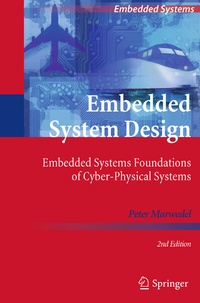
Embedded System Design
Description

Until the late 1980s, information processing was associated with large mainframe computers and huge tape drives. During the 1990s, this trend shifted toward information processing with personal computers, or PCs. The trend toward miniaturization continues and in the future the majority of information processing systems will be small mobile computers, many of which will be embedded into larger products and interfaced to the physical environment. Hence, these kinds of systems are called embedded systems. Embedded systems together with their physical environment are called cyber-physical systems. Examples include systems such as transportation and fabrication equipment. It is expected that the total market volume of embedded systems will be significantly larger than that of traditional information processing systems such as PCs and mainframes. Embedded systems share a number of common characteristics. For example, they must be dependable, efficient, meet real-time constraints and require customized user interfaces (instead of generic keyboard and mouse interfaces). Therefore, it makes sense to consider common principles of embedded system design.
Embedded System Design starts with an introduction into the area and a survey of specification models and languages for embedded and cyber-physical systems. It provides a brief overview of hardware devices used for such systems and presents the essentials of system software for embedded systems, like real-time operating systems. The book also discusses evaluation and validation techniques for embedded systems. Furthermore, the book presents an overview of techniques for mapping applications to execution platforms. Due to the importance of resource efficiency, the book also contains a selected set of optimization techniques for embedded systems, including special compilation techniques. The book closes with a brief survey on testing.
Embedded System Design can be used as a text book for courses on embedded systems and as a source which provides pointers to relevant material in the area for PhD students and teachers. It assumes a basic knowledge of information processing hardware and software. Courseware related to this book is available at http://ls12-www.cs.tu-dortmund.de/~marwedel.
More details
Other editions
Additional editions
Person
Dr. Peter Marwedel received his PhD in Physics from the University of Kiel in 1974. He is one of the early researchers in high level synthesis, working on the MIMOLA system for a number of years. Dr. Marwedel is a professor at the University of Dortmund since 1989. He has served as the chairman of the computer science department, has played a leading role in establishing the Design, Automation and Test in Europe (DATE) conference and is the chairman of the Informatik Centrum Dortmund (ICD), a technology transfer centre.
