

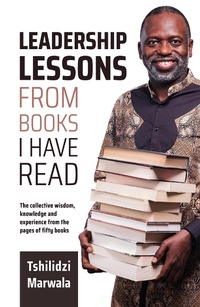
Leadership Lessons from Books I Have Read
Description

'Professor Marwala has sought to understand what good leadership should mean by drawing on the collective experience of authors who have written on many topics.' - Former President of South Africa, THABO MBEKI
We cannot underestimate how critical strong leadership is in all aspects of our lives. It enables us to run our lives, homes, communities, workplaces and nations. Given its importance, it is pertinent to ask: What is the source of good leadership?
Albert Einstein once said, 'The only source of knowledge is experience.' Many philosophers have observed this and, if we accept experience as the only source of knowledge, can we extend this conclusion to leadership? Or is the basis of good leadership intuition or instinct? Or is it perhaps a combination of these?
In Leadership Lessons From Books I Have Read, Tshilidzi Marwala adopts the thesis that the source of good leadership is knowledge, and the source of knowledge is experience, which can take many forms: reading widely, listening, and engaging in discussion and debate with other knowledge seekers.
If leadership is derived from knowledge and knowledge is derived from experience, the 'experience' in this book is from 50 books that Tshilidzi has read, and so the source of knowledge informing leadership is the collective experience of the more than 50 accomplished authors who wrote those books including, among others, Chinua Achebe, Thomas Sankara, NoViolet Bulawayo, Nelson Mandela, Mandla Mathebula, Eugène Marais, Chimamanda Ngozi Adichie, Jean-Jacques Rousseau, Daniel Kahneman, Karl Marx, Ngugi wa Thiong'o, Nassim Taleb and Aristotle.
Divided into four sections, Tshilidzi shares his leadership lessons in the areas of Africa and the diaspora, the search for the ideal polity, science, technology and society, and the leadership of nations.
'Those who do not read, should not lead.' - THILIDZI MARWALA
More details
Content
- Intro
- Title page
- Imprint page
- Foreword Thabo Mbeki
- Chapter 1 Introduction
- SECTION A AFRICA AND THE DIASPORA
- Chapter 2 Lessons from Heart of Darkness by Joseph Conrad
- Chapter 3 Lessons from Things Fall Apart by Chinua Achebe
- Chapter 4 Lessons from The Beautyful Ones Are Not Yet Born by Ayi Kwei Armah
- Chapter 5 Lessons from Decolonising the Mind by Ngugi wa Thiong'o
- Chapter 6 Lessons from Women's Liberation and the African Freedom Struggle by Thomas Sankara
- Chapter 7 Lessons from Beloved by Toni Morrison
- Chapter 8 Lessons from A Handbook of the Venda Language by Ziervogel, Wentzel and Makuya
- Chapter 9 Lessons from Long Walk to Freedom by Nelson Mandela
- Chapter 10 Lessons from Purple Hibiscus by Chimamanda Ngozi Adichie
- Chapter 11 Lessons from Unbowed by Wangari Maathai
- Chapter 12 Lessons from Americanah by Chimamanda Ngozi Adichie
- Chapter 13 Lessons from We Need New Names by NoViolet Bulawayo
- Chapter 14 Lessons from The Backroom Boy by Mandla Mathebula
- Chapter 15 Lessons from This Mournable Body by Tsitsi Dangarembga
- Chapter 16 Lessons from Africa's Business Revolution by Leke, Chironga and Desvaux
- Chapter 17 Lessons from The Perfect Nine by Ngugi wa Thiong'o
- SECTION B SEARCHING FOR THE IDEAL POLITY
- Chapter 18 Lessons from The Republic by Plato
- Chapter 19 Lessons from Politics by Aristotle
- Chapter 20 Lessons from How to Win an Electio by Quintus Tullius Cicero
- Chapter 21 Lessons from The Prince by Niccolò Machiavelli
- Chapter 22 Lessons from The Social Contract by Jean-Jacques Rousseau
- Chapter 23 Lessons from The Age of Reason by Thomas Paine
- Chapter 24 Lessons from A Tale of Two Cities by Charles Dickens
- Chapter 25 Lessons from The Eighteenth Brumaire of Louis Bonaparte by Karl Marx
- Chapter 26 Lessons from The Protestant Ethic and the Spirit of Capitalism by Max Weber
- Chapter 27 Lessons from The Twelve Who Ruled by R.R. Palmer
- Chapter 28 Lessons from The Open Society and its Enemies by Karl Popper
- Chapter 29 Lessons from 1984 by George Orwell
- Chapter 30 Lessons from Eichmann in Jerusalem: A Report on the Banality of Evil by Hannah Arendt
- Chapter 31 Lessons from Caste by Isabel Wilkerson
- SECTION C ON SCIENCE, TECHNOLOGY AND SOCIETY
- Chapter 32 Lessons from The Soul of the White Ant by Eugène Marais
- Chapter 33 Lessons from The Structure of Scientific Revolutions by Thomas Kuhn
- Chapter 34 Lessons from Irrational Exuberance by Robert Shiller
- Chapter 35 Lessons from Guns, Germs, and Steel by Jared Diamond
- Chapter 36 Lessons from Nudge by Richard Thaler and Cass Sunstein
- Chapter 37 Lessons from Deep Fakes by Nina Schick
- Chapter 38 Lessons from Thinking, Fast and Slow by Daniel Kahneman
- Chapter 39 Lessons from Homo Deus by Yuval Harari
- Chapter 40 Lessons from The Amazon Way on IoT by John Rossman
- Chapter 41 Lessons from Deep Medicine by Eric Topol
- Chapter 42 Lessons from Superintelligence by Nick Bostrom
- Chapter 43 Lessons from Profiles in Corruption by Peter Schweizer
- Chapter 44 Lessons from Fooled by Randomness by Nassim Taleb
- Chapter 45 Lessons from The Economic Singularity by Calum Chace
- Chapter 46 Lessons from Range by David Epstein
- Chapter 47 Lessons from COVID-19 by Michael Mosley
- SECTION D ON LEADING NATIONS
- Chapter 48 Lessons from Deng Xiaoping and the Transformation of China by Ezra Vogel
- Chapter 49 Lessons from The Governance of China by Xi Jinping
- Chapter 50 Lessons from Leadership in Turbulent Times by Doris Kearns Goodwin
- Chapter 51 Lessons from A Promised Land by Barack Obama
- Chapter 52 Conclusion: 50 Leadership Lessons from Books I Have Read
- LIST OF ACRONYMS
- ACKNOWLEDGEMENTS
- ABOUT THE AUTHOR
- YouTube Videos
- Endnotes
