

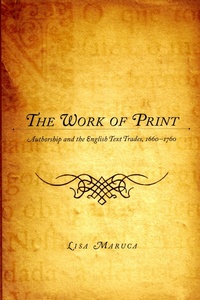
The Work of Print
Description

The Work of Print traces a shift in the very definition of literature, from one that encompasses the material conditions of the production and distribution of books to the more familiar emphasis on the solitary author's ownership of an abstract text. Drawing on contemporary accounts of those involved in the trade - printers, booksellers, publishers, and distributors - Lisa Maruca examines attitudes about the creative process and approaches to the commodification of writing. The "work of print" describes the labors through which literature was produced: both the physical labor of making books and the underlying cultural work performed by a set of ideologies about who counted as a maker of texts.
Printers' manuals, tracts on typography, legal documents, and booksellers' autobiographies reveal that print workers conceived of their roles as central to the production of literature. Maruca's insightful readings of these documents alongside traditional works of fiction and authors' correspondence show that the claims of print workers and booksellers were part of a struggle for ownership and control as the concept of author as proprietor of his or her intellectual property began to take hold in the mid-1700s, gradually eclipsing print workers' contributions to the process of textual creation.
The print trade asserted its authority using a rhetoric of hierarchical and binary sexuality and gender, which affected women working in the industry and limited the type of work they were allowed to perform. In response, women developed strategies to redeploy conventional ideas of gender to gain concessions for themselves as publishers and distributors of printed material, strategies that formed a foundation for the rise of female authorship later in the eighteenth century.
Encompassing the histories of literature, labor, technology, publishing, and gender, The Work of Print ultimately offers significant insights into the ideology of authorship and intellectual property and our understanding of textuality and print in the digital age.
More details
Other editions
Additional editions
Person
Lisa Maruca is associate professor of English at Wayne State University in Detroit.
Content
Acknowledgments
1. Introduction: Printing Production Values
2. Printers' Manuals and the Bodies of Type
3. Citizen, Hero, or Midwife? Re-presenting the Bookseller
4. From Authorized Print to Authoritative Author: The Regulated Trade
5. The Printer as Author: Samuel Richardson, Intellectual Property, and the Feminine Text
6. The Ghost in the Machine: Invisible Print in a Digital Age
Notes
Bibliography
Index
