

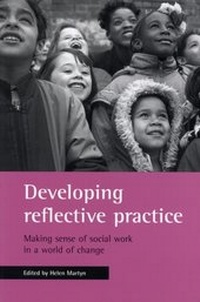
Developing reflective practice
Making sense of social work in a world of change
1st Edition
Published on 28. June 2000
248 pages
978-1-84742-510-2 (ISBN)
Description

Developing reflective practice is an invaluable resource, employing a unique 'bottom-up' approach to learning. Vivid examples of social work practice with children and families are presented, providing real life illustrations of the dilemmas and challenges facing practitioners.
Educators and practitioners provide analytic commentaries on course work submitted by social workers studying on a post-qualifying programme, indicating what went well, what didn't go well, and where improvements might have been made.
Implications for policy and practice from the perspective of the middle manager are provided, along with a list of learning points.
Developing reflective practice is essential reading for students (on how to realise practice in a course work context), teachers (on how to assess course work and enhance practice performance), practitioners (on how to approach specific pieces of work) and managers/supervisors (on how to promote best practice), providing standards for both training and practice rooted in the reality of the workplace.
Educators and practitioners provide analytic commentaries on course work submitted by social workers studying on a post-qualifying programme, indicating what went well, what didn't go well, and where improvements might have been made.
Implications for policy and practice from the perspective of the middle manager are provided, along with a list of learning points.
Developing reflective practice is essential reading for students (on how to realise practice in a course work context), teachers (on how to assess course work and enhance practice performance), practitioners (on how to approach specific pieces of work) and managers/supervisors (on how to promote best practice), providing standards for both training and practice rooted in the reality of the workplace.
Reviews / Votes
"... an important contribution to our understanding of reflective practice in work with children and families." British Journal of Social Work "This book achieves its aim of commencing from the practice of the workplace, linking practice to theory, and critically examining this. It provides a wealth of material for social workers, policy makers and managers, who need to ground their work and judgements within theory and accredited and proven practice, and who need to shape services to match need." Alison Williams, Reviewing Officer for Looked After Children, Royal Borough of Kensington and ChelseaMore details
Edition
First Edition
Language
English
Place of publication
Bristol
United Kingdom
Publishing group
Bristol University Press
Target group
Professional and scholarly
Illustrations
Not illustrated
ISBN-13
978-1-84742-510-2 (9781847425102)
DOI
https://doi.org/10.51952/9781847425102
Copyright in bibliographic data and cover images is held by Nielsen Book Services Limited or by the publishers or by their respective licensors: all rights reserved.
Schweitzer Classification
Other editions
Additional editions
Book
06/2000
1st Edition
Policy Press
€39.60
Shipment within 15-20 days
Person
Helen Martyn was formerly Lecturer in Social Work, Goldsmith College, University of London.
Content
Introduction ~ Helen Martyn.
Part One: Direct work with children and young people: Introduction ~ Helen Martyn; Case studies: James: moving on to independent living ~ Patrick Lonergan; Eve: from victim to healthy survivor? ~ Mary Cody; Amos and Christopher: working towards care proceedings ~ Michael O'Dempsey; Carol: moving to a permanent placement ~ Stephen Kitchman; Sarah: understanding and containing damage and disturbance? ~ Veronique Faure; Commentary from an academic perspective ~ Kate Wilson; Commentary from a practitioner perspective ~ Rosemary Gordon; Learning points ~ Rosemary Gordon.
Part Two: Direct work with families: Introduction ~ Helen Martyn; Case studies: The Phillips family: an adoption assessment ~ Mary Cody; The Drays: breaking the pattern of reactive behaviour ~ Stephen Kitchman; The Reids: putting boundaries in place ~ Michael Atkinson; The Green family: work with a lone parent and her children ~ Patrick Lonergan; Carol, Anna and Khadia: work with a three generation black family ~ Veronique Faure; Commentary from an academic perspective ~ Jane Dutton; Commentary from a practitioner perspective ~ Sigurd Reimers; Learning points ~ Helen Martyn.
Part Three: Implications for policy and practice: A management perspective ~ Patrick Kidner.
Part One: Direct work with children and young people: Introduction ~ Helen Martyn; Case studies: James: moving on to independent living ~ Patrick Lonergan; Eve: from victim to healthy survivor? ~ Mary Cody; Amos and Christopher: working towards care proceedings ~ Michael O'Dempsey; Carol: moving to a permanent placement ~ Stephen Kitchman; Sarah: understanding and containing damage and disturbance? ~ Veronique Faure; Commentary from an academic perspective ~ Kate Wilson; Commentary from a practitioner perspective ~ Rosemary Gordon; Learning points ~ Rosemary Gordon.
Part Two: Direct work with families: Introduction ~ Helen Martyn; Case studies: The Phillips family: an adoption assessment ~ Mary Cody; The Drays: breaking the pattern of reactive behaviour ~ Stephen Kitchman; The Reids: putting boundaries in place ~ Michael Atkinson; The Green family: work with a lone parent and her children ~ Patrick Lonergan; Carol, Anna and Khadia: work with a three generation black family ~ Veronique Faure; Commentary from an academic perspective ~ Jane Dutton; Commentary from a practitioner perspective ~ Sigurd Reimers; Learning points ~ Helen Martyn.
Part Three: Implications for policy and practice: A management perspective ~ Patrick Kidner.
