

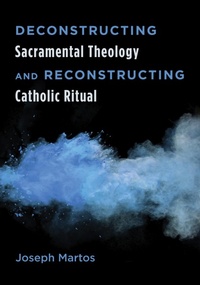
Deconstructing Sacramental Theology and Reconstructing Catholic Ritual
Published on 12. May 2015
326 pages
978-1-4982-2180-1 (ISBN)
Description

Catholic sacramental doctrine has lost much of its credibility. Baptized people leave the church, adolescents stop attending shortly after they are confirmed, supposedly indissoluble marriages regularly dissolve, few go to confession, and many do not believe in transubstantiation.
Drawing upon his decades-long study of the sacraments, Martos reveals how teachings that seemed rooted in the scriptures and Catholic life have become unmoored from the contexts in which they arose, and why seemingly eternal truths are actually historically relative.
After carefully constructing Catholic teaching from the church's own documents, he deconstructs it by demonstrating how biblical passages were misconstrued by patristic authors and how patristic writings were misunderstood by medieval scholastics. The long process of misinterpretation culminated in the dogmatic pronouncements of the Council of Trent, which continues to dominate Catholic thinking about the church's religious ceremonies. If the sacraments are released from their dogmatic baggage, Martos believes that the spiritual realities they symbolize can be celebrated in any human culture without being tied to their traditional rites.
More details
Other editions
Additional editions
Book
05/2015
Wipf & Stock Publishers
€37.50
Shipment within 15-20 days
Book
05/2015
Wipf & Stock Publishers
€63.80
Shipment within 15-20 days
Person
Joseph Martos is a retired professor of philosophy and theology who has been a visiting professor or guest lecturer at more than two dozen universities and seminaries during his lengthy career. He is the author of Doors to the Sacred: A Historical Introduction to Sacraments in the Catholic Church (1981, 1991, 2001, 2014) and The Sacraments: An Interdisciplinary and Interactive Study (2009).
Content
- Intro
- Title Page
- Preface
- Introduction
- A Note about Footnotes
- I. The Construct
- 1. Catholic Doctrine in Church Documents
- 2. Scholastic Sacramental Theology before Vatican II
- 3. Scholastic Sacramental Theology after Vatican II
- 4. Conclusion
- II. Construction
- 1. Sacramental Theology in Historical Perspective
- 2. Sacraments in a Literal Reading of the Scriptures
- 3. Sacraments in the Writings of the Church Fathers
- 4. Sacraments in Medieval Theology
- 5. Sacraments in Modern Theology
- 6. Conclusion
- III. Deconstruction
- 1. Sacraments in the Christian Scriptures
- 2. Sacraments in the Second and Third Centuries
- 3. Sacraments in the Christian Roman Empire
- 4. Sacraments in the Dark Ages
- 5. Sacraments in the High Middle Ages
- 6. Complex History and Theological Method
- IV. Reconstruction
- 1. Symbols and Meaning
- 2. Meaning and Context
- 3. Reality and Symbol
- 4. Dimensions of meaning
- 5. Toward an Authentic Future
- 6. Sacraments and Sacramentality
- A Summary of the Argument
- Introduction and Chapter 1
- Chapter 2
- Chapter 3
- Chapter 4
- Bibliography
