

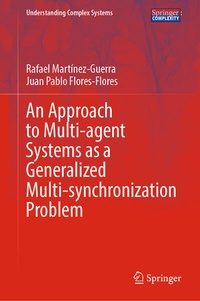
An Approach to Multi-agent Systems as a Generalized Multi-synchronization Problem
Description

This book addresses the problem of multi-agent systems, considering that it can be interpreted as a generalized multi-synchronization problem. From manufacturing tasks, through encryption and communication algorithms, to high-precision experiments, the simultaneous cooperation between multiple systems or agents is essential to successfully carrying out different modern activities, both in academy and industry. For example, the coordination of multiple assembler robots in manufacturing lines. These agents need to synchronize.
The first two chapters of the book describe the synchronization of dynamical systems, paying special attention to the synchronization of non-identical systems. Following, the third chapter presents an interesting application of the synchronization phenomenon for state estimation. Subsequently, the authors fully address the multi-agent problem interpreted as multi-synchronization. The final chapters introduce the reader to a more complex problem, the synchronization of systems governed by partial differential equations, both of integer and fractional order.
The book aimed at graduates, postgraduate students and researchers closely related to the area of automatic control. Previous knowledge of linear algebra, classical and fractional calculus is requested, as well as some fundamental notions of graph theory.
Reviews / Votes
"I find the book very interesting, well written and useful. It covers a broad field of synchronization problems, from relatively simple ones to those which are very complicated, and relates those problems to some other problems in control theory and related fields. It is a nice addition to any control theorist's technical library, no doubt." (Milan Rade Rapaic, Mathematical Reviews, April, 2024)
More details
Other editions
Additional editions
Persons
Rafael Mart í nez-Guerra obtained the B.Sc. degree in Physics and Mathematics from the National Polytechnic Institute (IPN), Mexico City (Mexico) and the M.Sc. degree in Automatic Control from CINVESTAV-IPN (Center for Research and Advanced Studies of IPN), Mexico City. He also got a M.Sc. degree in Mathematics and Automatic from Ecole des Mines, Paris (France) and earned his Ph.D. Degree from the Universidad Autónoma Metropolitana in 1996. Currently, he is a Researcher at the Automatic Control Department of the CINVESTAV-IPN and a Member of the National System Researchers since 1992 (Level 3, now).
He is author and co-author of more than 90 papers in international journals and more than 140 contributions in international conference proceedings. He is co-author of 9 books.
His main research interests are in the areas of nonlinear systems, differential geometric and differential algebraic methods, fractional nonlinear observers, fractional fault detection and diagnosis, secure communications, fractional synchronization and chaos.
Juan Pablo Flores-Flores obtained the B.Sc. degree as Aerospace Engineer from the National Polytechnic Institute (IPN) and the M.Sc. degree in Control Theory from the Automatic Control Department of CINVESTAV-IPN (Center for Research and Advanced Studies of IPN). He earned his Ph.D. from the same institution in 2022.
He is co-author of the book Encryption and Decryption Algorithms for Plain Text and Images using Fractional Calculus (Springer, 2023) and has published research papers in international journals and conference proceedings.
His main research interests are nonlinear systems, differential algebra methods, partial differential equations systems and integer and fractional synchronization of nonlinear systems.
