

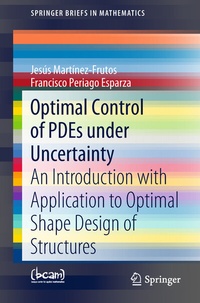
Optimal Control of PDEs under Uncertainty
Description

This book provides a direct and comprehensive introduction to theoretical and numerical concepts in the emerging field of optimal control of partial differential equations (PDEs) under uncertainty. The main objective of the book is to offer graduate students and researchers a smooth transition from optimal control of deterministic PDEs to optimal control of random PDEs. Coverage includes uncertainty modelling in control problems, variational formulation of PDEs with random inputs, robust and risk-averse formulations of optimal control problems, existence theory and numerical resolution methods. The exposition focusses on the entire path, starting from uncertainty modelling and ending in the practical implementation of numerical schemes for the numerical approximation of the considered problems. To this end, a selected number of illustrative examples are analysed in detail throughout the book. Computer codes, written in MatLab, are provided for all these examples. This book isadressed to graduate students and researches in Engineering, Physics and Mathematics who are interested in optimal control and optimal design for random partial differential equations.
Reviews / Votes
"The main objective of the book is to provide graduate students and researchers with a smooth transition from optimal control of deterministic PDEs to optimal control of random PDEs." (Mathematical Reviews, November, 2019)More details
Other editions
Additional editions
Persons
Jesús Martínez-Frutos obtained his PhD from the Technical University of Cartagena, Spain, in 2014 and is currently Assistant Professor in the Department of Structures and Construction and a member of the Computational Mechanics and Scientific Computing group at the Technical University of Cartagena, Spain. His research interests are in the field of robust optimal control, structural optimization under uncertainty, efficient methods for high-dimensional uncertainty propagation and high-performance computing using GPUs, with special focus on industrial applications.
Francisco Periago Esparza completed his PhD at the University of Valencia, Spain, in 1999. He is currently Associate Professor in the Department of Applied Mathematics and Statistics and a member of the Computational Mechanics and Scientific Computing group at the Technical University of Cartagena, Spain. His main research interests include optimal control, optimal design and controllability, both at the theoretical level and for applications to engineering problems. During recent years his research has focused on optimal control for random PDEs.
Content
1 Introduction.- 2 Mathematical Preliminaires.- 3 Mathematical Analysis of Optimal Control Problems Under Uncertainty.- 4 Numerical Resolution of Robust Optimal Control Problems.- 5 Numerical Resolution of Risk Averse Optimal Control Problems.- 6 Structural Optimization Under Uncertainty.- 7 Miscellaneous Topics and Open Problems.
