

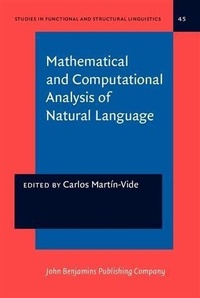
Mathematical and Computational Analysis of Natural Language
Selected papers from the 2nd International Conference on Mathematical Linguistics (ICML '96), Tarragona, 1996
1st Edition
Published on 15. October 1998
XVIII, 391 pages
978-90-272-8227-9 (ISBN)
Description

In the last decade, computational linguistics has produced a revival of the interest in the mathematical study of the various levels of human language. This volume contains a selection of recent research papers approaching mathematical and computational topics in natural languages, with a special attention being paid to syntax and semantics. According with their main focus, the papers are distributed into four parts: Syntax, Semantics, Natural language processing and Varia, which cover a vast range of problems. The book may be of interest to all those who intend to know which kind of mathematics is used when giving account of natural language, as well as to people working on computational issues involving human-machine interaction.
More details
Other editions
Additional editions

Carlos Martin-Vide
Mathematical and Computational Analysis of Natural Language
Selected papers from the 2nd International Conference on Mathematical Linguistics (ICML '96), Tarragona, 1996
Book
10/1998
John Benjamins Publishing Co
€137.80
Shipment within 10-15 days
Person
Content
- MATHEMATICAL AND COMPUTATIONAL ANALYSIS OF NATURAL LANGUAGE
- Editorial page
- Title page
- Copyright page
- Foreword
- Table of contents
- List of Contributors
- PART I: SYNTAX
- The Degree of Parallelism in Contextual Grammars with the Minimal Competence Strategy
- Abstract
- Introduction
- Basic definitions
- A comparison with the index measure
- Some properties of the degree of parallelism
- References
- The Syntactic Complexity of Internal Contextual Grammars and Languages
- Abstract
- Introduction
- Definitions and basic notions
- Compatibility problem
- References
- On Ambiguity in Internal Contextual Languages
- Abstract
- Introduction
- Basic definitions
- Contextual grammars without choice
- Determinism
- The one-letter case
- Final remarks
- References
- Linguistic and semiotic preliminaries to contextual grammars
- References
- Attempting to Define the Ambiguity of Internal Contextual Languages
- Abstract
- Introduction
- Internal contextual grammars. Ambiguity
- The existence of inherently ambiguous languages
- The undecidability of ambiguity
- A new type of ambiguity: intrinsic ambiguity
- Final remarks
- References
- Variantsof Parallel Communicating Grammar Systems
- Abstract
- Introduction
- Basic PC grammar systems
- Variants
- Final remarks
- References
- On Contextual Automata
- Abstract
- Introduction
- Contextual grammars
- Contextual automata
- References
- PART II: SEMANTICS
- Nonassociative and Commutative Categorial Grammars and their Languages
- References
- Words as Modules: a Lexicalised Grammar in the framework of Linear Logic Proof Nets
- Abstract
- Introduction
- Linear logic and word order
- Proof nets for pomset logic
- Labels for expressing and computing word order
- Lexicalised intuitionistic labelled partial proof-nets
- Gates and modifiers
- Discontinuous constituents
- Conclusion
- References
- A Metagrammatical Logical Formalism
- Introduction
- Notations for metagrammatical concepts
- Formal rules for metagrammatical representations
- Conclusions
- References
- Word Meaning, Logic and the Informative Entailment Relation
- Dynamic theories of meaning and lexical relations
- The language L and its semantics
- Informative content of sentences and the informative entailment relation
- Informative structures. A relevant calculus for informative contents
- References
- AccessibleSimilarWorlds and French Coherent Infinitival Constructions
- Introduction
- The data and the apparent paradox
- Analysing the direct/indirect contrast: Necessary versus probable cause
- References
- PART III: NATURAL LANGUAGE PROCESSING
- MachineTranslationof Motion Verbs from English into Spanish
- Abstract
- Motion events in English and Spanish
- JULIETTA
- Translating motion verbs with JULIETTA
- Notes
- References
- On the Complexity of Pronominal Anaphora Resolution in Machine Translation
- Introduction: Latest developments in anaphora resolution
- Anaphora in Machine Translation
- A workable example
- Improvement of the model
- References
- An Interval Algebra for Temporal Relations Conveyed by a Text
- Abstract
- Introduction
- The pragmatic interpretation of sentence tense and aspect
- The AI5 algebra
- Conclusions
- References
- Approximate Reasoning about Natural Language: A Certain Distributional-Mereological Model
- Abstract
- Introduction
- Distributional models
- Knowledge abstraction from a text
- References
- Bidirectional and Event-Driven Parsing with Multi Virtual Trees
- Abstract
- Bidirectional, event-driven and bottom-up parsing, with top-down predictions, based on multi virtual trees
- Mathematical foundations
- Bidirectional parsing and the plane of analysis
- Event driven parsing and multi virtual trees
- Experimental results
- Conclusion
- References
- An LALR Extension for DCGs in Dynamic Programming
- Abstract
- Introduction
- The general framework
- Improving sharing and efficiency
- Complexity bounds
- A comparison with previous works
- Experimental results
- Conclusion
- Acknowledgments
- References
- PART IV: VARIA
- Parsing Unrestricted Text into Prosodic Units. A Formal Description
- 1 Introduction
- 2 The empirical facts
- 2.1 Units
- 2.2 A definition of pause
- 2.3 Constraints guiding pause location
- 3 A formal description
- 3.1 Concepts
- 3.2 Formal description of the algorithm
- 4 Evaluating the methodology
- 5 Conclusions
- Notes
- References
- On Some Fundamental Concepts of Mathematical Linguistics: Means and Functional Domains
- Abstract
- Outline of basic concepts
- Scope of the paper
- Natural language illustration
- Illustration from first-order logic
- Comparison between the structure of FOL and natural languages
- Notes
- Abbreviations
- References
- A Model of Personal Pronouns
- Abstract
- The basic communication model
- Features of mathematical personal pronouns
- Cardinality
- Encoding of mathematical personal pronouns
- Relations between personal pronouns
- Encoding of binary relations
- References
- A Mathematical Model for the Post-Creole Continuum in Hawaii
- Introduction
- A mathematical model for HPCC lects
- Notes
- References
- Intaxis: aSyntactical Model of Intonation
- Abstract
- Introduction
- Word order
- Models
- Generalisations of SIM and PBM
- Conclusions
- References
- An Information-Based Treatment of Punctuation in Discourse Representation Theory
- Abstract
- Introduction
- Punctuation and discourse representation theory
- Asher's extension and its adaptation to modeling punctuation
- Conclusion
- Acknowledgments
- Notes
- References
- Author Index
- Subject Index
