

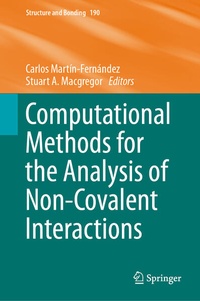
Computational Methods for the Analysis of Non-Covalent Interactions
Description

This volume showcases state-of-the-art computational methodologies for the description and analysis of non-covalent interactions. Each chapter focusses on a specific approach, outlining a theoretical framework for the method in hand that is then illustrated by cutting-edge applications. A range of energy decomposition analyses and real-space topological and geometrical schemes are covered, providing a menu of approaches from which to draw insight into non-covalent interactions. The book serves as a comprehensive resource for computational chemists, as well as experimental chemists seeking to understand how computational techniques can be applied in their research.
More details
Other editions
Additional editions
Persons
Carlos Martín-Fernández obtained his PhD from KU Leuven (Belgium) under the supervision of Profs. Jeremy Harvey and Kristine Pierloot studying the electronic structure of transition metal complexes with DFT and ab initio methods. Before that, he studied the Erasmus Mundus Master's in Theoretical Chemistry and Computational Modelling (EMTCCM) in Universidad Autónoma de Madrid (Spain) and worked as a predoctoral researcher at CSIC with Prof. Ibon Alkorta. His research expertise includes the application of high-level computational methods (both ab initio and DFT) to the study of (bio)inorganic chemistry, with a focus on transition metal complexes, chemical bonding, and non-covalent interactions.
Stuart Macgregor obtained his PhD degree from the University of Edinburgh working on the structural and electrochemical properties of metallaboranes. He was awarded a NATO Western European Fellowship to work with Odile Eisenstein in Orsay, where he first encountered DFT. After a post-doctoral position at ANU, Canberra, he took up a lectureship at Heriot-Watt University, Edinburgh, where he was promoted to full Professor in 2009. In 2024 he was appointed Chair of Computational Inorganic Chemistry at the University of St. Andrews. Stuart's research uses computational methods to model the structure and reactivity of transition metal systems in both solution and the solid state. He works in close collaboration with experimentalists and targets applications in catalysis. He received the 2019 RSC Ludwig Mond Award for work on the mechanisms of C-H and C-F activation and the organometallic chemistry of s-alkane complexes in the solid state.
Content
Interpreting Non Covalent Bonds with the Block Localized Wave Function (BLW) Method.- Local Energy Decomposition of Coupled Cluster Energies Principles and Applications.- Electron Density based Energy Decomposition Analysis from QM to QM/MM calculations.- GKS EDA method for intermolecular interactions in complex systems.- SAPT and many body dispersion: Intermolecular interactions at cubic scaling cost.- Survey of contemporary applications of Quantum Chemical Topology.- The Interpenetration Index and its applications in chemistry.- Exhibiting noncovalent interactions in dynamic environments using aIGM method.
