

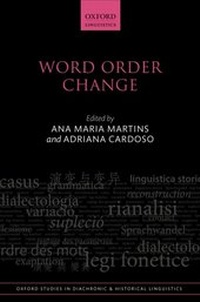
Word Order Change
1st Edition
Published on 7. June 2018
336 pages
978-0-19-106446-3 (ISBN)
Description

This volume explores word order change within the framework of diachronic generative syntax. Word order is at the core of natural language grammatical systems, linking syntax with prosody and with semantics and pragmatics. The chapters in this volume use the tools provided by the generative theory of grammar to examine the constrained ways in which historical word order variants have given way to new ones over time. Following an introduction by the editors, the book is divided into four parts that investigate changes regarding the targets for movement within the clausal functional hierarchy; changes (or stability) in the nature of the triggers for movement; verb movement into the left peripheries; and types of movement, with specific focus on word order change in Latin. Data are drawn from a wide variety of languages from different families and from both classical and modern periods, including Sanskrit, Tocharian, Italian, Portuguese, Dutch, Irish, Hungarian, and Coptic Egyptian. The book's broad coverage and combination of language-internal and comparative studies offers new perspectives on the relation between word order change and syntactic movement. The volume also provides a range of wider insights into the properties of natural language and the way in which those properties constrain language variation and change.
More details
Other editions
Additional editions

Ana Maria Martins | Adriana Cardoso
Word Order Change
Software
07/2018
Oxford University Press, USA
€102.02
Shipment within 15-20 days
Ana Maria Martins | Adriana Cardoso
Word Order Change
Book
06/2018
Oxford University Press
€145.50
Shipment within 15-20 days
Persons
Ana Maria Martins is Professor at the School of Arts and Humanities at the University of Lisbon. Her research in comparative syntax and historical syntax covers topics such as word order, clitics, negation, emphatic polarity, infinitival structures, and passive and impersonal constructions. She has directed projects resulting in parsed corpora for the study of the syntax of European Portuguese dialects (CORDIAL-SIN) and the syntax of Old Portuguese (WOChWEL). She has published articles in journals such as Lingua, Natural Language and Linguistic Theory, and Linguistic Inquiry, and is the editor of Manual de Linguística Portuguesa (De Gruyter, 2016) and co-editor of the journal Estudos de Lingüística Galega.
Adriana Cardoso is Assistant Professor at the Higher Education College of Lisbon (ESELx) and researcher at the Linguistics Centre of the University of Lisbon (CLUL). Her main research interests are historical linguistics, comparative syntax, and educational linguistics. She was recently involved in the WOChWEL project (Word Order and Word Order Change in Western European Languages), sponsored by the Portuguese National Science Agency. Her book Portuguese Relative Clauses in Synchrony and Diachrony was published in 2017 by OUP.
Content
- 1: Ana Maria Martins and Adriana Cardoso: Word order change from a diachronic generative syntax perspective
- Part I Targets for movement: Changes in the functional architecture of the clause
- 2: Moreno Mitrovic: Configurational change in Indo-European coordinate constructions
- 3: Adriana Cardoso: Discontinuous noun phrases and remnant-internal relativization in the diachrony of Portuguese
- 4: Julia Bacskai-Atkari: The relative cycle in Hungarian declaratives
- 5: Barbara Egedi: Word order change at the left periphery of the Hungarian noun phrase
- Part II Triggers for movement: Changes in nature or stability
- 6: Veronika Hegedus: Particle-verb order in Old Hungarian and complex predicates
- 7: Judy B. Bernstein: An effect of residual T-to-C movement in varieties of English
- 8: Cara M. DiGirolamo: Word order and information structure in the Würzburg Glosses
- Part III Verb movement into the left peripheries
- 9: Charlotte Galves and Alba Gibrail: Subject inversion in transitive sentences from Classical to Modern European Portuguese: A corpus-based study
- 10: Chris H. Reintges and Sonia Cyrino: Analyticization and the syntax of the synthetic residue
- 11: Gertjan Postma: Loss of laten-support in embedded infinitivals in fifteenth-century Low Saxon
- 12: Jacopo Garzonio and Cecilia Poletto: The distribution of quantifiers in Old and Modern Italian: Everything or nothing
- Part IV Types of movement and its constraints: Word order change in Latin
- 13: Lieven Danckaert: The decline of Latin VOAux: Neg-incorporation and syntactic reanalysis
- 14: Adam Ledgeway: On the decline of edge-fronting from Latin to Romance
