

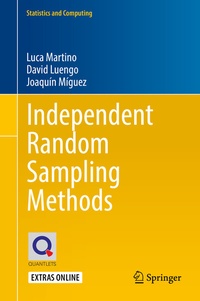
Independent Random Sampling Methods
Description

This book systematically addresses the design and analysis of efficient techniques for independent random sampling. Both general-purpose approaches, which can be used to generate samples from arbitrary probability distributions, and tailored techniques, designed to efficiently address common real-world practical problems, are introduced and discussed in detail. In turn, the monograph presents fundamental results and methodologies in the field, elaborating and developing them into the latest techniques. The theory and methods are illustrated with a varied collection of examples, which are discussed in detail in the text and supplemented with ready-to-run computer code.
The main problem addressed in the book is how to generate independent random samples from an arbitrary probability distribution with the weakest possible constraints or assumptions in a form suitable for practical implementation. The authors review the fundamental results and methods in the field, address the latest methods, and emphasize the links and interplay between ostensibly diverse techniques.
Reviews / Votes
"The book contains more than 300 references and has more than 50 coloured figures for better understanding. The book can be recommended to all readers, who are interested in this field, e.g. 'engineers working in signal theory or statisticians interested in computational methods or scientists working in the fields of biology, quantitative finance or physics, where complex models that demand Monte Carlo computations are needed'." (Ludwig Paditz, zbMATH 1414.62007, 2019)
More details
Other editions
Additional editions
Persons
Luca Martino is currently a research fellow at the University of Valencia, Spain, after having held positions at the Carlos III University of Madrid, Spain, the University of Helsinki, Finland and the University of São Paulo, Brazil. His research interests are in the fields of statistical signal processing and computational statistics, especially in connection with Bayesian analysis and Monte Carlo approximation methods.
David Luengo is an Associate Professor at the Technical University of Madrid, Spain. His research interests are in the broad fields of statistical signal processing and machine learning, especially Bayesian learning and inference, Gaussian processes, Monte Carlo algorithms, sparse signal processing and Bayesian non-parametrics. Dr. Luengo has co-authored over 70 research papers, which were published in international journals and conference volumes.
Joaquín Míguez is an Associate Professor at the Carlos III University of Madrid, Spain. His interests are in the fields of applied probability, computational statistics, dynamical systems and the theory and applications of the Monte Carlo methods. Having published extensively and lectured internationally on his research, he was a co-recipient of the IEEE Signal Processing Magazine Best Paper Award in 2007.
