

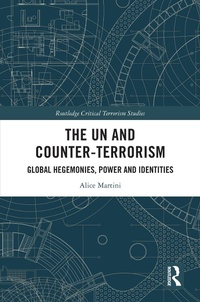
The UN and Counter-Terrorism
Global Hegemonies, Power and Identities
1st Edition
Published on 15. February 2021
220 pages
978-1-000-34407-3 (ISBN)
Description

This book traces the evolution of the UN Security Council's actions against terrorism and extremism.
The work examines the progression of the UN Security Council's fight against international terrorism and its development of practices to prevent radicalisation and extremism. It also looks at the consequences of these processes and how they have deeply moulded global counter-terrorism. The book looks at the discursive construction of a global threat and tracks how this construction evolved in relation to the Council's establishment of legal practices and bodies, and by its Members' discourses. It argues that the very specific definition the Council provided on international terrorism in the 2000s is profoundly shaped by global hegemonies, relations of power shaping the international community, and its own identity. To demonstrate this, it offers a long genealogical perspective of the structure of the UN since the 1930s and then focuses specifically on the developments taking place in the 2000s. The book thus looks at the Security Council's fight against international terrorism as a global, globalised, and globalising enterprise.
This book will be of much interest to students of critical terrorism studies, security studies, global governance, and International Relations.
The work examines the progression of the UN Security Council's fight against international terrorism and its development of practices to prevent radicalisation and extremism. It also looks at the consequences of these processes and how they have deeply moulded global counter-terrorism. The book looks at the discursive construction of a global threat and tracks how this construction evolved in relation to the Council's establishment of legal practices and bodies, and by its Members' discourses. It argues that the very specific definition the Council provided on international terrorism in the 2000s is profoundly shaped by global hegemonies, relations of power shaping the international community, and its own identity. To demonstrate this, it offers a long genealogical perspective of the structure of the UN since the 1930s and then focuses specifically on the developments taking place in the 2000s. The book thus looks at the Security Council's fight against international terrorism as a global, globalised, and globalising enterprise.
This book will be of much interest to students of critical terrorism studies, security studies, global governance, and International Relations.
Reviews / Votes
'Grounded in a constructivist approach, The UN and Counter-Terrorism, by Martini (Comillas Pontifical Univ., Spain), joins the burgeoning body of critical studies on terrorism by deconstructing the historical trajectory and evolution of policy at the United Nations. In the initial chapters, Martini's use of overly repetitive, post-structuralist jargon too advanced for a novice yet somewhat unnecessary to those familiar with the existing literature clouds her argument rather than clarifies it. Rather than add explanatory value, these terms tend to reduce it. However, the remainder of the book stands as an intriguing, insightful analysis of the manner in which the UN Security Council and General Assembly have developed an expansionist counter-terrorism policy since their inception. As inherently political actors, these bodies have actively sought to solidify the sovereign state as the primary actor within the international arena and defend the globalist system, thereby promulgating universal notions of civilization itself. Martini's genealogical approach highlights a morally dichotomous, hegemonic, yet flexible discursive framing (e.g., good vs. evil, civilized vs. uncivilized) that the UN strategically employs to establish terrorism as a global enterprise necessitating and justifying exceptional countermeasures. Summing Up: Recommended. With reservations. Graduate students and faculty.' --M. O'Gara, Rocky Mountain College, CHOICE September 2022'Martini's work represents an important contribution to the study of terrorism and extremism, and more broadly international security and international relations, through critical approaches.'--Critical Studies of Terrorism, August 2021
'Alice Martini's book is a crucial addition to the literature on terrorism and counter-terrorism measures. Her work shows how the UN was able to transcend national borders and legitimize the global and national adoption of exceptional security measures, justified by the construction of terrorism as an exceptional threat to the international community as a whole.'--Terrorism and Political Violence, April 2023
More details
Series
Edition
1. Auflage
Language
English
Place of publication
London
United Kingdom
Publishing group
Taylor & Francis Ltd
Target group
College/higher education
Professional and scholarly
Illustrations
1 Tables, black and white; 36 Line drawings, black and white; 36 Illustrations, black and white
ISBN-13
978-1-000-34407-3 (9781000344073)
Copyright in bibliographic data and cover images is held by Nielsen Book Services Limited or by the publishers or by their respective licensors: all rights reserved.
Schweitzer Classification
Other editions
Additional editions
Book
08/2022
1st Edition
Routledge
€65.10
Shipment within 15-20 days
Book
02/2021
1st Edition
Routledge
€205.40
Shipment within 15-20 days
Person
Alice Martini is Associate Professor in International Security Studies, Comillas Pontifical University, Spain. She is co-convenor of the Critical Studies on Terrorism Working Group (BISA).
Content
Introduction: the Council's fight against international terrorism 1. A constructivist theory of international terrorism 2. The UN and international terrorism. A genealogy 3. The emergence of the dispositif of international terrorism 4. The consolidation of the dispositif: writing the Self and the Other 5. Broadening the dispositif to radicalisation and extremism 6. Where consensus was not reached Conclusion. The long evolution of global counter-terrorism
