

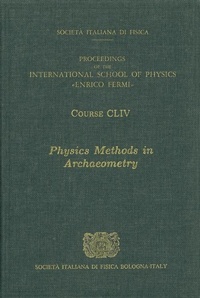
Physics Methods in Archaeometry
1st Edition
Published on 15. June 2006
532 pages
978-1-61499-010-9 (ISBN)
Description

The role of exact sciences in connection with cultural heritage now is well established and a new scientific branch has been generated: Archaeometry. Literally, Archaeometry means measurement on ancient objects. It is a multidisciplinary field of investigations where the rigorous methods of exact sciences give a fundamental contribution to solving the problems associated with conservation and restoration, as well as to the study itself of the cultural heritage. Archaeometry, as a scientific research field, involves interdisciplinary groups formed by scholars of the humanistic area together with scientists: physicists, chemists, mathematicians, biologists, engineers, etc. The primary justification for the need of involving exact sciences in the field which, in the past, traditionally has been exclusive of Art Historians must no doubt be found in the conservation and restoration activities. The second argument which, in the public opinion, justifies the involvement of science with the world of Art is the confidence that scientific methods are infallible in unmasking forgeries. But in our opinion the awareness of the central role of scientific methods as a support for philological and historical investigations is still very little diffuse or, at least, finds it hard to become widespread. Perhaps also because of our mentality, Physics, compared to chemistry, is more apt to find applications in a context free from authentication or conservation implications.
More details
Series
Language
English
Place of publication
London
Netherlands
Publishing group
IOS Press
Target group
Professional and scholarly
File size
13,53 MB
ISBN-13
978-1-61499-010-9 (9781614990109)
Copyright in bibliographic data and cover images is held by Nielsen Book Services Limited or by the publishers or by their respective licensors: all rights reserved.
Schweitzer Classification
Other editions
Additional editions
M. Martini | M. Milazzo | M. Piacentini
Physics Methods in Archaeometry
Book
06/2006
1st Edition
IOS Press,US
€170.84
Article exhausted; check different version
Content
- Title Page
- Indice
- Preface
- Gruppo fotografico dei partecipanti al Corso
- Optical spectroscopy and colorimetry
- Introduction
- Causes of colour
- Transitions between delocalised molecular orbitals
- Ligand field transitions
- Charge transfer transitions
- Energy band transitions
- Colorimetry: some concepts
- Instrumentation
- Fibre Optics Reflectance Spectroscopy (FORS)
- Image Spectroscopy (IS)
- Non-invasive techniques: pros and cons
- Applications to actual cases
- Pigment identification
- Colour change measurements
- Distance and transformation in the multivariate analysis of archaeometric data
- Introduction
- Some data
- Notation and terminology
- Distances
- Transformation
- Principal component analysis (PCA)
- Basic ideas
- The mathematics of PCA
- Biplots
- PCA and correspondence analysis
- Examples
- Cluster analysis and Mahalanobis distance
- Basic ideas
- Cluster analysis and Mahalanobis distance
- Discriminant analysis
- Basic ideas
- DA, Mahalanobis distance and classification
- Literature
- Thermodynamics for cultural heritage
- Forward
- Part 1: Air and artefact temperature
- Kinetic theory of perfect gases
- Equipartition law
- Real gases and the energy of interaction between particles U
- Development of dynamic internal boundary layers
- The molecular and the continuum regimes
- Molecular regime
- Continuum regime
- Transition regime
- Thermophoresis
- Thermophoresis in the molecular regime
- Thermophoresis in the continuum regime
- Measuring air and artwork temperature
- Measuring artworks temperature
- Part 2: Parameters describing atmospheric humidity
- The equation of state for real gases
- PVT diagram showing the gas and the liquid phases and the phase transitions
- Which variable is representative of the interactions between moisture and materials?
- Relationship between temperature and saturation vapour pressure
- Dew point: the temperature of condensation
- The mixing ratio r of moist air
- The specific humidity q
- The absolute humidity d v
- The molar fraction of water vapour
- The relative humidity U w
- The two definitions of relative humidity
- Relative humidity: the 1947 definition
- Relative humidity: the 1966 definition
- The role of relative humidity
- Key data about the H2O vapour and the minimum volume available for each molecule
- Potential energy U(r) of mutual interaction of a molecule of water vapour as a function of the inter-molecular distance r: a possible interpretation
- The physical meaning of relative humidity: a possible interpretation
- Wet bulb temperature: the temperature of evaporation
- Relative humidity from psychrometric readings
- Appendix
- Formulae for the derivation of the hygrometric variables from psychrometers, hygrometers, dew point meters
- Part 3: the Kelvin law and the adsorption isotherms
- Droplets and pores: how a curved water meniscus changes the equilibrium vapour tension
- The Kelvin law for different types of meniscus
- Hysteresis for a different combination of pores
- Adsorption hysotherm for a relative humidity cycle
- Allowed microclimate variability (T and RH thresholds) for artworks
- Part 4: Impact of moisture on materials
- Nocturnal and morning condensation
- Role of moisture and condensation on weathering and decay of cultural heritage
- The equilibrium moisture content (EMC) and dimensional changes in wood species
- The microclimate and the conservation of paper
- The problem of church heating
- Leaching and corrosion
- Damage caused by water on stones
- Ion beam techniques for the analysis of archaeological metallic artefacts
- Ion beams for material analysis: an introduction
- Kinematics of RBS (Rutherford Backscattering Spectroscopy)
- The scattering cross-sections of RBS
- Rutherford cross-sections
- Non-Rutherford cross-sections
- Typical RBS spectra
- Basic principles of PIXE (Particle Induced X-ray Emission)
- Fundamentals of PIGE (Particle Induced gamma-ray Emission) and nuclear reactions
- Identification of signals for analytical purposes
- Experimental procedure for external beam PIXE
- Analysis of coins
- The soldering of gold artefacts
- Prehispanic gold artefacts of Mesoamerica
- Differential PIXE analysis for the study of depletion gilding
- Conclusions
- Information technologies applied to scientific examination of museum collections
- Introduction
- The scientific research at the C2RMF
- Scientific information indexing and retrieval
- The European Research Open System (EROS)
- The database architecture
- Digitising activities for cultural applications
- From photo-archive digitisation to direct digitisation of objects
- New technologies for direct capture of 2D and 3D objects
- The C2RMF panoramic views digitisation systems for objects consulting and 3D model construction
- The 3D laser detection of objects
- The 2D and 3D digitisation of paintings
- The Jumbolux linear beam lighting system
- A pigmented chart for colour correction of paintings
- The CRISATEL high-definition digital camera
- Varnish opacity, thickness and colour measurement
- 3D capture of paintings
- Conclusion
- Scientific techniques and methodologies for the provenance of white marbles
- Introduction
- The nature of marble
- Techniques used for provenance determination
- Neutron activation analysis
- Cathodoluminescence
- Petrographic thin-section analysis
- Stable isotope analysis
- Electron Paramagnetic Resonance spectroscopy (EPR)
- Ancient quarries and database
- Provenance determination procedure
- Sampling or not sampling?
- Sampling procedure
- The movement of marble in antiquity
- The physical basis of thermoluminescence dating and its applications
- Introduction
- Thermoluminescence
- Defects, traps and luminescence centres
- Instrumentation
- Applied thermoluminescence
- Radiation sources
- TL dating
- TL dating: a few examples of application
- TL dating in excavation archaeology
- TL dating of historical buildings
- TL dating of burnt flints
- TL dating of archaeological glasses
- TL dating of clay-cores
- Conclusions
- Quantitative XRF analysis in archaeometric applications
- Introduction
- Quantitative XRF analysis
- General
- Quantitative analysis with monochromatic excitation radiation
- Secondary excitation effects
- Detailed examination of the effects on relative intensity values dependent on the irregular shape
- Measurement of coin fineness
- Quantitative analysis of glass and ceramics
- The gilding of other metals since 3000 BC. "All that glisters is not gold
- Gilding with gold foil
- Gilding with gold leaf
- Diffusion bonding of gold leaf on to silver
- Gilding of copper alloys with gold leaf
- Leaf gilding on a bole ground
- Fire gilding
- Depletion gilding
- Pseudogilding
- The manufacture of wire since the Bronze Age: A technological investigation using the microscope
- Hammered wire
- Swaged wire
- Block-twisted wire
- Strip drawn wire
- Strip twisted wire
- Cast wire
- Folded wire
- Drawn wire
- Summary
- The scientific work on the Sutton Hoo ship burial
- The presence of a body
- Dating the burial
- The analysis of the jewellery
- The examination of the shield and helmet
- The examination of the sceptre and of the iron standard
- Bronzes in the Sutton Hoo grave
- Glass in the Sutton Hoo grave
- The Sutton Hoo drinking horns
- Summary
- Unmasking forged antiquities. How scientific techniques are used to expose fakes in museum collections
- Copies made from moulds of original objects
- Copies made in the style of original objects
- Genuine objects which have been altered to make them rarer and thus more valuable
- Damaged antiquities which have been carefully restored so that the damage is invisible
- Forgeries made in ancient times
- The scientific detection of forgeries
- Non-destructive examination
- The materials of manufacture
- The alteration products (such as metallic corrosion or weathering layers)
- The structure of the original material and the techniques of manufacture
- The age of the object
- Synchrotron radiation and neutrons in archaeological and cultural heritage science
- Introduction
- Pigments
- Painting pigments
- Micro-sampling of pigment powders
- Glazes
- Hispano-Moresque lustre ware
- Etruscan black gloss
- Use of hard X-rays and neutrons on metal objects
- Summary
- Archaeometallurgy: Examples of the application of scientific methods to the provenance of archaeological metal objects
- Introduction
- The behaviour of trace elements
- Trace elements and technology
- Trace elements and provenance
- Image spectroscopy for diagnostics and conservation of contemporary art
- Contemporary art: characters and problems
- Image spectroscopy
- Principles of the method
- Measurement
- Experimental apparatus
- Calibration
- Experimental results
- Treatment of spectral data
- Principal Component Analysis: mathematical definitions
- Applications
- Conclusions
- Archaeometry - an overview
- History of archaeometry in the UK
- Remote sensing
- Science-based dating
- Artefact studies
- Pottery production
- Copper alloys
- Copper trade in the Late Bronze Age Mediterranean
- Artefact use
- Man and his environment
- Stable isotope analysis of human bone
- DNA studies
- Conclusions
- Production technology of ancient pottery
- Reconstruction
- Raw materials
- Forming
- Surface treatment
- Firing procedures
- Discovery and adoption
- The beginnings of pottery production in the Near East
- Organic residue analysis
- Mode of production
- Technological choice and change
- Glass and related vitreous materials
- Glazed stone, faience and related materials
- Egyptian blue frit
- The beginnings of glass
- Glass production in Egypt
- Roman and Byzantine glass
- Roman cameo glass
- Islamic and Medieval glass
- Glazed pottery
- The first glazed earthenware
- Lead glazed pottery
- Tin-opacified glazes
- Stonepaste bodies
- Isnik ware
- Related European glazed ceramics
- Italian maiolica
- Medici porcelain
- Radionuclide dating in archaeology by accelerator mass spectrometry
- Introduction
- Accelerator mass spectrometry
- Chemical process
- Accelerator measurement
- Radiocarbon dating
- Principles of radiocarbon dating
- Performance of AMS 14 C dating
- Datable age
- Sample size
- Precision and accuracy
- Archaeology at the radiocarbon limit
- Datable age
- Accuracy
- Sample size
- Bomb pulse dating
- Dating with in situ cosmogenic radionuclides
- Dating of hominids with 10 Be/26 Al
- Conclusions
- Scientific methods and applications to archaeological provenance studies
- Introduction
- Analytical methods and instrumentation
- Spectroscopy and spectrometry
- Optical spectroscopy
- X-ray spectroscopy
- Gamma-ray spectroscopy
- Isotope spectrometry
- Standards and calibration
- Principles and prerequisites of provenance studies
- Sample selection and other considerations
- Trade and exchange
- Copper
- Marble
- Obsidian sourcing in the central Mediterranean: a case study
- Discussion and conclusion
- Stable isotopes and diet: You are what you eat
- Introduction
- Principles of stable isotope analysis
- Analytical methods
- Recent applications
- Patagonia (Argentina and Chile)
- Highland Ecuador and Peru
- Coastal Ecuador and Peru
- Belize and Guatemala
- Florida
- Europe
- China
- Microsampling of teeth
- Strontium isotope analysis
- Physics and archaeological time: Luminescence and particle track dating
- Nuclear clocks
- Luminescence dating
- TL dating of heated flint
- OSL dating of colluvium
- Spatially resolved luminescence
- Fission track dating
- Alpha recoil track dating
- Innovative systems for digital radiography and computed tomography: Applications to cultural heritage diagnostics
- Introduction: the computed tomography technique
- The micro-CT system
- Intensified 3D tomography large-area system I
- Intensified 3D tomography large-area system II
- Fan beam tomography with an intensified linear detector
- Conclusions
- Forensic science trace evidence approaches in archaeology
- Hafting in the Acheulean
- 17000BP Mycrobacerium tuberculosis
- Infanticide in ancient Ashkelon
- The Dead Sea Scrolls
- A 2000 year old burial shroud
- The "Warrior Family" burial from Massada
- Conclusions
- Thermographic testing on historic building
- Foreword
- Use of thermography for wall inspection
- Laboratory tests
- Mathematical models for the on-field application
- The case of "Santa Maria Incoronata" church
- Detection of damp surfaces by active and passive thermography
- Active approach
- Passive approach
- Lab test on building material
- On-field applications
- Final remarks on moisture detection
- Active tests
- Independence from the surface
- Sensibility to water content
- Environmental condition
- Conclusive remarks
- Elenco dei partecipanti
