

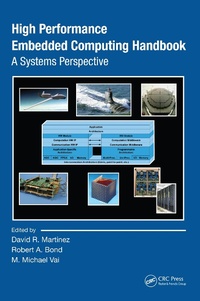
High Performance Embedded Computing Handbook
A Systems Perspective
1st Edition
Published on 3. October 2018
600 pages
978-1-4200-0666-7 (ISBN)
Description

Over the past several decades, applications permeated by advances in digital signal processing have undergone unprecedented growth in capabilities. The editors and authors of High Performance Embedded Computing Handbook: A Systems Perspective have been significant contributors to this field, and the principles and techniques presented in the handbook are reinforced by examples drawn from their work.
The chapters cover system components found in today's HPEC systems by addressing design trade-offs, implementation options, and techniques of the trade, then solidifying the concepts with specific HPEC system examples. This approach provides a more valuable learning tool, Because readers learn about these subject areas through factual implementation cases drawn from the contributing authors' own experiences.
Discussions include:
Key subsystems and components
Computational characteristics of high performance embedded algorithms and applications
Front-end real-time processor technologies such as analog-to-digital conversion, application-specific integrated circuits, field programmable gate arrays, and intellectual property-based design
Programmable HPEC systems technology, including interconnection fabrics, parallel and distributed processing, performance metrics and software architecture, and automatic code parallelization and optimization
Examples of complex HPEC systems representative of actual prototype developments
Application examples, including radar, communications, electro-optical, and sonar applications
The handbook is organized around a canonical framework that helps readers navigate through the chapters, and it concludes with a discussion of future trends in HPEC systems. The material is covered at a level suitable for practicing engineers and HPEC computational practitioners and is easily adaptable to their own implementation requirements.
The chapters cover system components found in today's HPEC systems by addressing design trade-offs, implementation options, and techniques of the trade, then solidifying the concepts with specific HPEC system examples. This approach provides a more valuable learning tool, Because readers learn about these subject areas through factual implementation cases drawn from the contributing authors' own experiences.
Discussions include:
Key subsystems and components
Computational characteristics of high performance embedded algorithms and applications
Front-end real-time processor technologies such as analog-to-digital conversion, application-specific integrated circuits, field programmable gate arrays, and intellectual property-based design
Programmable HPEC systems technology, including interconnection fabrics, parallel and distributed processing, performance metrics and software architecture, and automatic code parallelization and optimization
Examples of complex HPEC systems representative of actual prototype developments
Application examples, including radar, communications, electro-optical, and sonar applications
The handbook is organized around a canonical framework that helps readers navigate through the chapters, and it concludes with a discussion of future trends in HPEC systems. The material is covered at a level suitable for practicing engineers and HPEC computational practitioners and is easily adaptable to their own implementation requirements.
More details
Edition
1. Auflage
Language
English
Place of publication
Baton Rouge
United States
Publishing group
Taylor & Francis Inc
Target group
Professional and scholarly
Radar and sonar engineers, signal processors, hardware engineers, software engineers, system designers, algorithm developers, program managers, and professionals in communications and embedded computing.
Illustrations
362 s/w Abbildungen, 8 farbige Abbildungen, 40 s/w Photographien bzw. Rasterbilder
40 Halftones, black and white; 8 Illustrations, color; 362 Illustrations, black and white
File size
22,27 MB
ISBN-13
978-1-4200-0666-7 (9781420006667)
Copyright in bibliographic data and cover images is held by Nielsen Book Services Limited or by the publishers or by their respective licensors: all rights reserved.
Schweitzer Classification
Other editions
Additional editions
David R. Martinez | Robert A. Bond | M. Michael Vai
High Performance Embedded Computing Handbook
A Systems Perspective
Book
06/2008
1st Edition
CRC Press
€235.22
Shipment within 15-20 days
Persons
David R. Martinez is Laboratory Fellow at MIT Lincoln Laboratory and MIT Lead Instructor. His emphasis is on artificial intelligence, high performance computing, and technical leadership. Prior to this appointment, he was Associate Division Head, and a member of the Laboratory's Steering Committee.
He is the MIT Lead Lecturer for the course titled: "AI Strategies and Roadmap: Systems Engineering Approach to AI Development and Deployment." The course is based on his former graduate engineering course taught at MIT that instructed students on techniques to formulating an AI strategic roadmap, starting from AI architecture principles, leading to concept prototyping, and deployment of end-to-end AI system capabilities, including hands-on experiential learning leveraging a single-board computer. The course also addressed responsible AI, and the leadership of multi-disciplinary teams.
Mr. Martinez has developed and led complex prototype systems, from their inception to their final deployments. The system demonstrations operated in real-time, leveraging adaptive signal processing and high performance embedded computing. These successful prototype demonstrations served as the pathfinder for industry to later commercialize.
He has been a keynote speaker at both national and international conferences. He was elected IEEE Fellow "for technical leadership in the development of high performance embedded computing for real-time defense systems." He holds three U.S. patents based on his work in signal processing for seismic applications. He received the special achievement award from ARCO Oil and Gas Research Center.
He established and chaired workshops on Robustness of AI Systems and Artificial Intelligence for Cyber Security. He was awarded the Eminent Engineer Award from the College of Engineering at NMSU, and was elected to the NMSU Klipsch Electrical and Computer Engineering Academy.
Mr. Martinez was awarded a BS degree from New Mexico State University, an MS degree from MIT, and the EE degree jointly from MIT and the Woods Hole Oceanographic Institution in Electrical Engineering and Oceanographic Engineering. He completed an MBA from the Southern Methodist University. He was born in El Paso, Texas, to a Mexican-American father and a Bolivian mother, and grew up in South America. He is fluent in Spanish. He is an avid saltwater fisherman, golfer, and outdoorsman.
He is the MIT Lead Lecturer for the course titled: "AI Strategies and Roadmap: Systems Engineering Approach to AI Development and Deployment." The course is based on his former graduate engineering course taught at MIT that instructed students on techniques to formulating an AI strategic roadmap, starting from AI architecture principles, leading to concept prototyping, and deployment of end-to-end AI system capabilities, including hands-on experiential learning leveraging a single-board computer. The course also addressed responsible AI, and the leadership of multi-disciplinary teams.
Mr. Martinez has developed and led complex prototype systems, from their inception to their final deployments. The system demonstrations operated in real-time, leveraging adaptive signal processing and high performance embedded computing. These successful prototype demonstrations served as the pathfinder for industry to later commercialize.
He has been a keynote speaker at both national and international conferences. He was elected IEEE Fellow "for technical leadership in the development of high performance embedded computing for real-time defense systems." He holds three U.S. patents based on his work in signal processing for seismic applications. He received the special achievement award from ARCO Oil and Gas Research Center.
He established and chaired workshops on Robustness of AI Systems and Artificial Intelligence for Cyber Security. He was awarded the Eminent Engineer Award from the College of Engineering at NMSU, and was elected to the NMSU Klipsch Electrical and Computer Engineering Academy.
Mr. Martinez was awarded a BS degree from New Mexico State University, an MS degree from MIT, and the EE degree jointly from MIT and the Woods Hole Oceanographic Institution in Electrical Engineering and Oceanographic Engineering. He completed an MBA from the Southern Methodist University. He was born in El Paso, Texas, to a Mexican-American father and a Bolivian mother, and grew up in South America. He is fluent in Spanish. He is an avid saltwater fisherman, golfer, and outdoorsman.
Content
Introduction. Computational Nature of High Performance Embedded Systems. Front-End Real-Time Processor Technologies. Programmable High Performance Embedded Computing Systems. High Performance Embedded Computing Application Examples. Future Trends.
