

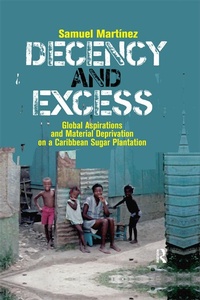
Decency and Excess
Global Aspirations and Material Deprivation on a Caribbean Sugar Plantation
Published on 3. December 2015
242 pages
978-1-317-26150-6 (ISBN)
Description

Based on periodic ethnographic fieldwork over a span of fifteen years, Martinez shows how impoverished plantation dwellers find ways of coping with the alienation that would be expected while laboring to produce goods for the richer countries. Despite living in dire poverty, these workers live in a thoroughly commodified social environment. Ritual, eroticism, electronic media, household adornment, payday-weekend "binging" are ways even chronically poor plantation residents dream beyond reality. Yet plantation residents' efforts to live decently and escape from the dead hand of necessity also deepen existing divisions of ethnic identity and status. As the divide between "haves" and "have-nots" worsens as a result of neoliberal reform and the decline of sugar in international markets, this book reveals on an intensely human scale the coarsening of the social fabric of this and other communities of the world's poorer nations.
Reviews / Votes
"Decency and Excess is a plantation ethnography comparable in terms of richness of observational detail with some of the best examples of this genre. But it also engages a set of concerns that never prominently figured on the agenda of classic Caribbean ethnographies: on the one hand, the study of consumption, and, on the other hand, a theoretical discourse that aims to track the emergence of flourishing local economies of the occult amidst the increasingly 'occult' workings of neoliberal global capitalism. Finding an unlikely ally in Georges Bataille, whose theories of expenditure, for Martinez, capture some of the tragic ironies of the consumer cultures developed by the severely exploited and radically impoverished, Martinez traces the contours of a fresh and potentially highly significant critique of capitalism emerging from an unexpected location: that of an eroticization of waste, rather than the fetishization of objectified value. Decency and Excess presents considerable challenges that will be noted not just in Caribbean studies but the anthropology of material culture and consumption, and-one would hope-in the discipline at large."-Stephan Palmie, University of Chicago
"In this ethnography Martinez convinces us to care about the fate of Monte Coca, a gritty sugar cane plantation community in the Dominican Republic, a place that no one calls home and that no one will mourn as globalization renders it obsolete. We come to empathize with the cane workers' struggles for dignity, even though these struggles engender invidious distinctions as much as solidarity, ephemeral relief rather than resistance or hopes for transformation. Finely tuned to meaning and materiality, to everyday practices and global processes, Martinez has made a prescient, masterful case for the return of political economy, back from its banishment to the margins of anthropological theory."
-Charles R. Hale, President, Latin American Studies Association (May 2006-October 2007) and Professor of Anthropology, University of Texas, Austin
More details
Language
English
Place of publication
London
United Kingdom
Publishing group
Taylor & Francis Ltd
Target group
College/higher education
Product notice
Reflowable
Illustrations
14 photos, 5 Maps, 4 Tables
File size
9,13 MB
ISBN-13
978-1-317-26150-6 (9781317261506)
Copyright in bibliographic data and cover images is held by Nielsen Book Services Limited or by the publishers or by their respective licensors: all rights reserved.
Schweitzer Classification
Other editions
Additional editions
Samuel Martinez
Decency and Excess
Global Aspirations and Material Deprivation on a Caribbean Sugar Plantation
Book
10/2007
1st Edition
Routledge
€93.70
Shipment within 3-4 weeks
Samuel Martinez
Decency and Excess
Global Aspirations and Material Deprivation on a Caribbean Sugar Plantation
Book
03/2006
1st Edition
Routledge
€297.50
Shipment within 3-4 weeks
Person
Martinez, Samuel
Content
Chapter 1 Introduction; Chapter 2 A Place No One Calls "Home"; Chapter 3 Living in Nowhere; Chapter 4 Commodity Consumption in a Globalizing Age; Chapter 5 An Indecent Life; Chapter 6 Places and Flows; Chapter 7 High Times in Hard Times; Chapter 8 Material Passions; Chapter 9 The Hot and the Cold; Chapter 10 Conclusions;
