

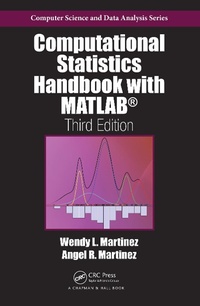
Computational Statistics Handbook with MATLAB
3rd Edition
Published on 16. December 2015
759 pages
978-1-4665-9274-2 (ISBN)
Description

A Strong Practical Focus on Applications and AlgorithmsComputational Statistics Handbook with MATLAB, Third Edition covers today's most commonly used techniques in computational statistics while maintaining the same philosophy and writing style of the bestselling previous editions. The text keeps theoretical concepts to a minimum, emphasizing the i
Reviews / Votes
Praise for Previous Editions:"... useful as a reference where one can look to get a concise description of a statistical methodology and MATLAB code that can be used to implement it ... the book is excellent."-Michael J. Evans, Mathematical Reviews, 2009e
"My own brief assessment of the book leaves me impressed with the number of subjects covered ... the book can be a valuable reference to practicing statisticians (or statistical researchers) using MATLAB as their computing engines."
-Biometrics, March 2009
"... this book is perfectly appropriate as a textbook for an introductory course on computational statistics. It covers many useful topics, which in combination with the well-documented code, make the underlying concepts easy to grasp by the students. ... a very nice book to be used in an undergraduate- or masters-level computational statistics course. It would also prove useful to researchers in other fields that want to learn and implement quickly some advanced statistical techniques."
-Journal of Statistical Software, July 2004, Vol. 11
"I am pleased to see the publication of a comprehensive book related to computational statistics and MATLAB. ... this book is ambitious and well written. As a long-time user of MATLAB, I find this book useful as a reference, and thus recommend it highly to statisticians who use MATLAB. The book also would be very useful to engineers and scientists who are well trained in statistics."
-Journal of the American Statistical Association, June 2004, Vol. 99, No. 466
More details
Series
Edition
3rd edition
Language
English
Place of publication
Philadelphia, PA
United States
Publishing group
Taylor & Francis Inc
Target group
College/higher education
ISBN-13
978-1-4665-9274-2 (9781466592742)
Copyright in bibliographic data and cover images is held by Nielsen Book Services Limited or by the publishers or by their respective licensors: all rights reserved.
Schweitzer Classification
Other editions
Additional editions
Wendy L. Martinez | Angel R. Martinez
Computational Statistics Handbook with MATLAB
Book
09/2021
3rd Edition
Chapman & Hall/CRC
€78.00
Shipment within 10-20 days
Wendy L. Martinez | Angel R. Martinez
Computational Statistics Handbook with MATLAB
Book
12/2015
3rd Edition
CRC Press
€159.40
Shipment within 15-20 days
Persons
Wendy L. Martinez is a mathematical statistician with the U.S. Bureau of Labor Statistics. She is a fellow of the American Statistical Association, a co-author of several popular Chapman & Hall/CRC books, and a MATLAB user for more than 20 years. Her research interests include text data mining, probability density estimation, signal processing, scientific visualization, and statistical pattern recognition. She earned an M.S. in aerospace engineering from George Washington University and a Ph.D. in computational sciences and informatics from George Mason University.
Angel R. Martinez is fully retired after a long career with the U.S. federal government and as an adjunct professor at Strayer University, where he taught undergraduate and graduate courses in statistics and mathematics. Before retiring from government service, he worked for the U.S. Navy as an operations research analyst and a computer scientist. He earned an M.S. in systems engineering from the Virginia Polytechnic Institute and State University and a Ph.D. in computational sciences and informatics from George Mason University.
Angel R. Martinez is fully retired after a long career with the U.S. federal government and as an adjunct professor at Strayer University, where he taught undergraduate and graduate courses in statistics and mathematics. Before retiring from government service, he worked for the U.S. Navy as an operations research analyst and a computer scientist. He earned an M.S. in systems engineering from the Virginia Polytechnic Institute and State University and a Ph.D. in computational sciences and informatics from George Mason University.
Content
Introduction. Probability Concepts. Sampling Concepts. Generating Random Variables. Exploratory Data Analysis. Finding Structure. Monte Carlo Methods for Inferential Statistics. Data Partitioning. Probability Density Estimation. Supervised Learning. Unsupervised Learning. Parametric Models. Nonparametric Models. Markov Chain Monte Carlo Methods. Appendices. References. Index.
