

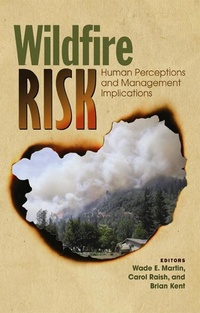
Wildfire Risk
Human Perceptions and Management Implications
1st Edition
Published on 30. September 2010
324 pages
978-1-136-52389-2 (ISBN)
Description

The continuing encroachment of human settlements into fire-prone areas and extreme fire seasons in recent years make it urgent that we better understand both the physical and human dimensions of managing the risk from wildfire. Wildfire Risk follows from our awareness that increasing public knowledge about wildfire hazard does not necessarily lead to appropriate risk reduction behavior. Drawing heavily upon health and risk communication, and risk modeling, the authors advance our understanding of how individuals and communities respond to wildfire hazard. They present results of original research on the social, economic, and psychological factors in responses to risk, discuss how outreach and education can influence behavior, and consider differences among ethnic/racial groups and between genders with regard to values, views, and attitudes about wildfire risk. They explore the role of public participation in risk assessment and mitigation, as well as in planning for evacuation and recovery after fire. Wildfire Risk concludes with a dedicated section on risk-modeling, with perspectives from decision sciences, geography, operations research, psychology, experimental economics, and other social sciences.
Reviews / Votes
'The authors advance our understanding of risk analysis by digging deeper into notions of vulnerability, issue framing, and tradeoff decisionmaking about the benefits of risk reduction. This book will have important policy and budgetary implications for how we approach wildfire risk response.'Sam Burns, Fort Lewis College
'Fills important gaps in our knowledge about social and economic dimensions of wildfire risk. It provides acrash course in the social science methods available to learn about individual and community perception and response to wildfire risk.'
John Loomis, Colorado State University
'Provides both practical perspectives and scholarly contributions...A valuable resource for anyone involved in wildfire management, including land planners, resource managers, fire protection personnel, policymakers, researchers, and students.'
Bonita McFarlane, Canadian Forest Service
'An excellent overview of research about the social, cultural, and economic dimensions of wildfire and their implications for public and private management of thewildland-urban interface and its risks.'
Tony Prato, University of Missouri
More details
Language
English
Place of publication
London
United Kingdom
Publishing group
Taylor & Francis Ltd
Target group
College/higher education
File size
5,72 MB
ISBN-13
978-1-136-52389-2 (9781136523892)
Copyright in bibliographic data and cover images is held by Nielsen Book Services Limited or by the publishers or by their respective licensors: all rights reserved.
Schweitzer Classification
Other editions
Additional editions
Wade E. Martin | Carol Raish | Brian Kent
Wildfire Risk
Human Perceptions and Management Implications
Book
12/2007
1st Edition
Resources for the Future Press (RFF Press)
€223.21
Shipment within 3-4 weeks
Wade E. Martin | Carol Raish | Brian Kent
Wildfire Risk
Human Perceptions and Management Implications
Book
10/2007
1st Edition
Resources for the Future Press (RFF Press)
€88.19
Article not available at the moment
Persons
Wade E. Martin is a professor of economics at California State University, Long Beach, and is editor of the journal Contemporary Economic Policy.
Carol Raish is a research social scientist at the USDA Forest Service's Rocky Mountain Research Station Albuquerque Lab.
Brian Kent is project leader in Natural Resource Assessment and Analysis at the Rocky Mountain
Research Station.
Carol Raish is a research social scientist at the USDA Forest Service's Rocky Mountain Research Station Albuquerque Lab.
Brian Kent is project leader in Natural Resource Assessment and Analysis at the Rocky Mountain
Research Station.
Content
Section 1: Risk Perspectives
1. Introduction
2. Assessing Public Perspectives of Wildfire Risk
Section 2: Community Perspectives
3. Wildfire Risk and Attribution: Viewpoints of Wildland-Urban Interface Residents
4. Collaborative Planning to Reduce Wildfire Risk: Linking Context and Outcomes
5. Altering Perceptions of Risk: Hazardous Fuel Reduction Strategies in Arizona, Colorado and New Mexico
6. Integrative Healing: Lessons from Post-Fire Community Recovery
Section 3: Individual Perspectives
7. Psychological Foundations for Socially Sustainable Wildfire Risk Management
8. What Motivates Homeowners to Protect Themselves from Risks?
9. Risk Perception, Adaptation and Behavior Change: Self-protective Behavior in the Wildland Urban Interface
10. An Exploration of Diversity in Southwesterners Views of Forest Service Fire Management
Section 4: Decision Analytic & Economic Perspectives
11. Avoiding Unnatural Disasters: Lessons for Successfully Navigating the Risk Management Landscape
12. Walking the Talk: Building Public Participation into Science-Based Decision Support for Wildland Fire Management
13. Spatially Arranging Fuel Treatments to Manage Landscape-wide Fire Risk
14. Using Economic Experiments in Policy Evaluations: Exploration of Wildfire Risk Mitigation Decisions
15. Valuing the Health Effects of a Prescribed Fire
Section 5: Overview & Summary
16. Summary Comments: Wildfire and Fuels Management: Risk and Human Reaction
1. Introduction
2. Assessing Public Perspectives of Wildfire Risk
Section 2: Community Perspectives
3. Wildfire Risk and Attribution: Viewpoints of Wildland-Urban Interface Residents
4. Collaborative Planning to Reduce Wildfire Risk: Linking Context and Outcomes
5. Altering Perceptions of Risk: Hazardous Fuel Reduction Strategies in Arizona, Colorado and New Mexico
6. Integrative Healing: Lessons from Post-Fire Community Recovery
Section 3: Individual Perspectives
7. Psychological Foundations for Socially Sustainable Wildfire Risk Management
8. What Motivates Homeowners to Protect Themselves from Risks?
9. Risk Perception, Adaptation and Behavior Change: Self-protective Behavior in the Wildland Urban Interface
10. An Exploration of Diversity in Southwesterners Views of Forest Service Fire Management
Section 4: Decision Analytic & Economic Perspectives
11. Avoiding Unnatural Disasters: Lessons for Successfully Navigating the Risk Management Landscape
12. Walking the Talk: Building Public Participation into Science-Based Decision Support for Wildland Fire Management
13. Spatially Arranging Fuel Treatments to Manage Landscape-wide Fire Risk
14. Using Economic Experiments in Policy Evaluations: Exploration of Wildfire Risk Mitigation Decisions
15. Valuing the Health Effects of a Prescribed Fire
Section 5: Overview & Summary
16. Summary Comments: Wildfire and Fuels Management: Risk and Human Reaction
