

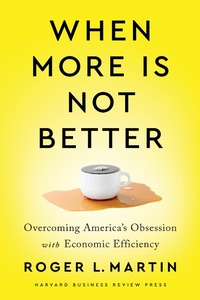
When More Is Not Better
Description

American democratic capitalism is in danger. How can we save it?
For its first two hundred years, the American economy exhibited truly impressive performance. The combination of democratically elected governments and a capitalist system worked, with ever-increasing levels of efficiency spurred by division of labor, international trade, and scientific management of companies. By the nation's bicentennial celebration in 1976, the American economy was the envy of the world.
But since then, outcomes have changed dramatically. Growth in the economic prosperity of the average American family has slowed to a crawl, while the wealth of the richest Americans has skyrocketed. This imbalance threatens the American democratic capitalist system and our way of life.
In this bracing yet constructive book, world-renowned business thinker Roger Martin starkly outlines the fundamental problem: We have treated the economy as a machine, pursuing ever-greater efficiency as an inherent good. But efficiency has become too much of a good thing. Our obsession with it has inadvertently shifted the shape of our economy, from a large middle class and smaller numbers of rich and poor (think of a bell-shaped curve) to a greater share of benefits accruing to a thin tail of already-rich Americans (a Pareto distribution).
With lucid analysis and engaging anecdotes, Martin argues that we must stop treating the economy as a perfectible machine and shift toward viewing it as a complex adaptive system in which we seek a fundamental balance of efficiency with resilience. To achieve this, we need to keep in mind the whole while working on the component parts; pursue improvement, not perfection; and relentlessly tweak instead of attempting to find permanent solutions.
Filled with keen economic insight and advice for citizens, executives, policy makers, and educators, When More Is Not Better is the must-read guide for saving democratic capitalism.
More details
Other editions
Additional editions
Person
Roger L. Martin is Professor of Strategic Management, Emeritus, at the University of Toronto's Rotman School of Management, where he served as Dean (1998-2013) and as Institute Director of the Martin Prosperity Institute (2013-2019). In 2017 Thinkers50 named him the world's number one management thinker. He has published eleven books, including Creating Great Choices with Jennifer Riel and Playing to Win with A.G. Lafley, as well as many Harvard Business Review articles. Martin is a trusted strategy adviser to the CEOs of many global companies. A Canadian from Wallenstein, Ontario, he holds an AB from Harvard College and an MBA from Harvard Business School.
You can find Roger Martin at:
rogerlmartin.com
twitter.com/RogerLMartin
Content
- Intro
- Contents
- Foreword
- Introduction: A System Out of Balance
- Part 1: Problem
- Ch. 1: The American Economy as an Efficient Machine
- Ch. 2: The Chain of Imperfection
- Ch. 3: Toward a Pareto Economy
- Ch. 4: The American Economy as a Natural System
- Part 2: Solutions
- Ch. 5: Achieving Balance in America's Natural System
- Ch. 6: An Agenda for Business Executives
- Ch. 7: An Agenda for Political Leaders
- Ch. 8: An Agenda for Educators
- Ch. 9: An Agenda for Citizens
- Ch. 10: Closing Thoughts
- Notes
- Index
- Acknowledgments
- About the Author
