

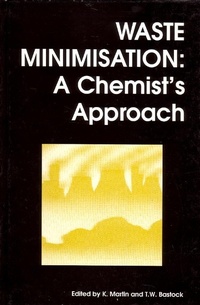
Waste Minimisation
A Chemist's Approach
Published on 14. March 2014
164 pages
978-1-84569-291-9 (ISBN)
Description

This book looks at the technical advances in the limitation of waste such as that produced by computing processes and the various industrial practices employed by major companies for waste disposal and minimisation.
More details
Other editions
Additional editions
Book
01/1994
Woodhead Publishing Ltd
€230.65
Article exhausted; check different version
Content
- Front Cover
- Waste Minimisation: A Chemist's Approach
- Copyright Page
- Table of Contents
- Preface
- Part 1: Legal Aspects of Waste Minimisation
- Chapter 1. Government Policies to Encourage Cleaner Production
- Definitions
- Policy
- Instruments
- Regulation
- Economic Instruments
- Management Procedures
- Information
- Grants
- Awards
- Conclusion: Sustainable Development
- Chapter 2. Waste Minimisation in the Context of Integrated Pollution Control
- Integrated Pollution Control
- BATNEEC
- IPC Applications
- Waste Minimisation in IPC Applications
- Waste Minimisation Guide
- Waste Minimisation and IPC
- Waste Minimisation in practice
- Conclusion
- References:
- Chapter 3. Waste Minimisation and Clean Technology - Why Do It? A CIA View
- 1. INTRODUCTION
- 2. PUBLIC PERCEPTION OF THE CHEMICAL INDUSTRY
- 3. GOVERNMENT RESPONSES
- 4. EXAMPLES AND LESSONS
- 5. COSTS AND COST-EFFECTIVENESS
- 6. ENVIRONMENTAL PRESSURES AND RESPONSES
- 7. VOLUNTARY ACTION PROGRAMMES
- 8. ENVIRONMENTAL REPORTING
- 9. MORE FROM LESS
- 10. OUTLOOK
- 11. CONCLUSION
- REFERENCES
- Part 2: Corporate Strategy to Waste Minimisation
- Chapter 4. Efforts of BASF towards Cleaner Technology and Waste Minimisation
- 1. "END OF THE PIPE"-ENVIRONMENTAL PROTECTION
- 2. ENVIRONMENTAL PROTECTION INTEGRATED INTO THE PRODUCTION PROCESS
- 3. AVOIDING BY-PRODUCTS BY PROCESS IMPROVEMENT
- 4. RECOVERY AND UTILIZATION OF BY-PRODUCTS
- 5. UTILIZATION OF BY-PRODUCTS ALSO ENTAILS A RISK
- 6. PREVENTION AND RECYCLING OF RESIDUES
- 7. INTEGRAL ENVIRONMENTAL PROTECTION
- 8. ECOLOGICAL OBJECTIVES IN RESEARCH AND DEVELOPMENT
- 9. ENVIRONMENTALLY SAFE PRODUCTS
- 10. INNOVATION, THE VITAL FORCE BEHIND INDUSTRIAL DEVELOPMENT
- Chapter 5. Shell Chemicals UK's Response to the Environmental Challenge
- 1. INTRODUCTION
- 2. THE SECTOR VISION
- 3. HISTORICAL PERFORMANCE
- 4. SOLID WASTE
- 5. LIQUID WASTE
- 6. GASEOUS EMISSION
- 7. ADDITIVE MANUFACTURE
- 8. POLYMER PRODUCTION
- 9. POLYMERS WASTE MANAGEMENT
- Chapter 6. A Corporate Commitment to Waste Minimisation
- HISTORY OF MONSANTO COMPANY
- MONSANTO IN EUROPE
- CORPORATE POLICY
- CORPORATE POLICY
- AIR EMISSIONS REDUCTION PROGRAMME '90% PROGRAMME'
- AIR EMISSION MEASUREMENT
- AVOID WASTE AND REDUCE EMISSIONS
- FUTURE
- Chapter 7. Waste Minimisation - A Small Company Perspective
- 1. LEGISLATION
- 2. ENVIROCATS
- 3. PHYSICAL TECHNIQUES
- Part 3: Practical Aspects of Waste Minimisation
- Chapter 8. The Interface between the Chemist and the Chemical Engineer as a Source of Waste
- 1. INTRODUCTION
- 2. REACTORS AS SOURCES OF WASTE
- 3. GETTING THE RIGHT REACTOR
- 4. THE INTERFACE BETWEEN THE CHEMIST AND THE CHEMICAL ENGINEER
- 5. FINAL COMMENTS
- 6. REFERENCES
- Chapter 9. Waste Minimisation - The Role of Process Development
- 1. GENERAL
- 2. SOURCES OF WASTE IN CHEMICAL PROCESSES
- 3. THE PROCESS BALANCE
- 4. CHEMICAL PROCESS DEVELOPMENT : OPTIONS AND EXAMPLES
- 5. INTEGRATED PROCESS DEVELOPMENT
- 6. SUMMARY
- Chapter 10. Advances in Chemical Recycling for Plastics and Elastomers
- Part 4: New Technology for Waste Minimisation
- Chapter 11. Profit and Waste - Allied Allies
- INTRODUCTION
- ALLIED COLLOIDS EXPERIENCE
- SIGNPOSTING TECHNIQUES
- INVESTIGATING OPPORTUNITIES
- CQMPAIfY STRENGTHS
- SPECIFIC EXAMPLES:
- SUMMARY
- REFERENCES
- Chapter 12. The Role of Biotechnology in the Development of Clean Manufacturing
- 1. INTRODUCTION
- 2. END OF PIPE TREATMENT
- 3. NOVEL PROCESS TECHNOLOGY
- 4. PRODUCT INNOVATION
- Chapter 13. The Benefits of Computer Control in the Process Development Laboratory
- Introduction
- Equipment
- Examples of use
- Conclusion
- Chapter 14. The Use of Heterogeneous Catalysis in the Synthesis of Fine Chemicals and Chemical Intermediates
- 1. INTRODUCTION
- 2. MICROPOROUS AND MESOPOROUS INORGANIC CATALYTIC MATERIALS
- 3. ENVIRONMENTAL FACTORS
- 4. CASE STUDIES
- GENERAL REFERENCES:
- Chapter 15. The Creation of New Catalysts
- 1. CATALYSTS AND CLEAN SYNTHESIS
- 2. BIOMIMETIC CATALYSTS
- 3. CHEMICALLY MODIFIED ENZYMES
- 3. CATALYTIC ANTIBODIES
- REFERENCES
- Subject Index
