

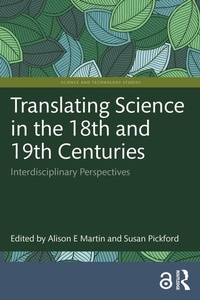
Translating Science in the 18th and 19th Centuries
Interdisciplinary Perspectives
Published on 28. May 2025
258 pages
978-1-040-36184-9 (ISBN)
Description

This book explores the role of translation in shaping the knowledge-sharing processes that were and are seminal to scientific endeavour. It considers the mechanisms by which eighteenth- and nineteenth-century European science writing travelled within and beyond its home continent and non- European science was taken up in a colonial context. Using insights from fields of research including book history and textual studies to investigate the paratextual framing, stylistic choices, rhetorical devices, and modes of expression deployed by scientific writers - key to shaping a work's credibility and its author's integrity -it argues that translators are central, yet largely overlooked, mediators in this creative process.
Encompassing West Africa, China, the Middle East, India, South America, Europe, and the Ottoman Empire, this volume comprises case studies working with around a dozen different languages to gain a sense of how scientific narratives were evolving both within and across an increasingly global intellectual commons in a key period in the development of the natural sciences, medicine, and technology.
Part of the Science and Technology Studies series, the volume will be indispensable for scholars and researchers of science and technology studies, philosophy of science, translation studies, gender studies, English literature, and philosophy in general.
Encompassing West Africa, China, the Middle East, India, South America, Europe, and the Ottoman Empire, this volume comprises case studies working with around a dozen different languages to gain a sense of how scientific narratives were evolving both within and across an increasingly global intellectual commons in a key period in the development of the natural sciences, medicine, and technology.
Part of the Science and Technology Studies series, the volume will be indispensable for scholars and researchers of science and technology studies, philosophy of science, translation studies, gender studies, English literature, and philosophy in general.
More details
Series
Language
English
Place of publication
London
United Kingdom
Publishing group
Taylor & Francis Ltd
Target group
College/higher education
Illustrations
4 Tables, black and white; 12 Halftones, black and white; 12 Illustrations, black and white
File size
2,58 MB
ISBN-13
978-1-040-36184-9 (9781040361849)
Copyright in bibliographic data and cover images is held by Nielsen Book Services Limited or by the publishers or by their respective licensors: all rights reserved.
Schweitzer Classification
Other editions
Additional editions
Alison E. Martin | Susan Pickford
Translating Science in the 18th and 19th Centuries
Interdisciplinary Perspectives
Book
05/2025
1st Edition
Routledge India
€63.80
Shipment within 10-20 days
Alison E. Martin | Susan Pickford
Translating Science in the 18th and 19th Centuries
Interdisciplinary Perspectives
Book
05/2025
1st Edition
Routledge India
€207.80
Shipment within 10-20 days
Persons
Alison E. Martin is Professor of British Studies at the Johannes Gutenberg University Mainz (Campus Germersheim). She has published extensively on translation studies, with a particular focus on travel literature, scientific writing, and gender. Her most recent monograph, Nature Translated: Alexander von Humboldt's Works in Nineteenth-Century Britain (2018), explores the role played by Humboldt's female translators in the transmission of scientific knowledge to a general audience in the nineteenth century. She is co-editor of The Handbook of Women and Science since 1660 (2022).
Susan Pickford is Head of the English Unit at the Faculty of Translation and Interpreting, University of Geneva. She has published widely on translation history, sociology, and book history, and recently completed a monograph on professional translators in nineteenth-century France. She has contributed articles on the early geologist Etheldred Benett to the 2015 special issue of the Journal of Literature and Science, 'Ingenious Minds: British Women as Facilitators of Scientific Knowledge Exchange, 1750-1900' and to the Women in the History of Science Source Book (2023).
Susan Pickford is Head of the English Unit at the Faculty of Translation and Interpreting, University of Geneva. She has published widely on translation history, sociology, and book history, and recently completed a monograph on professional translators in nineteenth-century France. She has contributed articles on the early geologist Etheldred Benett to the 2015 special issue of the Journal of Literature and Science, 'Ingenious Minds: British Women as Facilitators of Scientific Knowledge Exchange, 1750-1900' and to the Women in the History of Science Source Book (2023).
Content
Introduction Translation, Science, and Knowledge 1. Knowledge Production and Scientific Translations in Nineteenth-Century British India 2. British Astronomical Texts in Nineteenth-Century Chile: Andres Bello as a Pedagogical Translator 3. 'Tokens' Remained 'Tokens': Charles Lyell's Elements of Geology in China Terminology and the Languages of Science 4. Michel Adanson's Histoire naturelle du Senegal (1757) and His Use of Wolof in Scientific Terminology 5. Biological Nomenclature and Translation: The Case of Charles Darwin's Origin of Species and its Portuguese Translations 6. The Translation of Nineteenth-Century Medical Dictionaries Published in Spain and Its Effects on the Dissemination of Science Translation, Dissemination, and Nation 7. "Les opinions les plus accreditees parmi les geologues anglais": Translating Henry de la Beche's Geological Manual for the Continental Market 8. Translating Texts to Spread New Ideas: The Transmission of Modern European Scientific Materialism and Monism in Ottoman Intellectual Circles in the Long Nineteenth Century 9. Mediating Johann Georg Zimmermann's Erfahrung in France and Britain Science, Translation, and Ideology 10. Translating Alexander von Humboldt's Writings on the Americas in the Twenty-First Century 11. Translating M. et Mme/Mr. and Mrs: The Case of Male Scientific Translators in the Forging of Nineteenth-Century Natural Science by Women
