

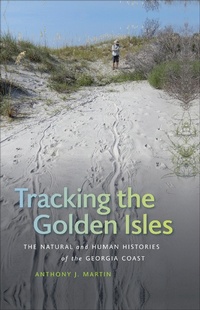
Tracking the Golden Isles
Description

With this collection of essays, Anthony J. Martin invites us to investigate animal and human traces on the Georgia coast and the remarkable stories these traces, both modern and fossil, tell us. Readers will learn how these traces enabled geologists to discover that the remains of ancient barrier islands still exist on the lower coastal plain of Georgia, showing the recession of oceans millions of years ago.
First, Martin details a solid but approachable overview of Georgia barrier island ecosystems-maritime forests, salt marshes, dunes, beaches-and how these ecosystems are as much a product of plant and animal behavior as they are of geology. Martin then describes animal tracks, burrows, nests, and other traces and what they tell us about their makers. He also explains how trace fossils can document the behaviors of animals from millions of years ago, including those no longer extant.
Next, Martin discusses the relatively scant history-scarcely five thousand years-of humans on the Georgia coast. He takes us from the Native American shell rings on Sapelo Island to the cobbled streets of Savannah paved with the ballast stones of slave ships. He also describes the human introduction of invasive animals to the coast and their effects on native species.
Finally, Martin's epilogue introduces the sobering idea that climate change, with its resultant extreme weather and rising sea levels, is the ultimate human trace affecting the Georgia coast. Here he asks how the traces of the past and present help us to better predict and deal with our uncertain future.
More details
Other editions
Additional editions
Persons
ANTHONY J. MARTIN is professor of practice in the Department of Environmental Sciences at Emory University. He is the author of two editions of the college textbook, Introduction to the Study of Dinosaurs, as well as Life Traces of the Georgia Coast, Dinosaurs without Bones, and his latest book, The Evolution Underground. His blog is Life Traces of the Georgia Coast. He is a fellow of the Explorers Club and of the Geological Society of America.
