

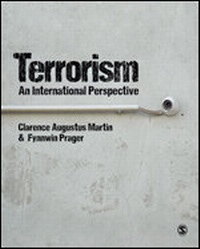
Terrorism
An International Perspective
1st Edition
Published on 16. January 2019
800 pages
978-1-5264-6166-7 (ISBN)
Description

A comprehensive investigation of modern terrorism and the global terrorist environment. The book uses a multidisciplinary approach and discusses an array of global case studies from the ideology of ISIS, to the Orlando Mass Shooting, and State-Sponsored Terrorism in Iran and Pakistan, to provide readers with an in-depth account of international terrorist violence, from its emergence through to events taking place today. Key topics examined in the book include:
The Causes of Terrorism
Terrorist Violence and the Role of the Media
Cyberterrorism
Gender-Selective Terrorism
The Lone Wolf Theory
The Future of Terrorism
The book is supported by online resources for students and lecturers, including: PowerPoint slides for each chapter, a sample syllabus, a list of films and documentaries related to key concepts in the book, and access to free SAGE journal articles.
Suitable reading for students studying Terrorism, International Terrorism, and Counter-terrorism.
The Causes of Terrorism
Terrorist Violence and the Role of the Media
Cyberterrorism
Gender-Selective Terrorism
The Lone Wolf Theory
The Future of Terrorism
The book is supported by online resources for students and lecturers, including: PowerPoint slides for each chapter, a sample syllabus, a list of films and documentaries related to key concepts in the book, and access to free SAGE journal articles.
Suitable reading for students studying Terrorism, International Terrorism, and Counter-terrorism.
Reviews / Votes
Dating from the 1970s, terrorism has evolved from a domestic to a transnational, global phenomenon: from ETA and the IRA to Al-Qa'ida and the Japanese Red Army. Yet, despite much analysis, the antecedents, causes and consequences of this product of modernity remains elusive for scholars, students and professional analysts alike. Clarence ("Gus") Martin and Fynnwin Prager do much to address this gap in our knowledge in this impressive and insightful volume. Weaving together theory and evidence, they comprehensively examine the evolution and contemporary forms of terrorism from a balanced, critical perspective that will inform academic and professional audiences alike. -- Simon Reich, Division of Global Affairs and Department of Political Science, Rutgers Newark A timely but very original contribution to the field of terrorism and homeland security. It provides a clear and holistic examination in terms of the events, ideas, motivations , theories and histories of terrorism.-- Zhenhua Chen, The Ohio State University A common theme runs through this astonishingly comprehensive study of terrorism. It is what Thucydides called war - 'the human thing'. This book, as the authors claim is, first and foremost a study in human behaviour. A rigorously researched, pioneering work packed with disturbing and at times arresting information. It is unlikely to be superseded for some time. -- Christopher Coker, Professor of International Relations at the LSE and Director of IDEAS, LSE's foreign policy think tank Terrorism is a masterful work with detailed accounts of the topic and approaches from a variety of angles. This comprehensive volume is indispensable and will appeal to readers well beyond the realm of terrorism studies. -- Scott N. Romaniuk
More details
Language
English
Place of publication
London
United Kingdom
Target group
College/higher education
ISBN-13
978-1-5264-6166-7 (9781526461667)
Copyright in bibliographic data and cover images is held by Nielsen Book Services Limited or by the publishers or by their respective licensors: all rights reserved.
Schweitzer Classification
Other editions
Additional editions
Book
01/2019
1st Edition
SAGE Publications Ltd
€186.60
Shipment within 15-20 days
Persons
Clarence Augustus "Gus" Martin is Professor Emeritus in the Department of Criminal Justice Administration at California State University, Dominguez Hills, where he teaches courses on criminal law, terrorism and extremism, and the criminal justice system. He served as the founding Chair of the department and as the founding Director of the School of Public Service and Justice. He also served as Associate Vice President for Human Resources Management, Acting Associate Dean of the College of Business Administration and Public Policy, Associate Vice President for Faculty Affairs, and Chair of the Department of Public Administration. He began his academic career as a member of the faculty of the Graduate School of Public and International Affairs, University of Pittsburgh, where he was an Administration of Justice professor. His current research and professional interests are terrorism and extremism, homeland security, and the administration of justice.
Dr. Martin is author of several books on the subjects of terrorism and homeland security, including Understanding Terrorism: Challenges, Perspectives, and Issues (SAGE Publications, 2025); Terrorism and WMDs: Awareness and Response, Third Edition (with John Pichtel, CRC Press, 2025); Understanding Homeland Security (SAGE Publications, 2024); The Handbook of Homeland Security (with Scott Romaniuk and Martin Scott Catino; Routledge, 2023); Essentials of Terrorism: Concepts and Controversies (SAGE Publications, 2022); Terrorism: An International Perspective (with Fynnwin Prager; SAGE Publications, 2019); The SAGE Encyclopedia of Terrorism, Second Edition (SAGE Publications, 2011); Terrorism and Homeland Security (SAGE, 2011); and The New Era of Terrorism: Selected Readings (SAGE Publications, 2004). He is also author of Juvenile Justice: Process and Systems (SAGE Publications, 2005).
Prior to joining academia, Dr. Martin served as Managing Attorney for the Fair Housing Partnership of Greater Pittsburgh, where he was also director of a program created under a federal consent decree to desegregate public and assisted housing. He was also Special Counsel to the Attorney General of the U.S. Virgin Islands on the island of St. Thomas. As Special Counsel, he occupied a personal and confidential position in the central office of the Department of Justice; sat as hearing officer for disciplinary hearings and departmental grievances; served as chair of the Drug Policy Committee; served as liaison to the intergovernmental Law Enforcement Coordinating Committee as well as to the Narcotics Strike Force; and provided daily legal and policy advice to the Attorney General. Prior to serving as Special Counsel, he was a "floor" Legislative Assistant to Congressman Charles B. Rangel of New York. As Legislative Assistant, he researched, evaluated and drafted legislation in areas of foreign policy, foreign aid, human rights, housing, education, social services, and poverty; he also drafted House floor statements, Congressional Record inserts, press releases, and news articles; and he composed speeches, briefing materials, and legislative correspondence.
Dr. Martin received his A.B. degree from Harvard College, J.D. from Duquesne University Thomas R. Kline School of Law, and Ph.D. from the Graduate School of Public and International Affairs at the University of Pittsburgh.
Fynnwin Prager is Assistant Professor of Public Administration and Co-Director of the Economics Institute at CSU Dominguez Hills, College of Business Administration and Public Policy. Previously, he was a Postdoctoral Research Associate at USC's Price School of Public Policy and Center for Risk and Economic Analysis of Terrorism Events (CREATE), and he remains affiliated with the Center. He received his PhD in Policy, Planning, and Development from the Price School, and his research and publications have focused on the policy and economics of disasters, particularly environmental and terrorism policy, and the impacts to regional economies and transportation systems. Dr. Prager's dissertation focused on climate policy, and used Computable General Equilibrium modeling to analyze the economic and distributional impacts of US federal emissions trading policy. He has also published on similar assessments of California's Global Warming Solutions Act (AB32) and co-founded Carbon Retirement, an innovative London-based carbon offsets company. Fynnwin has worked on studies for numerous organizations, including U.S. Customs and Border Protection, U.S. National Biosurveillance Integration Center, World Trade Center, Los Angeles, and South Bay Workforce Investment Board on the economic impacts of trade facilitation, airport wait times, influenza epidemics, foreign business investments and new technologies.
Dr. Martin is author of several books on the subjects of terrorism and homeland security, including Understanding Terrorism: Challenges, Perspectives, and Issues (SAGE Publications, 2025); Terrorism and WMDs: Awareness and Response, Third Edition (with John Pichtel, CRC Press, 2025); Understanding Homeland Security (SAGE Publications, 2024); The Handbook of Homeland Security (with Scott Romaniuk and Martin Scott Catino; Routledge, 2023); Essentials of Terrorism: Concepts and Controversies (SAGE Publications, 2022); Terrorism: An International Perspective (with Fynnwin Prager; SAGE Publications, 2019); The SAGE Encyclopedia of Terrorism, Second Edition (SAGE Publications, 2011); Terrorism and Homeland Security (SAGE, 2011); and The New Era of Terrorism: Selected Readings (SAGE Publications, 2004). He is also author of Juvenile Justice: Process and Systems (SAGE Publications, 2005).
Prior to joining academia, Dr. Martin served as Managing Attorney for the Fair Housing Partnership of Greater Pittsburgh, where he was also director of a program created under a federal consent decree to desegregate public and assisted housing. He was also Special Counsel to the Attorney General of the U.S. Virgin Islands on the island of St. Thomas. As Special Counsel, he occupied a personal and confidential position in the central office of the Department of Justice; sat as hearing officer for disciplinary hearings and departmental grievances; served as chair of the Drug Policy Committee; served as liaison to the intergovernmental Law Enforcement Coordinating Committee as well as to the Narcotics Strike Force; and provided daily legal and policy advice to the Attorney General. Prior to serving as Special Counsel, he was a "floor" Legislative Assistant to Congressman Charles B. Rangel of New York. As Legislative Assistant, he researched, evaluated and drafted legislation in areas of foreign policy, foreign aid, human rights, housing, education, social services, and poverty; he also drafted House floor statements, Congressional Record inserts, press releases, and news articles; and he composed speeches, briefing materials, and legislative correspondence.
Dr. Martin received his A.B. degree from Harvard College, J.D. from Duquesne University Thomas R. Kline School of Law, and Ph.D. from the Graduate School of Public and International Affairs at the University of Pittsburgh.
Fynnwin Prager is Assistant Professor of Public Administration and Co-Director of the Economics Institute at CSU Dominguez Hills, College of Business Administration and Public Policy. Previously, he was a Postdoctoral Research Associate at USC's Price School of Public Policy and Center for Risk and Economic Analysis of Terrorism Events (CREATE), and he remains affiliated with the Center. He received his PhD in Policy, Planning, and Development from the Price School, and his research and publications have focused on the policy and economics of disasters, particularly environmental and terrorism policy, and the impacts to regional economies and transportation systems. Dr. Prager's dissertation focused on climate policy, and used Computable General Equilibrium modeling to analyze the economic and distributional impacts of US federal emissions trading policy. He has also published on similar assessments of California's Global Warming Solutions Act (AB32) and co-founded Carbon Retirement, an innovative London-based carbon offsets company. Fynnwin has worked on studies for numerous organizations, including U.S. Customs and Border Protection, U.S. National Biosurveillance Integration Center, World Trade Center, Los Angeles, and South Bay Workforce Investment Board on the economic impacts of trade facilitation, airport wait times, influenza epidemics, foreign business investments and new technologies.
Content
Part I. Terrorism: A Conceptual Review
Chapter 1. Terrorism: First Impressions
Chapter 2. The Nature of the Beast: Defining Terrorism
Chapter 3. The Past as Prologue: History of Terrorism
Chapter 4. Beginnings: The Causes of Terrorism
Part II. The Terrorists
Chapter 5. Terror From Above: Terrorism by the State
Chapter 6. Terror From Below: Terrorism by Dissidents
Chapter 7. Violence in the Name of the Faith: Religious Terrorism
Chapter 8. Violent Ideologies: Terrorism From the Left and Right
Chapter 9. Terrorist Spillovers: International Terrorism
Chapter 10. Emerging Terrorist Environments: Gender-Selective Political Violence and Criminal Dissident Terrorism
Part III. The Terrorist Trade and Counterterrorism
Chapter 11. Tools of the Trade: Tactics and Targets of Terrorists
Chapter 12. The Information Battleground: Terrorist Violence and the Role of the Media
Chapter 13. Counterterrorism: The Options
Part IV. Final Analysis
Chapter 14. Domestic Security: A Comparative Analysis
15. What Next? The Future of Terrorism
Glossary
Chapter 1. Terrorism: First Impressions
Chapter 2. The Nature of the Beast: Defining Terrorism
Chapter 3. The Past as Prologue: History of Terrorism
Chapter 4. Beginnings: The Causes of Terrorism
Part II. The Terrorists
Chapter 5. Terror From Above: Terrorism by the State
Chapter 6. Terror From Below: Terrorism by Dissidents
Chapter 7. Violence in the Name of the Faith: Religious Terrorism
Chapter 8. Violent Ideologies: Terrorism From the Left and Right
Chapter 9. Terrorist Spillovers: International Terrorism
Chapter 10. Emerging Terrorist Environments: Gender-Selective Political Violence and Criminal Dissident Terrorism
Part III. The Terrorist Trade and Counterterrorism
Chapter 11. Tools of the Trade: Tactics and Targets of Terrorists
Chapter 12. The Information Battleground: Terrorist Violence and the Role of the Media
Chapter 13. Counterterrorism: The Options
Part IV. Final Analysis
Chapter 14. Domestic Security: A Comparative Analysis
15. What Next? The Future of Terrorism
Glossary
