

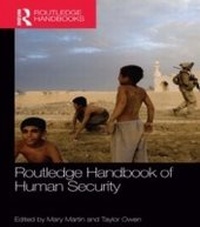
Routledge Handbook of Human Security
1st Edition
Published on 7. November 2013
368 pages
978-1-134-61973-3 (ISBN)
Description

This Handbook will serve as a standard reference guide to the subject of human security, which has grown greatly in importance over the past twenty years.
Human security has been part of academic and policy discourses since it was first promoted by the UNDP in its 1994 Human Development Report. Filling a clear gap in the current literature, this volume brings together some of the key scholars and policy-makers who have contributed to its emergence as a mainstream concept, including Nobel prize winner Amartya Sen and Sadako Ogata, who jointly chaired the 2001 Commission on Human Security. Drawing upon a range of theoretical and empirical analyses, the Handbook provides examples of the use of human security in policies as diverse as disaster management, arms control and counter-terrorism, and in different geographic and institutional settings from Asia to Africa, and the UN. It also raises important questions about how the concept might be adapted and operationalised in future.
Over the course of the book, the authors draw on three key aspects of human security thinking:
Theoretical issues to do with defining human security as a specific discourse
Human security from a policy and institutional perspective, and how it is operationalised in different policy and geographic contexts
Case studies and empirical work
Featuring some of the leading scholars in the field, the Routledge Handbook of Human Security will be essential reading for all students of human security, critical security, conflict and development, peace and conflict studies, and of great interest to students of international security and IR in general.
Human security has been part of academic and policy discourses since it was first promoted by the UNDP in its 1994 Human Development Report. Filling a clear gap in the current literature, this volume brings together some of the key scholars and policy-makers who have contributed to its emergence as a mainstream concept, including Nobel prize winner Amartya Sen and Sadako Ogata, who jointly chaired the 2001 Commission on Human Security. Drawing upon a range of theoretical and empirical analyses, the Handbook provides examples of the use of human security in policies as diverse as disaster management, arms control and counter-terrorism, and in different geographic and institutional settings from Asia to Africa, and the UN. It also raises important questions about how the concept might be adapted and operationalised in future.
Over the course of the book, the authors draw on three key aspects of human security thinking:
Theoretical issues to do with defining human security as a specific discourse
Human security from a policy and institutional perspective, and how it is operationalised in different policy and geographic contexts
Case studies and empirical work
Featuring some of the leading scholars in the field, the Routledge Handbook of Human Security will be essential reading for all students of human security, critical security, conflict and development, peace and conflict studies, and of great interest to students of international security and IR in general.
More details
Edition
1. Auflage
Language
English
Place of publication
London
United Kingdom
Publishing group
Taylor & Francis Ltd
Target group
College/higher education
Professional and scholarly
Illustrations
4 s/w Tabellen, 9 s/w Zeichnungen
4 Tables, black and white; 9 Line drawings, black and white
File size
2,10 MB
ISBN-13
978-1-134-61973-3 (9781134619733)
Copyright in bibliographic data and cover images is held by Nielsen Book Services Limited or by the publishers or by their respective licensors: all rights reserved.
Schweitzer Classification
Other editions
Additional editions
Mary Martin | Taylor Owen
Routledge Handbook of Human Security
Book
09/2015
1st Edition
Routledge
€84.36
Shipment within 10-20 days
Mary Martin | Taylor Owen
Routledge Handbook of Human Security
Book
10/2013
1st Edition
Routledge
€332.60
Shipment within 15-20 days
Persons
Mary Martin is a Research Fellow at the Civil Society and Human Security Research Unit, London School of Economics, UK.
Taylor Owen is the Research Director of the Tow Center for Digital Journalism at Columbia University, USA.
Taylor Owen is the Research Director of the Tow Center for Digital Journalism at Columbia University, USA.
Content
Introduction, Mary Martin and Taylor Owen Part I: Concepts of Human Security 1. Birth of a Discourse, Amartya Sen 2. From definitions to investigating a discourse, Des Gasper 3. In Defense of the Broad View of Human Security, Shahrbanou Tadjbakhsh 4. Human Security Thresholds, Taylor Owen 5. Filling the security gap. Human Security, Human Rights and Human Development, Mary Kaldor 6. Critical Perspectives on Human Security, Keith Krause 7. The Siren Song of Human Security, Ryerson Christie 8. Why Human Security?The Case for Resilience in an Urban Century, Peter Liotta and Aybueke Bilgin Part II: Human Security Applications 9. Violent conflict and the individual security dilemma, Mient Jan Faber and Martijn Dekker 10. Security and development. Context specific approaches to human insecurity, Richard Jolly 11. Human Security in the R2P Era, Lloyd Axworthy 12. Human Security and War, Jennifer Leaning 13. Human Security and Natural Disasters, Thea Hilhorst, Alp Ozerdem and Erin Smith 14. Food and Human Security, Robert Bailey 15. Navigating the 'national security' barrier:a human security agenda for arms control in the 21st century, Deepayan Basu Ray 16. Adjusting the Paradigm: A Human Security Framework for Combating Terrorism, Cindy R. Jebb and Andrew A. Gallo Part III: Human Security Actors 17. The United Nations and Human Security: Between Solidarism and Pluralism, Edward Newman 18. Japan and Networked Human Security, Yukio Takasu 19. The European Union and Human Security. The making of a global security actor, Javier Solana 20. The Pan-Africanization of Human Security, Thomas Kwasi Tieku 21. Human Security and Asia, Paul Evans Part IV: Human Security Tools 22. Econometrics and human security, Mansoob Murshed 23. From Concept to Method: The challenge of a human security methodology, Mary Martin and Denisa Kostovicova 25. Human Security Mapping, Taylor Owen 25. Human security: idea, policy, and law, Gerd Oberleitner Conclusion, Taylor Owen and Mary Martin
