

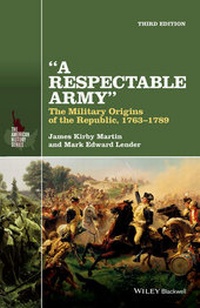
A Respectable Army
Description

Reviews / Votes
"This new edition of a landmark study incorporates the latest scholarship on the Revolutionary War, and presents the conflict in a unified and accessible manner. It is vital to any comprehensive understanding of America's definitive conflict." Edward G. Lengel , Professor and Director, Papers of George Washington, University of Virginia "A Respectable Army is an insightful, well-written account of the enduring legacy of America's war of independence. The authors have done a wonderful job turning their research into an immensely readable narrative." Terry Golway, Director, Kean University Center for History, Politics and Policy "There can be no finer introduction to the military history of the American Revolution and the character of the Continental Army than this classic study." David L. Preston, Professor of History, The CitadelMore details
Other editions
Additional editions
Persons
Content
1
Of Lexington and Concord, and the Myths of the War, 1763-1775
Lexington and Concord
At dawn on April 19, 1775, a select force of 700 British regulars under the command of Lieutenant Colonel Francis Smith approached the outer edges of Lexington, Massachusetts. The column had set out from Boston the night before under instructions from Thomas Gage, the commander in chief of British military forces in North America as well as the new royal governor of the Bay Colony. Gage had ordered the column to capture and destroy patriot military stores at Concord, another six miles beyond Lexington. The redcoat operation was to have been secret, but many officers in Boston talked unguardedly about the details. Patriot alarm riders had alerted the countryside. As Smith's advance units under Major John Pitcairn marched into Lexington, they saw some 70 minutemen assembling on the Green. Captain John Parker, the minuteman leader, was no fool. Completely outnumbered, his intention that fateful morning was not to provoke a fight with the British regulars but to demonstrate whig resolve-to state through the presence of his small militia force that troops of the King's standing army had no legal right in time of peace to trample on the property of freeborn English subjects.
Acting thus as an army of observation, Parker and his troops intended to leave the field once they had made their symbolic martial protest. Witnesses agreed that a British officer rode forward and ordered the minutemen to disperse. Then, as the defiant patriots began to move aside, a shot rang out. No one knows who fired first, but before the smoke cleared and Pitcairn had restored order, eight colonists lay dead or dying with another 10 wounded. Some had been shot or bayoneted to death in their backs. That the redcoats had lost control of themselves chagrined Pitcairn, but he could not turn back the clock. Perhaps he comprehended the grave reality that a civil war that would have profound short- and long-term consequences throughout the western world had just begun.
Within minutes, the redcoats moved on toward Concord, their intended target. There they started to burn or toss into the village pond whatever military stores the patriots had failed to remove. Meanwhile, news of the bloodshed at Lexington swept far and fast. Militiamen began moving toward Concord. Half a mile from town, across the North Bridge, one group of armed freeholders, seeing the rising smoke and fearing that Concord was being put to the torch, pressed forward. The time was 8:30?a.m. Fighting flared between the advancing militia and a British light infantry company guarding the bridge. The outnumbered regulars soon retreated, leaving behind three dead comrades; another eight in their unit had received wounds. Blood now had been spilled on both sides.
Lieutenant Colonel Smith, a portly gentleman not known for quick decisions, slowly realized that his units were in a precarious position. Partisan colonials were gathering on all sides. After some vacillation, Smith ordered his troops to pull out. Citizen-soldiers raked the retreating royal column from behind trees, stone fences, and any other available cover. "We were fired on from all sides," explained a dispirited British lieutenant. He and his comrades could not counter the sniping because the patriots "were so concealed there was hardly any seeing them." Such action went on all the way back to Lexington, with American "numbers increasing from all parts, while ours was reducing by deaths, wounds, and fatigue; and we were totally surrounded with such an incessant fire as it's impossible to conceive."
At Lexington, Smith's beleaguered redcoats linked up with a relief column. General Gage, suspecting the worst, had sent out Hugh, Lord Percy, with another 1,100 regulars. Even with these reinforcements and flanking parties challenging the Minutemen, the British continued to suffer heavily as they retreated from Lexington to Charlestown and Bunker Hill, which they reached at sundown. Of the 1,800 British regulars engaged in combat that day, 273 were killed, wounded, or missing. Counting the Lexington slain, the provincials had lost 95. What had begun as a sortie to destroy supplies had become a full-scale military confrontation, and the British regulars had fared poorly in comparison to the armed American amateurs who stood up in defense of family and property.
The battles of Lexington and Concord set in motion a civil war that would last for eight years, until 1783. Along with other events that soon followed, the martial clash on April 19, 1775, also has served to give credence to an enduring historical mythology about the Revolutionary era. Down to our own time, this mythology has dominated the conceptions that Americans hold about their national origins and their nation as an agency of peace in a sordid, warlike world.
Drawing lifeblood from the battles of Lexington and Concord, the dominant strands in the mythology about the War for Independence may be stated as follows: 1) that provincial Americans were reluctantly forced into war by their overbearing, if not tyrannical parent nation, Great Britain; 2) that the determined colonists willingly displayed public virtue and stouthearted commitment, rushing into combat as citizen-soldiers and steadfastly bearing arms through eight long years of military conflict; and 3) that, united as one family in the cause, they overcame the enemy after hundreds of battles, large and small, thereby assuring through their virtuous behavior that a republican political order would flourish and endure in post-Revolutionary America.
As with any national mythology, some truth (perhaps better stated as accurate observation) may be found in each of these strands. Otherwise, the mythology would have long since been dismissed as literary or patriotic conceit, worthy of study because of metaphorical form and symbolic effect but not because of factual substance. Just enough plausibility exists in these strands to make them believable-up to a limited point. Then they begin to fray and unravel.
One purpose of this volume is to separate popular mythology, aspects of which professional historians have too often enshrined in their writings, from the new historical reality that continues to come to light about the era of the American Revolution, of which the War for Independence was an integral part. Another purpose is to present a synthesis of the fragments of this new reality. As such, this study investigates how the experience of the war affected the establishment of republican values and institutions in Revolutionary America. Many historians have approached the war as an exclusive "guns-and-battles" phenomenon, not linking the conflict in any way to the larger currents of nation-making. The actual experience of the war, however, with all its hope, idealism, conflict, and dissension, was central to the process of constructing a specific form of well-ordered republicanism, as ultimately expressed in the Constitution of 1787. This examination of the historical evidence proposes that the military origins of American republic in the years 1763-89 should not only be evaluated but also given their rightful place in more completely constructing the history of the American Revolution.
The story must begin with Lexington and Concord because the salient features of the opening clash lent persuasive form to the deeply entrenched mythology. These qualities may be summarized by pointing out that the British army ostensibly invaded a peaceful countryside, thereby provoking the initial provincial response. The British force consisted of well-trained and disciplined regulars, representing a textbook standing army acting without provocation in time of peace. In turn, swarms of freedom-loving citizens beat back the regulars by using irregular tactics. Citizen-soldiers organized as militia found themselves in the position of fighting defensively to protect their liberties and property. Thus the beginning of the war fit neatly into the radical whig ideological mood of the era. For the colonists, the presence of Britain's standing army symbolized the abuse of power. The citizen-soldiers of Massachusetts personified virtuous protectors of liberty.
What commentators, among them some historians, have not appreciated is that the Lexington and Concord paradigm came apart quite early. By fitting this model into the whole of the Revolutionary War, they have skewed their interpretations about the nature of the conflict that followed, including such central issues as the depth and tenacity of patriot commitment, the actual nature of the American military effort, the matter of who actually accepted the burdens of combat, and the effect of the military confrontation in establishing a sense of national legitimacy, nationhood, and republicanism. To move forward from mythology, this study must begin with the ideological roots of the American rebellion that did reflect the experience of Lexington and Concord.
Of Standing Armies (Power) and Militia (Liberty)
An understanding of the ideological framework that helped structure the world view of eighteenth-century American colonists is of prime importance in reconciling treasured myth with historical reality. A key underlying assumption was that of an ongoing struggle between power and liberty, based on the view that human beings naturally lusted after power and would resort to any form of corruption to satisfy their petty, self-serving objectives....
