

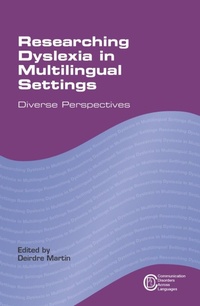
Researching Dyslexia in Multilingual Settings
Diverse Perspectives
Published on 4. October 2013
200 pages
978-1-78309-067-9 (ISBN)
Description

This volume draws together current research on dyslexia and literacy in multilingual settings across disciplines and methodologies. The contributors, all internationally recognised in the field, address developmental and acquired literacy difficulties and dyslexia in a range of language contexts including EAL/EFL. The book uses theories and analytical frameworks of a critical nature to reveal prejudicial social practices, and suggests future research directions towards a critical re-consideration of current understandings of dyslexia in multilingual settings, with a view to foregrounding the potential for interdisciplinarity. The book also suggests ways forward for evidence-informed practice, and it will be a valuable resource for researchers, practitioners and students alike.
Reviews / Votes
Research into reading disability has tended to focus rather too heavily upon the English language. This book offers a valuable corrective that will be of significant interest to all those who seek to understand the problems of those who struggle to read. * Julian Elliott, Durham University, UK * This volume constitutes a refreshing and valuable multidisciplinary contribution to the existing literature at the nexus of three intersecting fields: Literacy Studies, Multilingual Studies and the dichotomized field that focuses dyslexia. The contributions in the volume have relevance for both the fields themselves, but also for institutions like schools and work places. * Sangeeta Bagga-Gupta, *More details
Series
Language
English
Place of publication
Bristol
United Kingdom
Publishing group
Channel View Publications Ltd
Target group
Professional and scholarly
ISBN-13
978-1-78309-067-9 (9781783090679)
Copyright in bibliographic data and cover images is held by Nielsen Book Services Limited or by the publishers or by their respective licensors: all rights reserved.
Schweitzer Classification
Other editions
Additional editions
Book
10/2013
Multilingual Matters
€42.30
Shipment within 10-20 days
Person
Deirdre Martin is a Senior Lecturer in the School of Education, University of Birmingham, UK. Her research interests include speech, language and literacy disabilities in multilingual contexts, research methods and the relationship between research and professional practice. Her publications include Language Disabilities in Cultural and Linguistic Diversity (2009, Multilingual Matters).
Content
Introduction: Deirdre Martin: Researching Dyslexia in Multilingual Settings: Diverse Perspectives
Chapter 1. John Everatt, Gavin Reid and Gad Elbeheri: Assessment Approaches for Multilingual Learners with Dyslexia
Chapter 2. Richard L. Sparks: Individual Differences in Foreign (Second) Learning: A Cognitive Approach
Chapter 3. Carol Goldfus: Cognitive Intervention to Enhance Foreign Language Reading Comprehension in Adolescents with Dyslexia Difficulties
Chapter 4. Judit Kormos: Assessing Research on Dyslexic Language Learners in EFL Contexts
Chapter 5. Brendan Stuart Weekes, I-Fan Su, Carol To and Anastasia Ulicheva: Acquired Dyslexia in Bilingual Speakers: Implications for Models of Oral Reading
Chapter 6. Maria Rontou: Implementation of National Policy on Dyslexia in EFL Provision
Chapter 7. Jean Conteh: Multilingual Literacies in Mainstream Classroom Contexts
Chapter 8. Bobbie Kabuto: Becoming Biliterate within the Crossroads of Home and School: Insights Gained from Taking Multiple Theoretical Stances
Chapter 1. John Everatt, Gavin Reid and Gad Elbeheri: Assessment Approaches for Multilingual Learners with Dyslexia
Chapter 2. Richard L. Sparks: Individual Differences in Foreign (Second) Learning: A Cognitive Approach
Chapter 3. Carol Goldfus: Cognitive Intervention to Enhance Foreign Language Reading Comprehension in Adolescents with Dyslexia Difficulties
Chapter 4. Judit Kormos: Assessing Research on Dyslexic Language Learners in EFL Contexts
Chapter 5. Brendan Stuart Weekes, I-Fan Su, Carol To and Anastasia Ulicheva: Acquired Dyslexia in Bilingual Speakers: Implications for Models of Oral Reading
Chapter 6. Maria Rontou: Implementation of National Policy on Dyslexia in EFL Provision
Chapter 7. Jean Conteh: Multilingual Literacies in Mainstream Classroom Contexts
Chapter 8. Bobbie Kabuto: Becoming Biliterate within the Crossroads of Home and School: Insights Gained from Taking Multiple Theoretical Stances
