

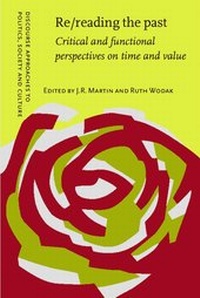
Re/reading the past
Critical and functional perspectives on time and value
1st Edition
Published on 17. November 2003
VI, 277 pages
978-90-272-9602-3 (ISBN)
Description

Re/reading the Past is concerned with the discourses of history, from the complementary perspectives of Critical Discourse Analysis (CDA) and Systemic Functional Linguistics (SFL). The papers in the book stress the discursive construction of the past, focussing on the different social narratives which compete for official acknowledgement. Issues of collective and cultural memory are addressed, reflecting the "linguistic turn" in the Social Sciences. The book covers a range of discourses, interpreting texts from popular culture to academic discourse including the construction and evaluation of past events in a variety of places around the world. It is especially timely in its focus on the construction of time and value in a post-colonial world where history discourses are central to on-going processes of reconciliation, debates on war crimes, and the issues of amnesty and restitution. As such the book fills a significant gap in interdisciplinary debates as well as in register and genre analysis, and will be of general interest to historians, political scientists and discourse analysts as well as students and teachers of ESP (English for Specific Purposes) and EAP (English for Academic Purposes).
More details
Other editions
Additional editions
Book
11/2003
John Benjamins Publishing Co
€116.60
Shipment within 10-15 days
Persons
Content
- Re/reading the past
- Editorial page
- Title page
- LCC page
- Table of contents
- Introduction
- Aims and scope
- SFL perspectives
- CDA perspectives
- Discourses on/about history
- History as discourse
- Preview
- References
- Part I. Constructing time and value
- Making history
- Past in present
- Whose history?
- Marking time
- Abstraction
- Cause
- Value
- Arguing
- Mapping histories
- Deconstructing history
- More to history
- Notes
- Texts cited
- References
- Part II. Recent past
- News as history
- Introduction
- The issues reports, genre structure and patterns of evaluation
- Event stories and patterns of evaluation
- The rhetorical functionality of the standard news report
- Conclusion: News as narrative or gossip
- Notes
- References
- Challenging media censoring
- Introduction
- Language as a medium in reporting news
- Contextual information
- The functions of news reports
- The functions of news reports generally
- The functions of censorship
- The functions of news reports which defy censorship
- The form of news reports which defy censorship
- Linguistic theory in analysis of news reports
- Relating form to function in specific censorship-defying texts
- Visibly crossing out potentially offensive words and phrases (see Figure 2)
- Direct reference to the restrictions
- indirect reference to restricted material (see Figure 3)
- Verbal as opposed to visual images (see Figure 4)
- Notes
- References
- Part III. Distant past
- The discursive construction of individual memories
- Introduction
- The construction of history
- Methodology
- The strategies surveyed
- The strategy of ``claiming victim-hood''
- The strategy of ``knowledge maintenance''
- The strategy of positive self-construction
- Strategic agency
- Notes
- References
- The languages of the past
- Introduction
- Theoretical framework
- Historical survey
- Setting and content of the TV discussion
- Strategies in the presentation of different historical views
- The term Austro-Fascism as a membership categorisation device
- The German Wehrmacht
- Turning stories into history: The role of the moderator
- Conclusion
- Notes
- References
- Orthopraxy, writing and identity
- Introduction
- Orthopraxy and having a life
- Two histories
- Borrowed genres
- The relocation of resources and functions
- Conclusion: Orthopraxy, genre and subjectivity
- Note
- References
- Appendix 1
- Appendix 2
- History as discourse
- discourse as history
- Background
- History and national identity
- Preferred readings
- Analysis
- Conditions of production
- Textual analysis
- Selection of texts
- A transformational model of text selection
- The language of the texts
- Conditions of reception
- Conclusion
- Notes
- References
- Part IV. Yesteryear
- Reconstruals of the past - settlement or invasion?
- Introduction. Approaches to history as a discursive practice: The role of evaluation
- Systems for giving value to the past: A systemic linguistic perspective
- Judging the past
- Reconstruals of the past - settlement or invasion? (A judgement analysis)
- Patterns of judgement in school history narratives: `Objectivity' as a rhetorical effect
- The contemporary history classroom - tools for revaluing the past
- Conclusion: The value of `value' tools
- References
- Pearl Harbor in Japanese high school history textbooks
- Introduction
- Background to the history controversy in Japan
- Data and methodology
- Analysis
- Participants and processes
- Primacy of meaning
- Recapitulation
- Statistical analysis
- Attacker and Attack
- Primacy of meaning
- Conclusion
- Notes
- References
- Examples from the following textbooks have been quoted in this paper
- Index
- The series DISCOURSE APPROACHES TO POLITICS, SOCIETY AND CULTURE
