

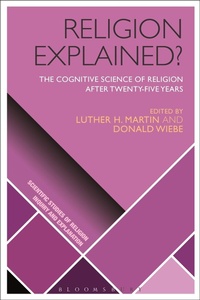
Religion Explained?
The Cognitive Science of Religion After Twenty-Five Years
1st Edition
Published on 21. September 2017
272 pages
978-1-350-03248-4 (ISBN)
Description

With contributions from founders of the field, including Justin Barrett, E. Thomas Lawson, Robert N. McCauley, Paschal Boyer, Armin Geertz and Harvey Whitehouse, as well as from younger scholars from successive stages in the field's development, this is an important survey of the first twenty-five years of the cognitive science of religion.
Each chapter provides the author's views on the contributions the cognitive science of religion has made to the academic study of religion, as well as any shortcomings in the field and challenges for the future. Religion Explained? The Cognitive Science of Religion after Twenty-five Years calls attention to the field whilst providing an accessible and diverse survey of approaches from key voices, as well as offering suggestions for further research within the field.
This book is essential reading for anyone in religious studies, anthropology, and the scientific study of religion.
Each chapter provides the author's views on the contributions the cognitive science of religion has made to the academic study of religion, as well as any shortcomings in the field and challenges for the future. Religion Explained? The Cognitive Science of Religion after Twenty-five Years calls attention to the field whilst providing an accessible and diverse survey of approaches from key voices, as well as offering suggestions for further research within the field.
This book is essential reading for anyone in religious studies, anthropology, and the scientific study of religion.
More details
Series
Edition
1. Auflage
Language
English
Place of publication
London
United Kingdom
Publishing group
Bloomsbury Publishing PLC
Target group
Professional and scholarly
Illustrations
6 BW illus
ISBN-13
978-1-350-03248-4 (9781350032484)
Copyright in bibliographic data and cover images is held by Nielsen Book Services Limited or by the publishers or by their respective licensors: all rights reserved.
Schweitzer Classification
Other editions
Additional editions
Luther H. Martin | Donald Wiebe
Religion Explained?
The Cognitive Science of Religion after Twenty-five Years
Book
03/2019
Bloomsbury Academic
€62.08
Shipment within 15-20 days
Luther H. Martin | Donald Wiebe
Religion Explained?
The Cognitive Science of Religion after Twenty-five Years
Book
09/2017
Bloomsbury Academic
€161.80
Shipment within 15-20 days
Persons
Luther H. Martin is Professor of Religion Emeritus at the University of Vermont, USA.
Donald Wiebe is Professor of Philosopy of Religion, Trinity College, University of Toronto, Canada.
Donald Wiebe is Professor of Philosopy of Religion, Trinity College, University of Toronto, Canada.
Content
List of contributors
Introduction: Religion Explained? The Cognitive Science of Religion after Twenty-five Years, Luther H. Martin (University of Vermont, USA) and Donald Wiebe (University of Toronto, Canada)
Part One: Retrospectives
1. The Cognitive Science of Religion and the Growth of Knowledge, E. Thomas Lawson (Queen's University, Belfast, UK)
2. Twenty-Five Years In: Landmark Empirical Findings in the Cognitive Science of Religion, Robert N. McCauley (Emory University, USA)
3. Twenty-Five Years of CSR: A Personal Retrospective, Harvey Whitehouse (University of Oxford, UK)
4. The Beautiful Butterfly: On the History and Prospects of the Cognitive Science of Religion,
Uffe Schjødt & Armin W. Geertz (Aarhus University, Denmark)
Part Two: State of the Art
5. Religion Explained? Some Variants of Cognitive Theory, Stewart Elliott Guthrie, (Fordham University, USA)
6. Cognitive Attractors in the Evolution and Diffusion of Religious Representations, Pascal Boyer (Washington University in St. Louis) & Nicolas Baumard (École Normale Supérieure Paris, France)
7. The Long Way from Cognitive Science to History: To Shorten the Distance and Fill in the Blanks, Panayotis Pachis & Olympia Panagiotidou (Aristotle University of Thessaloniki, Greece)
8. The Indispensability of Cognitive Science for a Genuine History of Religion, Anders Klostergaard Petersen (Aarhus University, Denmark)
Part Three: CSR 2.0
9. Exiting the Motel of the Mysteries? How Historiographical Floccinaucinihilipilification Is Affecting CSR 2.0, Leonardo Ambasciano (Masaryk University, Czech Republic)
10. Minimal Counterintuitiveness Revisited, Again: The Role of Emotional Valence in Memory for Conceptual Incongruity, Micheala Porubanova (State University of New York, Farmingdale, USA) & John H. Shaver (Victoria University of Wellington)
11. Constraints on Theory-Building in the Cognitive Science of Religion with Reflections on the Influence of Physics Envy and the Principle of Sufficient Reason, Benson Saler & Charles A. Ziegler (Brandeis University, USA)
12. The Effects of Relative Stable Feedback Loops: Cognitive Science and Historical Explanations, Jesper Sørensen (Aarhus University, Denmark)
Part Four: Looking Forward
13. The Road Not Taken: Possible Paths for the Cognitive Science of Religion, Richard Sosis (University of Connecticut, USA)
14. Looking Back to Look Forward: From Shannon and Turing to Lawson and McCauley to...?, Justin Lane (Boston University, USA)
15. A Neo-Victorian Cognitive Science of Religion, Steven Hrotic (Independent Scholar)
Conclusion
16. On Keeping Cognitive Science of Religion Cognitive and Cultural, Justin L. Barrett (Fuller Theological Seminary, USA)
Bibliography
Index
Introduction: Religion Explained? The Cognitive Science of Religion after Twenty-five Years, Luther H. Martin (University of Vermont, USA) and Donald Wiebe (University of Toronto, Canada)
Part One: Retrospectives
1. The Cognitive Science of Religion and the Growth of Knowledge, E. Thomas Lawson (Queen's University, Belfast, UK)
2. Twenty-Five Years In: Landmark Empirical Findings in the Cognitive Science of Religion, Robert N. McCauley (Emory University, USA)
3. Twenty-Five Years of CSR: A Personal Retrospective, Harvey Whitehouse (University of Oxford, UK)
4. The Beautiful Butterfly: On the History and Prospects of the Cognitive Science of Religion,
Uffe Schjødt & Armin W. Geertz (Aarhus University, Denmark)
Part Two: State of the Art
5. Religion Explained? Some Variants of Cognitive Theory, Stewart Elliott Guthrie, (Fordham University, USA)
6. Cognitive Attractors in the Evolution and Diffusion of Religious Representations, Pascal Boyer (Washington University in St. Louis) & Nicolas Baumard (École Normale Supérieure Paris, France)
7. The Long Way from Cognitive Science to History: To Shorten the Distance and Fill in the Blanks, Panayotis Pachis & Olympia Panagiotidou (Aristotle University of Thessaloniki, Greece)
8. The Indispensability of Cognitive Science for a Genuine History of Religion, Anders Klostergaard Petersen (Aarhus University, Denmark)
Part Three: CSR 2.0
9. Exiting the Motel of the Mysteries? How Historiographical Floccinaucinihilipilification Is Affecting CSR 2.0, Leonardo Ambasciano (Masaryk University, Czech Republic)
10. Minimal Counterintuitiveness Revisited, Again: The Role of Emotional Valence in Memory for Conceptual Incongruity, Micheala Porubanova (State University of New York, Farmingdale, USA) & John H. Shaver (Victoria University of Wellington)
11. Constraints on Theory-Building in the Cognitive Science of Religion with Reflections on the Influence of Physics Envy and the Principle of Sufficient Reason, Benson Saler & Charles A. Ziegler (Brandeis University, USA)
12. The Effects of Relative Stable Feedback Loops: Cognitive Science and Historical Explanations, Jesper Sørensen (Aarhus University, Denmark)
Part Four: Looking Forward
13. The Road Not Taken: Possible Paths for the Cognitive Science of Religion, Richard Sosis (University of Connecticut, USA)
14. Looking Back to Look Forward: From Shannon and Turing to Lawson and McCauley to...?, Justin Lane (Boston University, USA)
15. A Neo-Victorian Cognitive Science of Religion, Steven Hrotic (Independent Scholar)
Conclusion
16. On Keeping Cognitive Science of Religion Cognitive and Cultural, Justin L. Barrett (Fuller Theological Seminary, USA)
Bibliography
Index
