

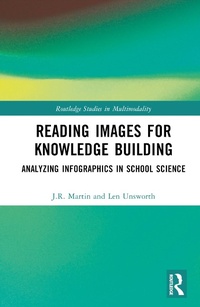
Reading Images for Knowledge Building
Analyzing Infographics in School Science
1st Edition
Published on 7. August 2023
304 pages
978-1-000-91550-1 (ISBN)
Description

This innovative volume provides a new analytic framework for understanding how meaning-making resources are deployed in images designed for knowledge building in school science.
The framework enables analyses of science images from the perspectives of both their complexity and recognizability. Complexity deals with the technical and abstract knowledge of school science (technicality), evaluative dispositions in relation to that knowledge (iconization) and the condensation of the technical and dispositional meanings as 'synoptic eyefuls' in discipline-specific infographics (aggregation). Recognizability concerns the relationship between the appearance of phenomena in reality and the reconfiguration of this reality in images (congruence), the perceptibility or discernibility of the features and contexts of phenomena in images (explicitness), and how images engage their viewers (affiliation). The framework is illustrated by more than 100 images in colour in the e-book and black and white in the paper version and will inform research into multimodal literacy pedagogy that incorporates an understanding of the role of images in the teaching and learning of school science.
This book will be of particular interest to scholars in multimodality, semiotics, literacy education and science education.
The framework enables analyses of science images from the perspectives of both their complexity and recognizability. Complexity deals with the technical and abstract knowledge of school science (technicality), evaluative dispositions in relation to that knowledge (iconization) and the condensation of the technical and dispositional meanings as 'synoptic eyefuls' in discipline-specific infographics (aggregation). Recognizability concerns the relationship between the appearance of phenomena in reality and the reconfiguration of this reality in images (congruence), the perceptibility or discernibility of the features and contexts of phenomena in images (explicitness), and how images engage their viewers (affiliation). The framework is illustrated by more than 100 images in colour in the e-book and black and white in the paper version and will inform research into multimodal literacy pedagogy that incorporates an understanding of the role of images in the teaching and learning of school science.
This book will be of particular interest to scholars in multimodality, semiotics, literacy education and science education.
Reviews / Votes
"The book represents a substantial contribution to bothsemiotics and science education. Its comprehensive framework for analysing the complexity and recognizability of infographics provides valuable insights into how images organize the complexity and abstraction of meaning. Furthermore, it offers practical guidance for educators to facilitate science teaching through the use of infographics. This book is thus highly recommended for researchers in semiotics and science education, and educators seeking effective methods to utilize infographics in science instruction." - Zhigang Yu, Beijing Institute of Technology, Visual Communication"...the book is undoubtedly of particular benefit to researchers in semiotics who are concerned with multimodality in academic discourse, researchers in literacy education and science education who are concerned with empirical resources at stake for knowledge building, and school science teachers who are concerned with an explicit metalanguage for expounding on infographics in pedagogical practice." - Ying Hua, Shanghai Dianji University, Language and Education
"Martin and Unsworth's book is an informative, engaging and well-structured
volume solely devoted to analyzing infographics for knowledge building in school science from the systemic functional semiotic perspective. It is such a comprehensive and meticulous work that makes a significant contribution to science pedagogy, multimodal literacy as well as Content and Language Integrated Learning (CLIL). Theoretically rooted in social semiotics and
systemic functional linguistics, the authors' framework for analyzing infographics is thorough and accessible, offering valuable insights into the complexity and recognizability of scientific infographics." - Yanxiu Li, Guangdong University of Foreign Studies, Social Semiotics
More details
Series
Edition
1. Auflage
Language
English
Place of publication
London
United Kingdom
Publishing group
Taylor & Francis Ltd
Target group
College/higher education
Illustrations
13 Tables, black and white; 44 Line drawings, black and white; 75 Halftones, black and white; 119 Illustrations, black and white
ISBN-13
978-1-000-91550-1 (9781000915501)
Copyright in bibliographic data and cover images is held by Nielsen Book Services Limited or by the publishers or by their respective licensors: all rights reserved.
Schweitzer Classification
Other editions
Additional editions
J.R. Martin | Len Unsworth
Reading Images for Knowledge Building
Analyzing Infographics in School Science
Book
12/2024
1st Edition
Routledge
€63.70
Shipment within 15-20 days
J.R. Martin | Len Unsworth
Reading Images for Knowledge Building
Analyzing Infographics in School Science
Book
08/2023
1st Edition
Routledge
€208.10
Shipment within 15-20 days
Persons
J.R. Martin is Professor of Linguistics at the University of Sydney. His research interests include systemic theory, functional grammar, discourse semantics, register, genre, multimodality and positive discourse analysis (PDA), focusing on English, Tagalog and Korean. He was elected a fellow of the Australian Academy of the Humanities in 1998, was Head of its Linguistics Section from 2010-2012, and was awarded a Centenary Medal for his services to linguistics and philology in 2003. In April 2014, Shanghai Jiao Tong University opened its Martin Centre for Appliable Linguistics, appointing Professor Martin as Director.
Len Unsworth is Professor in English and Literacies Education in the Institute for Learning Sciences and Teacher Education (ILSTE) at the Australian Catholic University. Len's current research interests include systemic functional semiotic perspectives on multimodal and digital disciplinary literacies and in English curricula. His most recent books include Multimodal Literacy in School Science: Transdisciplinary Perspectives on Theory, Research and Pedagogy (Routledge, 2022), Learning from Animations in Science Education: Innovating in Semiotic and Educational Research (2020), and Literacy for Digital Futures: Mind, Body, Text with Kathy Mills and Laura Scholes (Routledge, 2022). https://lenunsworth.wordpress.com/.
Len Unsworth is Professor in English and Literacies Education in the Institute for Learning Sciences and Teacher Education (ILSTE) at the Australian Catholic University. Len's current research interests include systemic functional semiotic perspectives on multimodal and digital disciplinary literacies and in English curricula. His most recent books include Multimodal Literacy in School Science: Transdisciplinary Perspectives on Theory, Research and Pedagogy (Routledge, 2022), Learning from Animations in Science Education: Innovating in Semiotic and Educational Research (2020), and Literacy for Digital Futures: Mind, Body, Text with Kathy Mills and Laura Scholes (Routledge, 2022). https://lenunsworth.wordpress.com/.
Content
List of Figures
List of Tables
Preface
Acknowledgements
Images In Disciplinary Discourse in School Science
PART I Disciplinary Discourse for Knowledge Building: Systemic Functional Semiotic Perspectives
2. Mass and presence
PART II Image Complexity - Mass
3. Technicality
4. Iconization
5. Aggregation
PART III Image Recognizability - Presence
6. Explicitness
7. Affiliation
8. Congruence
PART IV Applying Image Analyses for Knowledge Representation
9. Mass Presence and Cumulative Knowledge Building
10. Mass and Presence in Biology, Chemistry and Physics Textbook Infographics
List of Tables
Preface
Acknowledgements
Images In Disciplinary Discourse in School Science
PART I Disciplinary Discourse for Knowledge Building: Systemic Functional Semiotic Perspectives
2. Mass and presence
PART II Image Complexity - Mass
3. Technicality
4. Iconization
5. Aggregation
PART III Image Recognizability - Presence
6. Explicitness
7. Affiliation
8. Congruence
PART IV Applying Image Analyses for Knowledge Representation
9. Mass Presence and Cumulative Knowledge Building
10. Mass and Presence in Biology, Chemistry and Physics Textbook Infographics
