

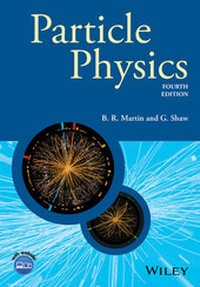
Particle Physics
Description

More details
Other editions
Additional editions
Persons
Professor Brian R Martin, Emeritus, Department of Physics & Astronomy, University College London, UK
Brian Martin was a full-time member of staff of the Department of Physics & Astronomy at UCL from 1968 to 1995, including a decade from 1994 to 2004 as Head of the Department. He retired in 2005 and now holds the title of Emeritus Professor of Physics. He has extensive experience of teaching undergraduate mathematics classes at all levels and experience of other universities via external examining for first degrees at Imperial College and Royal Holloway College London. He was also the external member of the General Board of the Department of Physics at Cambridge University that reviewed the whole academic programme of that department, including teaching.
Dr Graham Shaw, School of Physics & Astronomy, The University of Manchester, UK
Graham Shaw (http://www.hep.man.ac.uk/u/graham/) was a full-time member of staff of the School of Physics & Astronomy at Manchester University until September 2009. He continued to teach part-time until September 2012 and currently holds an honorary position in the department. He has extensive experience of teaching undergraduate physics and the associated mathematics and was a member of the school's Teaching Committee and Course Director of the Honours School of Mathematics and Physics for many years.
Content
Editors' preface to the Manchester Physics Series xiii
Authors' preface xv
Suggested Short Course xvii
Notes xix Physical Constants, Conversion Factors and Natural Units xxi
1 Some basic concepts 1
1.1 Introduction 1
1.2 Antiparticles 3
1.3 Interactions and Feynman diagrams 9
1.4 Particle exchange 15
1.5 Units and dimensions 19
Problems 1 22
2 Leptons and the weak interaction 24
2.1 Lepton multiplets and lepton numbers 24
2.2 Leptonic weak interactions 31
2.3 Neutrino masses and neutrino mixing 35
Problems 2 50
3 Quarks and hadrons 52
3.1 Quarks 53
3.2 General properties of hadrons 55
3.3 Pions and nucleons 58
3.4 Strange particles, charm and bottom 61
3.5 Short-lived hadrons 66
3.6 Allowed and exotic quantum numbers 72
Problems 3 75
4 Experimental methods 77
4.1 Overview 77
4.2 Accelerators and beams 79
4.3 Particle interactions with matter 86
4.4 Particle detectors 95
4.5 Detector systems and accelerator experiments 112
4.6 Non-accelerator experiments 121
Problems 4 123
5 Space-time symmetries 126
5.1 Translational invariance 127
5.2 Rotational invariance 129
5.3 Parity 135
5.4 Charge conjugation 142
5.5 Positronium 145
5.6 Time reversal 149
Problems 5 153
6 The quark model 155
6.1 Isospin symmetry 156
6.2 The lightest hadrons 162
6.3 The L = 0 heavy quark states 174
6.4 Colour 177
6.5 Charmonium and bottomonium 184
Problems 6 191
7 QCD, jets and gluons 193
7.1 Quantum chromodynamics 193
7.2 Electron-positron annihilation 210
Problems 7 215
8 Quarks and partons 217
8.1 Elastic electron scattering: the size of the proton 217
8.2 Inelastic electron and muon scattering 222
8.3 Inelastic neutrino scattering 231
8.4 Other processes 236
8.5 Current and constituent quarks 243
Problems 8 246
9 Weak interactions: quarks and leptons 248
9.1 Charged current reactions 250
9.2 The third generation 262
Problems 9 274
10 Weak interactions: electroweak unification 276
10.1 Neutral currents and the unified theory 277
10.2 Gauge invariance and the Higgs boson 287
Problems 10 305
11 Discrete symmetries: C, P, CP and CPT 308
11.1 P violation, C violation and CP conservation 308
11.2 CP violation and particle-antiparticle mixing 316
11.3 CP violation in the standard model 340
Problems 11 343
12 Beyond the standard model 346
12.1 Grand unification 347
12.2 Supersymmetry 354
12.3 Strings and things 358
12.4 Particle physics and cosmology 360
12.5 Dirac or Majorana neutrinos? 373
Problems 12 381
A Relativistic kinematics 383
A.1 The Lorentz transformation for energy and momentum 383
A.2 The invariant mass 385
A.2.1 Beam energies and thresholds 385
A.2.2 Masses of unstable particles 387
A.3 Transformation of the scattering angle 388
Problems A 390
B Amplitudes and cross-sections 392
B.1 Rates and cross-sections 392
B.2 The total cross-section 394
B.3 Differential cross-sections 395
B.4 The scattering amplitude 397
B.5 The Breit-Wigner formula 400
B.5.1 Decay distributions 401
B.5.2 Resonant cross-sections 404
Problems B 406
C The isospin formalism 408
C.1 Isospin operators 409
C.2 Isospin states 411
C.3 Isospin multiplets 411
C.3.1 Hadron states 412
C.4 Branching ratios 414
C.5 Spin states 416
Problems C 416
D Gauge theories 418
D.1 Electromagnetic interactions 419
D.2 Gauge transformations 420
D.3 Gauge invariance and the photon mass 421
D.4 The gauge principle 423
D.5 The Higgs mechanism 425
D.5.1 Charge and current densities 425
D.5.2 Spin-0 bosons 427
D.5.3 Spontaneous symmetry breaking 428
D.6 Quantum chromodynamics 429
D.7 Electroweak interactions 434
D.7.1 Weak isospin 434
D.7.2 Gauge invariance and charged currents 436
D.7.3 The unification condition 437
D.7.4 Spin structure and parity violation 440
Problems D 441
E Answers to selected questions 443
References 448
Index 451
